

Cuba Fuel Crisis Cuts Flights, Strains April Travel
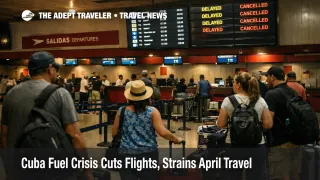
Cuba's travel problem has hardened from general destination risk into a narrower operational question, whether a trip can still run end to end without breaking on flights, transfers, lodging, or basic services. WestJet says it is beginning an orderly wind down of its Cuba operations through April 25, 2026, Air Canada Vacations says canceled Cuba bookings are being refunded through April 30, 2026, and both the Canadian and U.K. governments now warn that fuel shortages and power cuts are disrupting transport, hotels, water, food service, communications, and other essentials. For travelers with near term Cuba plans, the practical takeaway is that getting to the island is harder, and once there, moving around and relying on normal tourism infrastructure is harder too.
Cuba Fuel Crisis: What Changed
What changed since earlier coverage is that the Cuba fuel crisis is no longer just about blackouts and unreliable local conditions. It is now visibly shrinking carrier supply. WestJet's advisory says the airline group has decided to begin an orderly wind down of its operations to Cuba, covering travel between February 8 and April 25, 2026. Air Canada Vacations separately says all customers with Cuba flight cancellations from February 9 through April 30, 2026, will automatically receive full refunds. Air Canada itself has already said it is postponing its Cuba service resumption until November 1, 2026.
On the ground, official advisories have become blunter. Canada now advises against non essential travel to Cuba because of worsening shortages of fuel, electricity, food, water, and medicine, and it explicitly warns that the shortages can affect resort services and ground transportation. The U.K. says severe and worsening infrastructure disruption is affecting reliable transport, medical care, communications, and basic services, with fuel rationing and scaled back public services already in place.
Which Cuba Trips Now Look Hardest To Execute
The hardest Cuba trips to execute now are the ones that depend on multiple moving parts after arrival. Independent city hopping, self drive itineraries, guesthouse based travel, and trips with fixed timed activities across more than one destination have become much less reliable because fuel availability is hard to predict and power cuts can interrupt transport, payments, refrigeration, water service, and communications. Those are exactly the systems both Canada and the U.K. say are under strain.
Resort stays are not immune. Larger all inclusive properties may have more generator backup and stronger supplier relationships than smaller operators, but Canada explicitly notes that shortages can still affect services at resorts. That means travelers who do reach Cuba may still face broken or delayed airport transfers, reduced excursion schedules, patchy air conditioning, intermittent water service, limited food choice, and longer waits for fuel dependent transport. In an earlier Adept Traveler article, Cuba Blackouts Raise Travel Risk Amid U.S. Threats framed the problem as a fragile destination. The change now is that the fragility is biting both the air side and the hotel and transfer side at the same time.
What Travelers Should Do Now
For departures through April 30, 2026, travelers booked on Canadian packages or flights should treat Cuba as a high friction destination even if a booking still exists in the system. If your airline or vacation provider has already canceled, take the refund or approved rebooking path quickly rather than waiting for a late operational recovery that may not materialize. If your trip is still technically operating, simplify it. A single stay with private transfers arranged and confirmed close to departure is more workable than a multi stop itinerary with long road legs and tight same day dependencies.
The rebook versus wait threshold is also clearer now. Rebook if your trip depends on intercity road travel, private lodging without robust backup power, or tight links between airport arrival, ferry, tour, or onward departure. Wait only if your provider is still operating, your property has credible backup systems, and your plan can absorb transfer delays, service reductions, and at least several days of unstable local conditions. Cash backup, offline maps, battery packs, and communications redundancy remain sensible, but they do not solve fuel scarcity or shrinking flight supply.
Why The Disruption Is Spreading, And What Happens Next
The mechanism is now easy to see. Cuba's repeated grid failures and fuel shortages are not just local inconveniences. They reduce the reliability of the full visitor chain, airport operations, refueling, bus and taxi supply, hotel utilities, food storage, water pumping, medical response, and mobile connectivity. Reuters and AP both reported fresh national grid collapses in March, while Reuters also reported that a fuel tanker originally bound for Cuba diverted away from the island, underscoring how thin Cuba's supply picture has become.
What happens next depends less on one restored outage and more on whether fuel imports and power stability improve enough to support normal tourism operations. Right now, the official travel advice from Canada and the U.K. still points the other way, and carrier actions are reinforcing that signal rather than contradicting it. Travelers should watch three things over the next few days, whether more airlines or package operators extend suspensions beyond April, whether government advisories harden further, and whether Cuba's grid stabilizes without another national scale failure. Until those indicators improve together, Cuba remains a trip that may still be possible on paper, but is increasingly hard to trust in practice.
Sources
- WestJet Travel Advisories, Cuba Power Outage
- Air Canada Vacations Travel Advisories
- Air Canada, Travel to or from Cuba
- Government of Canada, Travel Advice and Advisories for Cuba
- GOV.UK, Cuba Travel Advice
- Reuters, Cuba's Electric Grid Collapses Again
- Reuters, Tanker Carrying Fuel Originally Bound for Cuba Diverts
- AP News, Cuba's Power Grid Collapses for the Third Time This Month