

Europe Middle East Flight Cuts Stretch to October
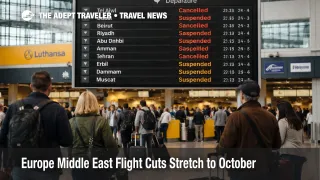
Europe Middle East flight cuts widened again after the latest carrier updates, and the practical change is scope, not just duration. As of March 23, 2026, Lufthansa Group says Dubai and Tel Aviv are suspended through May 31, while Abu Dhabi, Amman, Beirut, Dammam, Riyadh, Erbil, Muscat, and Tehran are suspended through October 24. Eurowings shows a split pattern, with Tel Aviv, Beirut, and Erbil paused through April 30, and Dubai, Abu Dhabi, and Amman through October 24. LOT has Dubai canceled through March 28 and Tel Aviv through May 31, while Reuters reports Wizz Air has suspended Israel through March 29 and Dubai, Abu Dhabi, Amman, and Jeddah from mainland Europe until mid September. For travelers, that turns what looked like rolling short extensions into a broader Europe to Middle East network pullback that can no longer be treated as a near term blip.
Europe Middle East Flight Cuts, What Changed
The largest block of long dated suspensions now sits inside the Lufthansa family. Lufthansa, Swiss, Austrian Airlines, Brussels Airlines, ITA Airways, and Edelweiss all show the same May 31 stop for Dubai and Tel Aviv, and the same October 24 stop for Abu Dhabi, Amman, Beirut, Dammam, Riyadh, Erbil, Muscat, and Tehran. That is not a single route adjustment, it is a carrier family decision spanning Gulf, Levant, and wider Middle East points. Eurowings, which matters more for leisure and lower fare demand, still leaves some cities in the shorter April bucket, but pushes Dubai, Abu Dhabi, and Amman all the way to October 24.
Outside that group, the pattern still points in the same direction. LOT's official Middle East notice keeps Dubai suspended through March 28, Riyadh through April 30, Tel Aviv through May 31, and Beirut from March 31 through April 30. Reuters' March 23 airline matrix adds that Wizz Air has Israel suspended through March 29 and mainland Europe service to Dubai, Abu Dhabi, Amman, and Jeddah suspended until mid September. In an earlier Adept Traveler article, British Airways Extends Gulf Flight Cuts to May 31 showed a similar dynamic from another European airline group, and in KLM Dubai, Riyadh, Dammam Suspensions Extend to May 17, the issue was already shifting from a late March problem into a spring planning problem. The new step is breadth across multiple carriers at once.
Which Travelers Now Face the Longest Gap
Summer travelers who were still waiting for a normal Europe to Gulf or Levant restart now need to separate markets into three buckets. Tel Aviv and Dubai are no longer just week by week problems on major European brands, because May 31 now appears across several important networks. Abu Dhabi, Amman, Beirut, Dammam, Riyadh, Erbil, Muscat, and Tehran are worse in one specific sense, some of the biggest European carrier family suspensions now run to October 24, which takes much of the summer and early autumn timetable off the table on those airlines.
The most exposed travelers are those who built trips around nonstop convenience, alliance loyalty, or single ticket protection on European network carriers. First order, some city pairs disappear entirely on the airline family they expected to use. Second order, displaced passengers crowd onto the smaller number of remaining operators, which can raise fares, reduce recovery options after a missed connection, and force awkward overnight handoffs through alternate hubs. Reuters also reported last week that European airlines were warning of higher fares if elevated fuel costs persist, which adds another reason not to assume replacement capacity will stay cheap even where seats remain bookable.
What Travelers Should Do Now
If you are booked on a route that now shows a published suspension through May 31 or October 24, the default should be to stop waiting for a quick restart unless your ticket has unusually generous refund or rebooking protections. A carrier posting an October date is not signaling a near term operational rebuild. It is telling you that the airline sees the route as out of plan for most of the summer season. Travelers with weddings, business travel, cruises, or fixed land arrangements should move first, because the cost of waiting is not only a canceled flight, but weaker alternate inventory when everyone rebooks at once.
The better use of the next few days is to test the whole itinerary, not just the long haul segment. That means checking whether your replacement routing depends on a fragile Gulf connection, whether an overnight is now likely, and whether your onward hotel, tour, or cruise timing can survive a one day slip. Travelers who still need the region soon should favor itineraries with more schedule depth, longer connection buffers, and easier same day recovery, even if that means giving up a preferred carrier or nonstop plan. The main decision point is simple, if your trip depends on a city now suspended into late May or late October on your chosen airline family, rebook around the suspension window rather than around hope.
Why the Pullback Is Spreading, and What Happens Next
The mechanism is bigger than one airport or one security advisory. Reuters' March 23 matrix shows airlines responding to a regional operating environment shaped by conflict related airspace risk, airport level disruptions, and longer rerouting pressure across the Middle East. Once multiple carriers trim service at the same time, the damage spreads outward, fewer nonstops means more reliance on connection banks, thinner connection banks mean weaker recovery when a leg fails, and weaker recovery increases hotel, transfer, and missed event costs for travelers. Lufthansa has also said it is shifting capacity away from suspended Middle East markets toward Asia and Africa, which is another signal that some lost flying is being structurally redeployed, not merely parked for a quick restart.
What happens next is likely to be uneven rather than linear. Some short dated suspensions may keep inching forward by days or weeks, but routes already pushed to October 24 should be treated as effectively off the map for summer planning on those airline families unless official notices change materially. Travelers should watch for three signals, whether carriers shorten or lengthen published suspension dates, whether waivers expand to later ticketing windows, and whether alternate hubs start showing sustained schedule depth instead of isolated restored flights. Until then, the Europe to Middle East map is smaller than many travelers think, and the planning mistake is assuming a route is coming back simply because it still exists in a booking system.
Sources
- Current information, Lufthansa
- Information about travel to the Middle East, LOT Polish Airlines
- Airlines cancel more flights as Middle East conflict escalates, Reuters
- European airlines warn of higher fares as fuel hedges unwind, Reuters
- British Airways Extends Gulf Flight Cuts to May 31
- KLM Dubai, Riyadh, Dammam Suspensions Extend to May 17