

British Airways Extends Gulf Flight Cuts to May 31
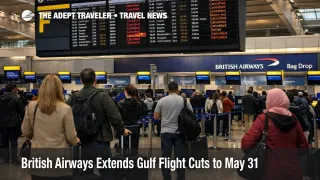
British Airways Gulf flight cuts have moved from a short horizon disruption into a spring planning problem. British Airways now says flights to Amman, Bahrain, Dubai, and Tel Aviv are canceled through May 31, 2026, while Doha remains canceled through April 30, 2026, and the airline says it added more than 3,300 seats on alternative services between March 10 and March 19. That is a harder stance than BA's earlier public guidance, which still described these routes as cut only until later in March, with date-change flexibility tied to travel through March 15 or March 29. Travelers with April and May itineraries should stop treating this as a wait a few days story and start rebuilding the trip around a different carrier, a different hub, a different destination, or a different date.
The practical change from Adept's earlier British Airways Asia Reroutes Reshape Gulf Exits coverage is duration. BA's March 13 update was still about extra Singapore and Bangkok flying for disrupted customers and paused Muscat relief flights. The March 16 update turns that stopgap logic into a longer capacity withdrawal, which matters because spring travelers now have less room to rely on a normal Gulf recovery before departure.
British Airways Gulf Flight Cuts: What Changed
What changed is not only the existence of cancellations, but the publication of firm end dates. BA now lists Amman, Bahrain, Dubai, and Tel Aviv as canceled up to and including May 31, 2026, and Doha as canceled until April 30, 2026. Earlier BA updates on March 10 still framed those same markets as canceled only until later this month, while customers booked up to March 15 could change travel dates free of charge to fly on or before March 29.
That matters because date certainty changes traveler behavior. A short disruption can justify delay tolerance, especially for flexible leisure trips or corporate travelers waiting for policy guidance. A two to three month withdrawal usually does not. It pushes passengers, travel managers, and tour operators to rebuild inventory, not just hold it. Reuters also notes that BA has extended these cuts against a backdrop of continuing Middle East instability and airspace disruption, which means the airline is reacting to a wider operational risk environment, not a single isolated airport problem.
Which Spring Itineraries Now Need Full Replanning
The most exposed travelers are the ones who were still assuming BA would return before Easter, late April conferences, or May half term style travel windows. Nonstop BA demand into Jordan, Bahrain, the United Arab Emirates, Qatar, and Israel is now being removed deeper into the booking curve, so the damage is bigger than one canceled flight. It hits seat availability, through fares, loyalty redemptions, and onward connection logic across the region.
The next layer of exposure is on mixed itineraries. That includes travelers using London as a long haul gateway before connecting onward on separate tickets, package travelers whose flights and hotels were bundled around BA timing, and corporate trips built around preferred-carrier rules. When one major carrier exits a market for weeks, rival carriers and substitute hubs absorb the spill. BA itself says it has added more than 3,300 seats on alternative services and had already introduced extra Bangkok and Singapore returns, which suggests the airline is trying to move disrupted demand toward hubs and destinations still operating reliably rather than replace the Gulf network city for city. That last point is an inference from BA's network moves, not an explicit statement of strategy.
A third exposed group is travelers whose trip depends on regional onward movement after arrival. Even where a traveler can still reach the broader region on another airline, the surrounding system remains fragile. Adept's Dubai Airport Shutdown Exposes DXB Hub Failure coverage on March 16 showed how quickly a same day Gulf hub interruption can turn nominally open networks into misconnect and recovery problems. In plain language, a replacement ticket is not the same thing as a resilient itinerary.
What Travelers Should Do Now
If you are booked on BA to one of the affected cities in April or May, rebooking logic now depends on trip purpose, not patience. Rebook early if the trip is time sensitive, includes a cruise, tour start, wedding, conference, or same day onward connection. Wait only if your dates are soft, your fare rules are favorable, and you are prepared for BA to keep adjusting its network. Travelers going to Jordan or Israel should also recheck entry and transit requirements while rebuilding the itinerary, because a reroute can change where document checks happen and whether a land or air entry plan still makes sense. Adept's Jordan Entry Requirements For Tourists In 2026 and Israel Entry Requirements For Tourists In 2026 guides are the useful evergreen references here.
For travelers who still want to reach the region this spring, the decision threshold is simple. Do not optimize first for the cheapest replacement fare. Optimize for routing resilience. Prefer single-ticket itineraries over self-connects, longer connection buffers over minimum legal connections, and carriers with stable current operations over theoretical schedule availability months out. If your replacement path still depends on a Gulf mega-hub, assume that renewed rolling delays, diversions, or aircraft displacement can still affect your trip even when the airport is technically open.
Over the next 24 to 72 hours, watch three things. First, whether other European carriers extend similar suspensions deeper into spring. Second, whether Gulf airspace interruptions continue repeating, because repeated stop-start disruption makes crew and aircraft recovery harder. Third, whether BA adds more replacement flying beyond Bangkok and Singapore or shifts more leisure demand toward Caribbean and Indian Ocean markets, which BA says are already seeing stronger search interest.
Why BA Is Steering Traffic Away From the Gulf
The mechanism is bigger than one airline's schedule. British Airways says the trigger is continuing uncertainty in the Middle East and airspace instability. Reuters places that in the wider regional crisis that has already disrupted one of the world's most important air corridors. Once those corridors become unreliable, airlines do not only lose the canceled sectors themselves. They also lose aircraft rotations, crew timing, and the confidence needed to sell tight connection banks at scale.
That is why the replacement flow matters. BA's earlier Muscat relief flights were a targeted recovery tool for stranded passengers already moved into Oman. Extra Bangkok and Singapore flying is different. Those are large, established long haul gateways that can absorb displaced demand without asking BA to restore the same Middle East network immediately. BA's own release also points to stronger search demand for places such as Barbados, Antigua, the Maldives, Mauritius, Tenerife, and Gran Canaria, which shows how quickly leisure demand can redirect when one region becomes operationally unattractive.
For travelers, the first order effect is obvious, fewer BA seats to key Gulf and Levant destinations through late spring. The second order effect is the one that usually hurts more, tighter availability on substitutes, more expensive replacement routings, weaker same day connection reliability, and more pressure on package and corporate booking rules. That is the real shift here. BA is no longer only helping stranded customers get out. It is visibly reshaping where its near term long haul capacity can be used with less operational risk.
Sources
- British Airways Announces Major Winter 2026 Expansion
- British Airways, Our Middle East Operation: March 16, 2026
- British Airways Extends Flight Cuts in Middle East, Reuters, March 16, 2026
- UAE Airspace Briefly Closed Due to Missile, Drone Threat, Reuters, March 17, 2026
- British Airways Asia Reroutes Reshape Gulf Exits
- Dubai Airport Shutdown Exposes DXB Hub Failure
- Jordan Entry Requirements For Tourists In 2026
- Israel Entry Requirements For Tourists In 2026