

Eurostar Delays, April Cuts Hit Channel, Benelux Rail
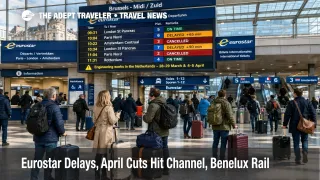
Eurostar delays and cancellations have become a broader Easter planning problem on Thursday, March 26, 2026, because the operator is posting live delays today while also carrying forward separate cancellations and service reductions into April and May. Travelers on the London, Paris, Brussels, and Amsterdam axis are the main group exposed, especially if they built a same day handoff into a flight, cruise embarkation, hotel check in, or business meeting. The immediate issue is not a full shutdown. It is a thinner, less forgiving network, where one late or canceled train can push passengers onto later departures and strip away recovery options. For travelers, the safest move is to stop treating Eurostar as a low friction timing layer on tight itineraries over the next two weeks.
Eurostar Delays and Cancellations: What Changed
On March 26, Eurostar's disruption page showed live delays tied to a technical problem on another train, broader operational restrictions, delays at Paris Gare du Nord, and a temporary stop at Aachen Hauptbahnhof with an estimated delay of about 60 to 90 minutes. Separately, Eurostar is also listing longer dated disruption windows, including cancellations on parts of the network between March 22 and May 17, and other cancellation blocks running into April.
The Dutch side is a distinct problem rather than a footnote. Eurostar lists train cancellations on the Dutch network for March 28 to 29 because of engineering works, and a separate limited service notice for April 4 to 5 for the same reason. The March 28 disruption page specifically shows cancellations affecting Amsterdam Centraal to Paris Gare du Nord, Paris Gare du Nord to Brussels Midi, Brussels Midi to Paris Gare du Nord, and Paris Gare du Nord to Amsterdam Centraal services. The April 4 to 5 Dutch engineering notice then shows a reduced pattern rather than a normal timetable, which means some trips still run, but the network has less slack if anything else goes wrong.
Which Eurostar Trips Face the Most Risk
The most exposed trips are not every Eurostar booking equally. The highest risk sits on self connected itineraries that use Paris Gare du Nord, Brussels South station, usually called Brussels Midi, or Amsterdam Centraal as a transfer point into something fixed later that day. That includes rail to air chains, rail to cruise positioning, and separate ticket journeys where the missed leg is not automatically protected. Eurostar's current disruption pattern matters most on the Paris, Brussels, and Amsterdam triangle because that is where the operator is showing both same day friction and multiple planned cuts.
Brussels deserves special attention because it functions as both a destination and a relay point. In an earlier Adept Traveler article, Belgium Rail Strike Eurostar Connections Risk Jan 30 explained how a near normal Eurostar arrival does not guarantee a near normal onward journey once a station becomes a constrained handoff point. That logic applies again here, even without a Belgian national strike, because fewer trains and active delays create the same practical outcome, longer platform waits, fewer fallback options, and a higher chance that a small timing loss becomes a broken day.
Amsterdam side travelers have seen this kind of fragility before. In an earlier Adept Traveler article, Eurostar Amsterdam, Rotterdam Stops Canceled Mid December, the issue was stop level disruption. The current problem is broader because it combines Dutch engineering works with unrelated Eurostar network cancellations and live day of delays. That creates a worse Easter setup for passengers who assumed they could recover later the same afternoon.
What Travelers Should Do Now
For departures on March 26, the right move is to monitor the live Eurostar updates right up to station arrival and to treat Paris Gare du Nord, Brussels Midi, and Aachen as active trouble points. If your onward plan is on a separate ticket and missing it would force a full re purchase, move off the tight plan now rather than waiting for a perfect recovery. Eurostar's customer charter says that when a delay of 60 minutes or more is reasonably expected before departure, travelers can choose a full refund or postpone to a later service or date, and canceled trains triggering an arrival delay of 60 minutes or more carry the same basic choice.
For March 28 to 29, and again on April 4 to 5, travelers using Amsterdam or Paris on the Dutch linked corridor should assume the timetable is not normal even if their own train still appears to run. The decision threshold is simple. Do not keep a tight rail to air or rail to cruise connection unless you have enough buffer to absorb one missed departure without collapsing the rest of the trip. In practice, that usually means abandoning same day self connections when one delayed Eurostar arrival would leave less than a comfortable margin before airport check in cutoff, terminal transfer, or final embarkation. That tradeoff is dull, but it is cheaper than a walk up ticket, a missed ship, or a forced airport hotel.
Travelers already disrupted should also document costs and keep receipts. Eurostar says delays of 60 minutes or more can qualify for compensation, and the operator says it may assist with onward connections, hotels, and taxis during major disruptions where possible. That will not save a fragile itinerary in real time, but it does matter for recovery if you end up paying to protect the rest of the trip.
Why Eurostar Disruption Is Becoming an Easter Timing Problem
The mechanism is not complicated, but it is easy to underestimate. Same day delays are one layer. Planned cancellations and engineering cuts are another. When both exist together, the network may still be running, but it is running with less depth. That means fewer spare seats, fewer convenient fallback departures, and a larger penalty when one train goes late. First order, passengers lose time or lose their booked train. Second order, the damage spreads into hotel arrivals, airport transfers, cruise embarkations, and meetings that were built on the old assumption that the Channel and Benelux rail corridor was frequent enough to absorb small shocks.
This also lands while border timing across Europe remains less predictable than many travelers expect. Europe Border Delays: EES Rollout Still Uneven noted that new Schengen biometric processing can add variable time at some crossings, including UK side departures into the Schengen Area via Eurostar. That is a separate mechanism from the current train cuts, but the traveler consequence overlaps, more variance, less slack, and a higher price for trying to run a cross border trip on a tight clock. Over the next two weeks, the smarter planning assumption is that Eurostar may still be the right mode, but not for itineraries that depend on perfect timing.
Sources
- Disruptions | Travel News | Eurostar
- Dutch Network Cancellations, March 28 to 29, 2026 | Eurostar
- Dutch Network Limited Service, April 4 to 5, 2026 | Eurostar
- Customer Charter | Eurostar
- Belgium Rail Strike Eurostar Connections Risk Jan 30
- Eurostar Amsterdam, Rotterdam Stops Canceled Mid December
- Europe Border Delays: EES Rollout Still Uneven