

U.S. Visa Vetting Expands for More Nonimmigrant Classes
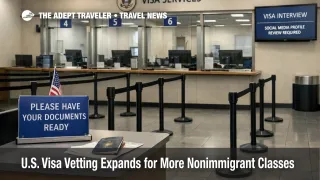
The U.S. visa vetting expansion takes effect on March 30, 2026, and it reaches well beyond students, exchange visitors, and H-1B workers. The State Department said it will add online presence review for more nonimmigrant categories, including A-3, C-3 domestic workers, G-5, H-3 trainees, H-4 dependents of H-3 applicants, K-1, K-2, K-3, Q, R-1, R-2, S, T, and U visas, and it instructed applicants in those covered categories to set all social media profiles to "public" or "open." For travelers and families already holding interview slots or trying to book around weddings, school starts, religious assignments, work placements, or reunification trips, the practical change is that interview prep now includes online presence access as well as documents.
U.S. Visa Vetting Expansion: What Changed on March 30
The main change is scope. Until now, the State Department had already applied online presence review to F, M, and J student and exchange visitor applicants, then expanded that requirement in December 2025 to H-1B applicants and their H-4 dependents. Effective March 30, 2026, it adds a wider mix of family, work, religious, cultural exchange, protective, and official employee categories. The Department did not publish new processing time estimates with the announcement, so applicants should not assume embassies and consulates will move on the same timelines they saw before this change.
In plain English, the newly covered pool includes fiancé(e) and spouse related K visas, international cultural exchange visitors in Q, religious workers and their family members in R, trainees in H-3 and their H-4 dependents, domestic employees tied to foreign officials or international organization staff in A-3, C-3, and G-5, witnesses or informants in S, trafficking victims in T, and victims of qualifying crimes in U. State's visa directory and category pages describe Q as international cultural exchange, R-1 as temporary religious work, H-3 as training not primarily for employment, U as status for victims of certain criminal activity, T as status for victims of severe human trafficking, and A-3 and G-5 as personal or domestic employees connected to official postings.
Which Travelers Now Face the Most Timing Risk
The most exposed travelers are the ones planning around fixed dates. That includes couples trying to enter the United States for marriage through K-1, spouses and children tied to K-3 or K-2 processing, religious workers with scheduled start dates, trainees entering specific programs, and applicants in T or U related cases whose travel timing is already constrained by legal or safety realities. A review requirement does not automatically mean a denial or a long delay, but it does add another screening layer that applicants must now accommodate.
The first order effect is more preparation before interview day. Applicants in covered categories now need to make sure all social media profiles are public or open, and they should expect officers to evaluate online presence alongside the rest of the case. The second order effect is trip fragility. When travelers build plans around old assumptions about interview readiness, visa issuance speed, or document sufficiency, the weak point shifts from booking mechanics to consular screening. In an earlier Adept Traveler article, U.S. Visa Bonds Add 12 Countries for April 2 the pressure point was cash and eligibility for some visitor visa applicants. This new move is different, because it widens the compliance and timing burden for other nonimmigrant classes instead of adding a bond payment.
What Travelers Should Do Before the Visa Interview
Applicants in the newly covered categories should act as if March 30, 2026 is a real workflow cutoff, not a soft policy date. Anyone interviewing on or after that date should review every social media account they maintain, make those profiles public or open as instructed, and make sure names, job history, school history, relationship details, and travel purpose are consistent with the visa application and supporting documents. If a profile cannot be matched cleanly to the case, that is a reason to slow down and fix inconsistencies before the interview rather than improvising at the window.
Booking strategy should change too. Travelers with ceremonies, school intake dates, employer start dates, conference appearances, or nonrefundable onward trips should build more slack between the interview date and the intended departure date. The threshold is simple. If the trip falls apart when the visa does not issue on the expected timeline, keep flights, hotels, and event payments flexible until the visa is in hand. For advisors, sponsors, and U.S. hosts, the safest assumption is that applicants in these categories now face a more document and profile intensive process, even where the State Department has not published a formal wait time penalty.
Why the Screening Is Broadening, and What Happens Next
The State Department says it uses all available information in screening and vetting to identify applicants who may be inadmissible, including people viewed as threats to U.S. national security or public safety, and it framed every visa decision as a national security decision. That is the official mechanism behind the expansion. In practice, it also means more categories now sit inside the same online presence review architecture that had already been extended first to F, M, and J applicants, then to H-1B and H-4 applicants.
What happens next depends on two things the Department has not yet published in detail, how consistently posts apply the new workflow, and whether additional visa classes are added later. For now, the seriousness is not a border shutdown or a blanket pause. It is a structural process change. Travelers who would once have treated the visa interview as a mostly document based step now need to treat it as a document plus digital profile review, with trip timing built around that reality.
Sources
- Announcement of Expanded Screening and Vetting for Visa Applicants
- Announcement of Expanded Screening and Vetting for H-1B and Dependent H-4 Visa Applicants
- Directory of Visa Categories
- Temporary Religious Worker Visa
- Visas for Victims of Criminal Activity
- Visas for Victims of Human Trafficking
- Visas for Employees of International Organizations and NATO
- Green Card for an Informant, S Nonimmigrant