

United Flight Attendant Deal Moves to Ratification
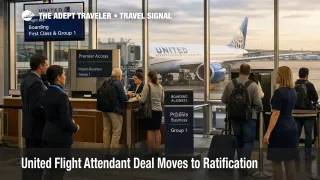
United's roughly 30,000 flight attendants are now in the waiting phase of a tentative five year labor deal that could reshape both crew pay and the onboard experience if it is ratified. The agreement, announced March 26, 2026, includes immediate raises upon ratification, boarding pay, compensation for long gaps between flights, and a $740 million signing bonus pool. For travelers, the near term effect is not schedule disruption. It is a test of whether a better contract can stabilize a work group that directly shapes service consistency as United keeps pushing deeper into premium cabins and higher yield flying.
United Flight Attendant Contract: What Changed
The tentative agreement would give United flight attendants their first new contract in about six years and, if approved, would make United the last major U.S. airline to close out a post pandemic cabin crew deal. Reuters and the union both say the agreement runs for five years, with top hourly pay reaching $100 by the end of the term, a level United says would make its flight attendants the best paid in the industry. The package also adds pay for boarding and for some long stretches between flights, two long running pain points in cabin crew bargaining across the U.S. airline sector.
This is still only a tentative agreement. AFA CWA said the proposal will go to the United Master Executive Council on April 1, 2026. If that group approves sending it forward, full details are due on April 3, 2026, and the membership ratification vote is scheduled to run from April 23 through May 12, 2026. That means travelers should not treat the deal as finished yet, but the immediate strike risk looks lower than it did before a tentative settlement was reached.
Which Travelers Stand To Notice It Most
The first travelers likely to notice the effect are frequent United flyers, long haul premium cabin passengers, and anyone moving through major United hubs where service consistency matters more than the headline fare. A stronger contract does not guarantee a visibly better trip next week. It does improve United's odds of holding on to experienced cabin crew and reducing some of the friction that comes from a work group operating for years without a fresh deal. That matters most on long haul flights, premium heavy routes, and irregular operations days when cabin staffing and scheduling flexibility show up directly in the passenger experience.
The timing also lines up with United's broader premium push. This week the airline unveiled new premium focused aircraft interiors, including upgraded Polaris suites and other higher end seating products, while earlier this month it also outlined a new chef led Polaris dining program. In an earlier Adept Traveler article, United A321XLR, Coastliner Add Premium Seats the operational point was that United is selling more of its network on comfort and product quality, not only on schedule. In another earlier Adept Traveler article, United Polaris Chef's Table Dining Starts Aug. 1 that same strategy showed up in meal service. A labor deal does not create those premium products, but it does matter for whether United can deliver them with fewer service gaps and less internal strain.
What Travelers Should Do Before Ratification
For booked passengers, there is no strong reason to change a United itinerary purely because this labor deal is still awaiting ratification. The practical move is to watch the union approval calendar rather than assume a contract headline automatically means every labor issue is solved. The next hard decision point is April 1, 2026, when the Master Executive Council reviews the agreement. If that group sends the deal to members, the risk picture improves, but the longer ratification process still matters because flight attendants already rejected a prior contract in July 2025 that included immediate raises of 26 percent.
There is also a tradeoff for travelers to watch. A richer labor deal can support better staffing retention and service standards over time, but it also adds cost. In plain language, that does not mean fares jump because of this contract alone. It does mean United will keep looking for higher yielding revenue, especially in premium cabins and on routes where passengers will pay for a stronger onboard product. That fits a broader airline pattern in 2026, where United is adding premium seats, defending margins, and reshaping aircraft around travelers willing to spend more for comfort.
Why This Matters Beyond Pay, And What Happens Next
The bigger mechanism here is operational, not symbolic. Flight attendants are central to boarding flow, onboard service, customer handling during disruptions, and the execution of premium products that airlines now use to drive margin. When a carrier spends heavily on new lie flat suites, upgraded meals, and premium heavy aircraft, but the cabin crew side is stuck in a prolonged labor dispute, the airline risks selling a better promise than it can consistently deliver. A new contract will not erase all friction, though it can reduce one of the major internal pressure points.
What happens next is straightforward. Union leaders review the deal on April 1, 2026. If it advances, members get the full package on April 3, 2026, and voting runs into mid May. Until then, the travel consequence is mostly about outlook. A ratified contract would remove one of the last major post pandemic cabin crew labor overhangs among big U.S. airlines. A rejection would reopen uncertainty just as United tries to monetize a more premium, more service dependent network. For travelers, especially frequent flyers and premium cabin buyers, that is the real story to watch.
Sources
- United flight attendants reach tentative five year labor deal, Reuters
- United Flight Attendants Reach Tentative Agreement, AFA CWA
- United Reaches New Agreement with Association of Flight Attendants, PR Newswire
- United Airlines Reaches Tentative Deal With Flight Attendants, TravelPulse
- United Airlines unveils new premium cabins and suites, United