

U.S. Europe Summer Flights Slip Further for July
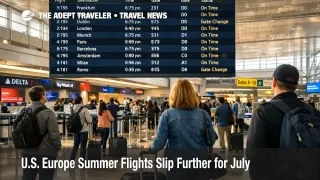
U.S. Europe summer flights for July 2026 have weakened further in Cirium's latest advance booking snapshot, and the shift is no longer small. Based on bookings made from October 7, 2025 through March 14, 2026, the share of July demand captured in third party channels was down 11.2 percent year over year from the United States to Europe, worse than the 7.3 percent decline Cirium saw through January 31. The same dataset shows an even steeper 15.3 percent decline from Europe to the United States. Travelers should read this as a market signal, not a guarantee of empty planes, because the sample excludes direct airline bookings, but it still points to softer pricing power on some routes and a higher chance of schedule reshuffling before peak summer.
U.S. Europe Summer Flights, What Changed
The practical change is deterioration, not just softness. In February, Cirium's directional sample showed July bookings from the United States to Europe down 7.27 percent versus the same advance purchase window a year earlier. By March 14, that decline had widened to 11.2 percent. Europe to U.S. bookings also worsened, moving from a 14.2 percent decline to 15.3 percent in the newer read. That means the weakness is persisting deeper into the booking season rather than correcting as summer gets closer.
The city pattern is uneven, which matters more than the headline average. Cirium's latest comparison shows the weakest U.S. origin July performance into Frankfurt, Germany, down 26.8 percent, followed by Athens, Greece, down 19.9 percent, and Dublin, Ireland, down 12.4 percent. London, England, Munich, Germany, and Milan, Italy were each down about 11 percent, while Barcelona, Spain, Paris, France, Amsterdam, Netherlands, Rome, Italy, and Madrid, Spain also ran below last year's pace.
This does not automatically mean airlines will slash capacity everywhere. The dataset is drawn mainly from online travel agencies and global distribution systems, so it does not capture direct carrier sales, loyalty redemptions booked straight with airlines, or app targeted promotions. What it does show is that one widely watched booking channel is not building July transatlantic demand the way it did last year.
Which Routes and Travelers Look Softest
Travelers most exposed are people booking July Europe trips now, especially those who need a specific nonstop, are tied to one departure day, or are building trips around a fragile connection bank at a major hub. Frankfurt Airport (FRA), Athens International Airport (ATH), and Dublin Airport (DUB) matter beyond their local markets because they also feed onward flights, rail connections, cruises, and multi city itineraries. When demand softens unevenly, airlines tend to protect their strongest departures first and trim around the edges, which can leave marginal frequencies, shoulder day service, or less convenient aircraft timings more vulnerable.
The softer signal can help some travelers and hurt others at the same time. First order, lower demand in third party channels can mean better fares, more tactical sales, or added flexibility on some city pairs. Second order, if carriers later cut frequencies or swap to smaller aircraft, the same softness can reduce recovery options when a flight is canceled or a connection breaks. A cheaper fare does not help much if the route ends up with fewer same day backups. That is why the weakest markets in Cirium's table deserve more attention than the overall average.
The broader backdrop supports the idea that this is not only a one week data wobble. The European Travel Commission said in February that long haul travel sentiment for 2026 had softened, and U.S. intent to visit Europe had eased amid economic uncertainty, while Reuters separately reported that American travel growth to Europe was expected to cool even as overall European arrivals remained positive.
What Travelers Should Do Before Booking
Travelers booking from the United States to Europe for July should treat this as a shopping advantage, but not as permission to wait forever. Start by comparing fares across multiple gateways, including secondary departure airports within driving or short hop range, because softer demand is rarely distributed evenly. Routes into cities showing the biggest year over year weakness may produce better prices first, while strong leisure dates and the most convenient nonstops can stay expensive anyway.
The next decision point is whether you value fare savings more than schedule certainty. Rebookable or change friendly tickets make more sense than bare bones price chasing if your trip depends on one daily long haul departure or a tight onward connection. Travelers headed to Europe for fixed events, cruises, or complex multi stop trips should lean toward booking once the fare is acceptable, because later airline schedule changes are easier to absorb when there is still inventory in the market. Travelers with flexible dates and simple city stays can afford to watch for another round of tactical pricing.
Keep an eye on route level signals, not just fares. Watch for frequency changes, aircraft swaps, or shrinking seat maps, especially on weaker city pairs such as Frankfurt, Athens, and Dublin. Those moves would confirm that the booking slowdown is starting to change actual operating plans. In an earlier Adept Traveler article, July 2026 U.S. Europe Flight Bookings Lag 2025 framed the early advantage as pricing leverage. The March update says travelers now also need to watch for reduced recovery room if carriers act on the weaker demand signal.
Why the Booking Slide Matters Next
The next few months will determine whether this stays a pricing story or turns into a schedule story. Airlines do not need every flight to be weak to make changes. They only need enough softness in selected banks, days, or gateways to trim around the margins and push travelers toward stronger departures. That can change connection patterns, airport arrival times, and same day reaccommodation odds without creating a dramatic headline.
There is also a split market risk. Cirium's March data says Europe to U.S. demand is weaker than U.S. to Europe demand, while June bookings from Europe to the 11 U.S. World Cup host cities were down 6.7 percent as of March 14. That suggests some North America event demand may not fully offset broader softness, even with the FIFA World Cup concentrating attention on specific cities.
For now, the clean read is that U.S. Europe summer flights are still selling, but not with the same momentum seen last year in the booking channels Cirium tracks. That can create real opportunity for travelers who shop carefully, but it also raises the odds that weaker routes get fine tuned before departure. If you are planning July travel, use the softer U.S. Europe summer flights market to hunt for value, but do not ignore schedule risk while the summer network is still taking shape.
Sources
- Travel Weekly, "Cirium: U.S.-Europe summer air bookings have further deteriorated."
- European Travel Commission, "Long-haul travellers grow more cautious in 2026, while safety and flexibility shape demand for Europe."
- Reuters, "Europe loses hold on American tourists, woos Chinese, Indian travellers."