

Air France-KLM Europe Fares Rise as Route Cuts Linger
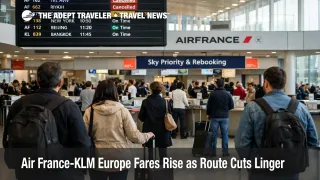
Travelers booking long haul trips on Air France-KLM now face a more expensive and less flexible network at the same time. Reuters reported the group will raise long haul economy fares by €50.00 (EUR), about $57.00 (USD), per round trip to offset higher fuel costs, while Air France and KLM still have several Middle East routes suspended on different timelines. That combination matters most for passengers using Paris, France, or Amsterdam, Netherlands, as connection bridges into the Gulf or the Levant during the late March and April travel window. Travelers with fixed dates, separate tickets, or thin layovers should stop treating those hubs as cheap repair options and price protected backups now.
Air France-KLM Fare Increase, What Changed
The fare move and the suspension story are related, but they are not the same thing. Reuters reported on March 25 that Air France-KLM plans to raise long haul economy ticket prices by €50.00 (EUR) round trip as fuel costs climb. That means some travelers will pay more even on routes that are still operating normally.
At the same time, route availability remains uneven across the group. Air France said it has suspended Dubai and Riyadh through March 31, 2026, with Dubai departures affected into April 1, and Tel Aviv and Beirut through April 4, 2026. KLM's current travel alert is materially longer, showing Tel Aviv, Dubai, Riyadh, and Dammam suspended through May 17, 2026. So the commercial hit is now two layered, higher fares across long haul economy, plus fewer workable routings in parts of the Middle East network.
This also changes the story from a simple cancellation alert into a pricing and recovery problem. In an earlier Adept Traveler article, Air France Paris Gulf Routes Stay Cut Through March 31 focused on the Paris side of the disruption. In another, KLM Dubai, Riyadh, Dammam Suspensions Extend to May 17 showed that Amsterdam based recovery options were already stretching much further into spring.
Which Travelers Face the Most Exposure
The most exposed travelers are not only people flying to Dubai, Riyadh, Beirut, Tel Aviv, or Dammam as final destinations. The bigger problem is for passengers who were using Paris Charles de Gaulle Airport (CDG) or Amsterdam Airport Schiphol (AMS) as one stop bridges on longer itineraries between Europe, North America, and the Middle East.
For point to point travelers, the damage is straightforward. A suspended nonstop means a rebooking problem. For connecting travelers, the damage is broader. The first order effect is fewer available flights on the group itself. The second order effect is that passengers pushed off suspended routes must compete for seats on substitute carriers just as Air France-KLM raises long haul economy pricing. That makes late repairs more expensive, narrows same day rebooking options, and increases the odds of extra hotel nights or split ticket fixes.
The longest dark markets also matter. Air France's current suspensions run into March 31 or April 4, depending on destination. KLM's alert runs through May 17 across Tel Aviv, Dubai, Riyadh, and Dammam. That makes Amsterdam a weaker spring fallback for those markets than some travelers may assume, especially if they are relying on a single overnight connection bank or a self transfer.
What Travelers Should Do Now
Travelers holding tickets on affected Air France or KLM routes should separate two decisions immediately. The first is whether the operating segment itself is still safe on paper, meaning the flight still exists and remains on one protected ticket. The second is whether the total itinerary still makes sense after the fare rise and the thinner route map. A cheaper original booking can become a worse value quickly if one broken segment forces a new fare purchase later.
Rebook now if your trip depends on arriving on a fixed date, if you are ticketed across separate reservations, or if a missed arrival would break a cruise, meeting, tour, or onward long haul departure. Waiting may still be rational if your ticket is flexible, the airline has already reprotected the itinerary, and you can absorb an overnight disruption without losing the trip.
Over the next 24 to 72 hours, watch three signals. First, whether Air France extends beyond March 31 or April 4 again. Second, whether KLM shortens or extends its May 17 horizon. Third, whether competing carriers raise fares further as displaced demand keeps crowding into fewer workable alternatives. The key decision point is no longer just whether a seat exists. It is whether that seat leaves enough slack to survive another schedule change without forcing an expensive rebuild.
Why the Price Rise and Route Cuts Matter Together
Fuel pressure and network pressure reinforce each other. Higher fuel costs push airlines to raise fares, but suspended routes also remove some of the network flexibility that normally helps travelers recover from disruption. When both happen at once, price becomes part of the operational risk, not just a budgeting detail.
That is why this shift matters more on a group like Air France-KLM than it would on a smaller carrier. Paris and Amsterdam are major long haul connection systems. When parts of those systems stay offline for weeks while fares rise across the wider long haul network, travelers lose both price efficiency and repair capacity. A big hub only helps when enough onward options remain available to absorb missed or canceled segments.
What happens next depends on two separate timelines. One is fuel, whether carriers keep passing costs through into fares. The other is network restoration, whether Air France and KLM can reopen suspended markets without another extension. Until those lines improve together, the practical rule for travelers is simple, Air France-KLM may still move you where you need to go, but it is becoming a less forgiving place to improvise a long haul itinerary on price alone.
Sources
- Price hikes, outlook cuts, What airlines are doing as fuel costs surge
- Air France extends suspension of its flights to and from Dubai, Riyadh, Tel Aviv, Beirut
- Air France's 2026 summer schedule
- Travel alerts and disruptions, KLM
- Air France Paris Gulf Routes Stay Cut Through March 31
- KLM Dubai, Riyadh, Dammam Suspensions Extend to May 17