

London Euston Easter Closure Cuts Rail for Six Days
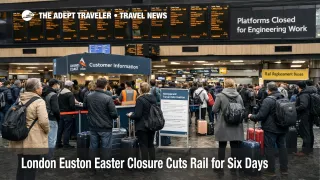
Travel over Easter in Britain now has a fixed weak point. The London Euston Easter closure will shut one of the country's main long distance rail gateways from Friday, April 3, 2026, through Wednesday, April 8, 2026, with Avanti West Coast confirming no trains to or from the station during that window while Network Rail carries out major works. For travelers heading between London and the Midlands, North West England, or Scotland, that turns normal through journeys into a mix of shortened services, bus bridges, and alternate London terminals. If your Easter plan depends on same day rail to a flight, a hotel check in, or a long intercity connection, the safer move is to rebuild it now around earlier departures, different stations, or a different mode entirely.
London Euston Easter Closure, What Changes
The closure runs for six consecutive days, from Friday, April 3, to Wednesday, April 8. National Rail says lines between Milton Keynes Central and London Euston will be closed throughout, and services from Scotland, the North West, and the West Midlands that would normally reach Euston will instead terminate at Milton Keynes Central. From there, travelers are being pushed onto replacement buses toward Bedford or Potters Bar for onward rail access into London.
Avanti says the disruption is broader than the station closure alone. During the same Easter period, it is running a reduced timetable across all routes, with London bound services starting and ending at Milton Keynes Central, and separate engineering work also affecting North West and Scotland flows. That means the practical hit is not just that Euston is shut, it is that the normal West Coast Main Line path into London loses both speed and recovery margin at the busiest spring holiday travel window.
For travelers trying to reach central London, the main official fallback is Bedford to London St Pancras International, rather than a like for like replacement into Euston. That sounds manageable on paper, but it changes how the trip behaves. Luggage gets moved more often, coach segments introduce road exposure, and any plan built around a simple rail arrival into Euston no longer exists for nearly a week.
Which Easter Trips Face the Most Disruption
The most exposed travelers are those moving between London and Manchester, Birmingham, Liverpool, Glasgow, Edinburgh, and other West Coast Main Line markets, especially when the rail leg is only one part of a longer itinerary. National Rail's Easter summary makes clear that this is a corridor problem, not a station problem, because the closure cuts the main London approach for services linking Scotland, the North West, and the West Midlands into the capital.
Airport linked trips also get less resilient. National Rail says London Stansted Airport keeps its core London service, but CrossCountry passengers face buses between Ely and Stansted Airport from Friday, April 3, through Monday, April 6, and Greater Anglia's Norwich direction is cut back to Cambridge with bus replacement onward. On Sunday, April 5, Stansted Express travelers who usually connect via Stratford and Tottenham Hale also lose that connecting rail option until after 6:00 p.m., pushing them back toward Liverpool Street.
Manchester Airport is more mixed, but still weaker for long distance travelers. National Rail says the airport itself keeps mainly normal service, yet TransPennine Express will terminate certain airport trains short at Preston, Stalybridge, York, or Carlisle depending on the day, while Northern notes no direct Windermere or Barrow in Furness trains on Saturday and Sunday. So the airport station stays open, but the long distance web feeding it becomes less direct and less forgiving.
This is where second order risk matters. A rail closure at Euston can spill into busier St Pancras flows, tighter airport transfer margins, and higher demand for coach seats, airport hotels, and backup rail routes. In an earlier Adept Traveler article, London Heathrow Transfers Still Snag on Weekend Closures, Heathrow travelers were already being pushed toward Paddington and the Elizabeth line during separate London disruption. Easter now adds another reason to avoid assuming that a normal central London rail transfer will hold together.
What Travelers Should Do Now
The immediate move is to treat any April 3 to April 8 itinerary involving Euston as already broken, not merely at risk. Recheck every ticketed segment, because the right fallback depends on where the rail trip ends. Some passengers will do better rerouting via St Pancras and Bedford, others by switching the entire London leg to coach or air, and some by moving the overnight stay closer to the airport or departure station rather than trying to force a same day cross city connection.
The next decision point is whether your trip contains a hard timing dependency. If you are connecting to a flight, a cruise embarkation, a Eurostar departure, or a non refundable event, waiting for the journey planner to smooth things out is the weaker strategy. Rebooking early usually costs less than repairing a broken Easter holiday chain once buses, alternate trains, and hotels start filling. If your trip is flexible and rail only, you may be able to wait, but only after checking that your operator's amended timetable is actually loaded and sellable.
For London airport users, separate the airport itself from the route feeding it. Stansted and Manchester Airport both retain service, but not all usual approaches do. Build more buffer than you normally would, avoid the last workable train of the day, and be careful with cheap itineraries that rely on one narrow interchange. In an earlier Adept Traveler article, London Tube Strike Dates Shift to Late Spring, London travelers were reminded that a backup route only helps if it is available when you need it. That logic applies here too.
Why the Disruption Spreads Beyond Euston
The mechanism is straightforward. Euston is not just a London station, it is the southern anchor of the West Coast Main Line. Remove it for six days, and the system has to break long through journeys into shorter pieces, usually with buses inserted where track access disappears. That slows travel time, but the bigger issue is that it removes slack. Once a trip needs a train, then a bus, then another train into a different London terminus, small delays become harder to absorb.
Network Rail says the Easter works are part of a wider national engineering push, and National Rail's holiday summary shows that Euston is only one of several major projects running over the bank holiday. That matters because travelers cannot assume the rest of the network will serve as a clean escape valve. Waterloo is reduced, airport links in East Anglia and the North are altered, and Scotland facing West Coast flows are also under pressure.
What happens next is mostly published already. The closure window itself is firm, and journey times will remain longer until services return after Wednesday, April 8. The practical uncertainty is not whether there is disruption, but where the strain shows first, bus capacity, alternate London terminal crowding, or airport feeder routes. Travelers with London Euston Easter closure exposure should make their main changes now, then recheck operator specific updates again in the final 24 to 48 hours before departure.
Sources
- Easter engineering work, Avanti West Coast
- Easter Bank Holiday Travel Summary, National Rail
- Easter Bank Holiday Engineering Works, Network Rail
- Travel by Train to the Airport on Bank Holidays, National Rail
- Bank Holiday Information, TransPennine Express, National Rail
- London Heathrow Transfers Still Snag on Weekend Closures
- London Tube Strike Dates Shift to Late Spring