

Scotland CalMac Ferry Disruption Hits Spring Break
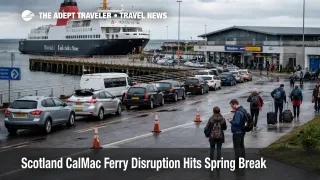
CalMac ferry disruption Scotland is no longer a narrow vessel story. As of March 30, 2026, CalMac's service status page shows 25 of 30 routes affected, and the operator's latest network update says overhaul delays and wider fleet issues are still forcing amended plans even as some vessels edge back toward service. That leaves western Scotland island access unusually brittle at the point when spring breaks, Easter planning, and the summer timetable build are pushing more travelers into fixed date trips. Anyone treating a ferry as a simple last leg, especially for Arran, Mull, Barra, South Uist, or Islay, should now plan with mainland buffer and overnight fallback in mind.
CalMac Ferry Disruption Scotland: What Changed
The immediate change is scope. CalMac's own live status page shows most of the network affected, not just one route, while its March 2026 network update says technical issues, weather risk, and delayed overhauls are still shaping service across the network even after some recent progress. CalMac says MV Glen Sannox returned to Arran service, MV Caledonian Isles is in sea trials after repairs, MV Isle of Arran is expected back to Mull soon, and MV Isle of Islay is expected to enter service next week. That is an improvement, but it is not a return to normal. CalMac is still warning that individual routes may remain affected and that impacted bookings may need amendment.
The route level picture shows where the operational strain is already visible. For Mull, CalMac says timetable amendments are in force from March 27 through April 16. For Barra, a combined Oban to Lochboisdale to Castlebay timetable is operating in that same period. For South Uist, the same combined timetable applies, and CalMac says there is no service to or from Mallaig from March 27 through April 16. That is the kind of change that turns what looks like a normal island transfer into a reduced frequency network with fewer recovery options if one sailing slips.
Which Travelers Face the Most Disruption
The most exposed travelers are not only island residents. Visitors doing self drive circuits, short stay island breaks, coach and rail feeder trips, event travel, and hotel stays linked to one arrival window are now in the danger zone. A one night Arran or Mull plan can still work, but only if the traveler treats the ferry as the main constraint rather than a flexible hop. The risk rises further when the island stay depends on timed check in, prepaid activities, or a return to the mainland for rail or onward flights.
Islay is a slightly different case. The pressure there is partly about near term capacity and partly about what happens as the summer timetable approaches. CalMac says summer bookings are being phased, that current Islay bookings are based on the vessels already available, and that extra availability will only be added once the entry dates for newer vessels are confirmed. It also says MV Finlaggan is scheduled for overhaul from April 22 to May 14, 2026, with bookings initially based on a single vessel plan unless MV Isle of Islay is in service by then. That makes Islay a planning risk even before a same day cancellation appears on the board.
What Travelers Should Do Now
For spring break or Easter period travel, the safer assumption is that island access may still work, but it may not work cleanly. Travelers heading to Arran, Mull, Barra, or South Uist should stop planning on day trip style precision when a missed sailing would break hotel, rail, or event plans. Overnighting on the mainland before a key sailing, or on the island before a hard deadline back on the mainland, is now the more resilient choice for trips with real consequences.
The decision threshold is simple. If your trip includes a fixed accommodation check in, medical appointment, guided departure, car rental closing time, or onward rail or air connection that cannot absorb a delay, build a full buffer night instead of a tight same day handoff. If the trip is flexible and the financial penalty for delay is low, monitoring the live status page and waiting for route specific notices may still be reasonable. Carrying extra food, charging gear, and flexible cancellation terms matters more here than on a normal mainland trip, because replacement transport is limited by geography, not just price.
In an earlier Adept Traveler article, Scottish Island Ferries Stay Fragile Through March 14 the weakness was a stacked transfer problem around Troon and northern ferry weather exposure. The newer shift is broader. Now the system issue is fleet resilience across much of the CalMac network, right as more travelers begin making fixed date spring and summer plans.
Why the Network Is Still Fragile, and What Happens Next
The mechanism is straightforward. A ferry network with delayed overhauls, vessels out for repair, and new ship entry dates still in motion has less spare capacity to recover when anything else goes wrong. That means a repair delay, a weather hit, or a vessel redeployment on one corridor can spread into timetable changes somewhere else. CalMac's own updates show exactly that pattern, with combined timetables, route amendments, phased summer bookings, and warnings that further route impacts remain possible even as some ships return.
What happens next depends on whether the recent progress turns into stable service. The best case is that Glen Sannox stays in service, Caledonian Isles completes its return, Isle of Arran resumes Mull work, and Isle of Islay enters service on schedule. That would give CalMac more room to restore capacity before the heavier Easter and early summer travel flow. The risk case is that another technical issue or weather disruption hits before that resilience is rebuilt. For now, CalMac ferry disruption Scotland should be treated as a live access planning problem, not as background noise.
Sources
- Service status | Caledonian MacBrayne
- Customer Update, Network update March 2026 | Caledonian MacBrayne
- Customer Update, Oban, Craignure (Mull) services | Caledonian MacBrayne
- Customer Update, Oban, Castlebay (Barra services) | Caledonian MacBrayne
- Customer Update, Mallaig, Oban, Lochboisdale (South Uist) services | Caledonian MacBrayne
- Customer Update, Summer 2026 timetables | Caledonian MacBrayne
- Scottish Island Ferries Stay Fragile Through March 14