

Southern Africa Safari Bookings Hold as Flight Costs Rise
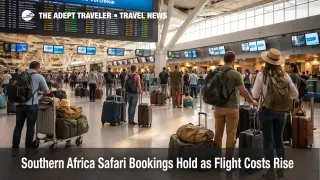
Southern Africa safari bookings are holding even as March 2026 airfare pressure and Gulf corridor disruption make the trip harder to build. The immediate effect is not a collapse in demand, but a sharper divide between travelers who can absorb expensive nonstop or one stop air options and those who cannot. For travelers planning 2026 safari trips, the main decision now is less about whether Southern Africa remains bookable, and more about how much air cost and routing complexity the itinerary can absorb before the ground experience starts getting cut back.
Southern Africa Safari Bookings: What Changed
The shift is counterintuitive. Safari demand has stayed firm even while the broader aviation system absorbs war driven fuel shocks, restricted airspace, and weaker Gulf connectivity. Travel Weekly reported on March 30 that operators including Rhino Africa and U.S. based advisor Travel Beyond were still seeing year over year gains in safari inquiries and little to no cancellation pressure, even after the late February disruption wave in the Middle East.
For travelers, that means the pressure has moved upstream. The safari itself is still selling, but the journey to get there is taking a larger share of the trip budget. Reuters reported on March 30 that jet fuel prices had surged from about $2.50 to $4.24 per gallon, while United has warned that elevated fuel costs can force both fare increases and capacity cuts. In an earlier Adept Traveler article, Fuel Shock Cuts Summer Flights as Fares Rise, we noted that airlines were already widening the response from higher prices to thinner schedules.
That matters on Southern Africa itineraries because travelers have fewer easy workarounds when Gulf routings become less reliable or more expensive. Reuters reported on March 5 that more than 19,000 flights had been canceled across seven major Middle East airports since February 28, a reminder that even as some flying resumes, the region remains a less stable transfer environment than it was before the conflict.
Who Still Benefits, and Who Gets Squeezed
The biggest winners are affluent travelers who see safari as a protected purchase. Go2Africa's State of Safari 2025 report said average safari spend rose to about $8,625 per person sharing in 2025, while medium budgets continued to lose share and medium high budgets became the dominant part of the market. That aligns with the current pattern, demand is holding best where travelers can protect the lodge and wildlife portion of the trip by paying more for air or cutting elsewhere.
The pressure falls hardest on the middle market. Travel Weekly's reporting indicates that travelers facing steeper flight costs are adjusting trip length, simplifying routing, trimming remote add ons, and concentrating spend on easier combinations such as Cape Town plus Kruger rather than wider, more air dependent itineraries. The result is not a shutdown in safari demand, but a narrowing of who can still book the classic multi stop trip without compromise.
Travelers also need to separate continent wide safari demand from specific access points. South Africa remains the single most popular safari destination in Go2Africa's 2025 data, taking 24 percent of inquiries, while Botswana's share also rose sharply. In an earlier Adept Traveler article, Kenya Airways Surge Tightens Nairobi Airfares, we showed how displaced booking flows can quickly tighten another gateway. Strong demand does not mean broad flexibility. It often means fewer affordable ways into the same trip.
What Travelers Should Do Now
Travelers considering a 2026 safari should price the flight before locking the lodge strategy. That sounds backward for a safari, where camp space is usually the scarce asset, but airfare volatility is now large enough to force redesigns later. United's current fare pages still show Newark to Cape Town economy options around $1,660 in April and May 2026, while business class deals to Cape Town are shown above $7,500 on some date pairs, illustrating how quickly premium air can distort the total budget before any bush flights or lodge nights are added.
The next decision point is trip shape. Travelers with a fixed total budget should protect the core safari nights first, then decide whether coastal add ons, extra internal flights, or premium cabin seats are still worth it. Travelers with low schedule flexibility should also favor longer buffers at the start of the trip, because thinner airline schedules and disrupted hubs reduce same day recovery options when something slips en route.
Waiting only makes sense if the traveler is flexible on dates, routing, and lodge category. It makes less sense for travelers targeting peak wildlife windows, family trips, or limited inventory camps. Go2Africa's 2025 data shows demand concentrating in established safari countries and rising average spend, which usually means the most desirable combinations do not get easier late.
Why the Main Threat Is Economic Confidence, Not Headlines Alone
The current booking picture suggests that war related disruption is raising friction more than it is crushing demand. Travel Weekly reported that multiple safari sellers see the larger booking threat not in geopolitics by itself, but in what sustained oil shock could do to U.S. consumer confidence and financial markets. That distinction matters because luxury travel often holds longer than expected during a routing crisis, then weakens faster if household wealth, equity portfolios, or business confidence deteriorate.
Reuters' March 30 reporting points in the same direction from the airline side. Higher fuel costs are already stressing weaker carriers, pushing fare increases and capacity cuts, and creating a wider risk of thinner networks into summer. For safari travelers, that means access can worsen before destination demand does. Southern Africa safari bookings may remain resilient in the near term, but the next signal to watch is whether market stress starts changing who feels comfortable committing to a high cost long haul trip in the first place.
For now, Southern Africa safari bookings still look more resilient than the route map around them. The traveler mistake would be reading that resilience as normal conditions. It is not. The trip is still sellable, but the air component is doing more damage to affordability, itinerary breadth, and recovery options than the safari side itself. Travelers who treat Southern Africa safari bookings as a flight first budgeting exercise, not just a dream trip, will make better decisions over the next few months.
Sources
- The real threat to Africa's safari market
- State of Safari 2025: African Safari Travel Trends
- U.S. airlines face fuel-driven financial shakeout
- Oil spike hits airline shares as some Gulf flights cautiously resume
- Featured daily fares for flights from Newark/New York to Cape Town
- United's most popular flights to Cape Town (CPT)