

Fuel Shock Cuts Summer Flights as Fares Rise
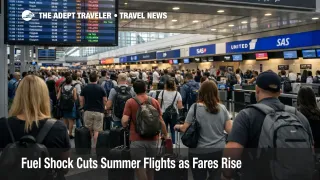
Summer flight cuts are no longer a side effect of higher fuel bills. They are becoming part of the main airline response. Reuters reported on March 30 that carriers are now raising fares and cutting flying as jet fuel prices roughly double, while United Airlines, SAS, and Air New Zealand have already tied published reductions or schedule trimming to the fuel shock. For travelers booking April through summer 2026 trips, the main consequence is not just a more expensive ticket. It is a thinner schedule with fewer fallback departures when a connection breaks, a delay rolls forward, or a same day repair is needed.
Summer Flight Cuts: What Changed
What changed is the industry response. Over the past week, the fuel story was still mostly about surcharges and fare increases. Now Reuters says airlines are also pulling capacity as they test how much consumers will keep paying. That is a more serious traveler signal because a fare hike can still leave multiple usable flights in the market, while a schedule cut removes recovery room from the system itself.
The carrier examples are already concrete. United said it would cut up to 5 percent of scheduled capacity in the second and third quarters, focusing on weaker midweek, Saturday, overnight, and some hub flying. SAS said it would cancel 1,000 flights in April after already canceling several hundred in March. Air New Zealand said it would cut about 5 percent of flights, around 1,100 services through early May, affecting roughly 44,000 passengers.
That progression makes this a different story from Global Airfare Hikes Spread as Fuel Squeeze Widens, where the main traveler problem was broader pass through into prices. The new problem is that some of that pricing pressure is now arriving with fewer seats and fewer frequencies.
Which Travelers Face the Most Exposure
The most exposed travelers are the ones who depend on schedule slack rather than just a low headline fare. That includes passengers starting at smaller airports, travelers booking one stop summer itineraries, and anyone trying to protect cruises, tours, weddings, conferences, or same day long haul departures. When a carrier trims marginal flights, the first order effect is fewer choices. The second order effect is that the surviving schedule becomes less forgiving when irregular operations begin.
United's move matters most in U.S. hub and connecting traffic because trimming weaker flying can leave Chicago O'Hare International Airport (ORD), Newark Liberty International Airport (EWR), and other hub flows with less off peak repair capacity. SAS matters most for travelers connecting through Copenhagen Airport (CPH), Oslo Airport (OSL), and Stockholm Arlanda Airport (ARN), where frequency is part of the value proposition. Air New Zealand matters most for domestic and regional travelers because Reuters said many of the cuts fall on domestic flying, even though the long haul U.S. network remained intact.
This also raises the risk that some summer markets get hit twice. Travelers can pay more up front, then discover that a canceled or delayed segment is harder to repair because the next workable flight is later, more expensive, or already full. In an earlier Adept Traveler article, SAS April Flight Cuts Tighten Nordic Connection Risk, the concern was already shifting from price to schedule resilience. In another, United Cuts 5% of Flights as Fuel Prices Surge, the same logic showed up in the U.S. network.
What Travelers Should Do Now
Travelers with fixed summer dates should stop treating this as a wait and see fare story. Rebooking early starts to make more sense when you see three conditions together, fares rising, published flight cuts, and a trip that breaks if one segment fails. That threshold matters most for one stop international trips, separate ticket itineraries, and journeys where an overnight misconnect would create hotel, meal, or onward transport costs.
Waiting can still make sense if your dates are flexible, your route has heavy competition, and your trip can absorb a day lost to reaccommodation. That is a narrower set of cases than it was a week ago. Once airlines move from fare language to published cuts, the market is no longer just expensive. It is structurally thinner. Travelers should compare not only the fare they want, but the backup flight they would need if the first plan breaks. If the backup is already sparse or sharply more expensive, the network is telling you to book the safer option now.
Over the next 24 to 72 hours, watch for three signals. First, whether more carriers shift from surcharges to explicit summer schedule reductions. Second, whether hub focused airlines cut off peak or marginal departures rather than headline trunk routes, which makes disruption harder to notice until something goes wrong. Third, whether substitute carriers keep adding seats, or decide higher yields are more attractive than filling the gap. If cuts widen faster than replacement capacity appears, summer flight cuts become a broader availability problem, not just a pricing problem.
Why the Fuel Shock Is Spreading Into Schedules
The mechanism is straightforward. Fuel is one of the largest airline operating costs, and Reuters reported that jet fuel prices have roughly doubled during this crisis. Airlines can pass through some of that cost with fares and surcharges, but not all of it, especially if higher gasoline prices also make consumers more cautious about discretionary trips. At that point, removing unprofitable or lower yield flying becomes a margin defense tool.
This is also happening in a system that already has less spare room than it looks like from a booking screen. Fleet renewal is delayed by supply chain problems, according to Reuters, which means airlines cannot always swap in newer, more fuel efficient aircraft fast enough to offset the shock. That leaves carriers balancing three levers at once, price, frequency, and network shape. Travelers mostly see the result only after it reaches the timetable.
What happens next depends on duration. If fuel stays elevated into April and May, the current pattern suggests more rolling cuts, not one clean adjustment that ends the problem. Stronger carriers may hold up better, while weaker or thinner network operators may have to cut more aggressively. That would widen the gap between routes that still have real same day recovery options and routes that only look plentiful until the first cancellation hits.
Sources
- Airlines Face Fare Dilemma as Fuel Spike Threatens Travel Demand
- United Airlines to Cut More Flights as It Eyes Oil Above $100 Through 2027
- Airline SAS to Cancel 1,000 Flights in April Due to High Fuel Prices, DI Reports
- Air New Zealand to Cut Flights as Fuel Price Surge Wreaks Havoc on Travel
- Global Airfare Hikes Spread as Fuel Squeeze Widens
- SAS April Flight Cuts Tighten Nordic Connection Risk
- United Cuts 5% of Flights as Fuel Prices Surge