

Eurostar Easter Rail Disruption Widens Past April 1
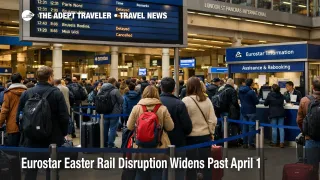
Eurostar Easter rail disruption is no longer just an April 1 operating wobble. On Wednesday, April 1, 2026, Eurostar posted live delays at Paris Gare du Nord, Amsterdam Centraal, London St Pancras International, and on parts of the Dutch, Belgian, French, and German networks, alongside same day cancellations on the wider network. That would be manageable on a normal timetable. It matters more now because Eurostar is already running with separate cancellation blocks through April 12 and May 17, plus Dutch engineering limits through April 11 and again on April 4 and 5. Travelers with same day flights, cruise embarkations, hotel check ins, or business meetings should treat cross Channel rail as a lower resilience option than usual through the Easter window.
Eurostar Easter Rail Disruption: What Changed
The new development is the stack, not any single incident. Eurostar's live update page on April 1 showed multiple operational trouble points at once, including technical issues at Paris Gare du Nord, operational restrictions at Amsterdam Centraal and Paris Gare du Nord, delay notices on the Dutch and German networks, and same day train cancellations on the Eurostar network. In isolation, that would point to a rough day. In context, it means the network is absorbing day of disruption while already carrying a thinner timetable into mid April and mid May.
The dated cuts are not abstract. Eurostar is currently listing cancellations between February 1 and April 12, a second cancellation window between March 1 and April 12, and another from March 22 through May 17. It is also listing limited service on the Dutch network through April 11, plus extra Dutch engineering restrictions on April 4 and 5. Specific trains already shown as cancelled or altered in these notices include Paris, Brussels, and Amsterdam pairings, with April 4 and April 5 also affected by Dutch engineering works.
This follows earlier Adept Traveler reporting, but the frame is wider now. In an earlier Adept Traveler article, Eurostar Delays Today, April Cuts Tighten Rail Options, the network was already showing strain. The difference on April 1 is that Eurostar's own live page now shows fresh same day disruption on top of those pre existing schedule cuts, which makes fallback options thinner as Easter demand builds.
Which City Pairs and Itineraries Are Most Exposed
The most exposed city pairs are Paris to Brussels, Brussels to Paris, Amsterdam to Paris, and the broader London, Paris, Brussels, and Amsterdam axis that depends on those cross border links holding together. Eurostar's published cancellation notices for April 1 and the following days repeatedly hit Paris Gare du Nord and Brussels Midi, while Dutch engineering notices touch Amsterdam linked services on April 4 and 5. That means the main risk is no longer only a single station delay, it is that the core recovery corridors are already running with less spare capacity.
Travelers most likely to feel this are not just leisure riders with flexible plans. The sharper exposure is for people making same day handoffs, such as London or Paris airport transfers after a rail leg, cruise embarkation days, rail to hotel arrivals with fixed late check in windows, and business trips that depend on a specific arrival slot. When the rail timetable is both reduced and unstable, a 30 to 60 minute slip stops being a nuisance and starts becoming a missed chain. Eurostar's customer charter also matters here, because it confirms that when a delay of 60 minutes or more is reasonably expected before departure, customers can take a refund or postpone to a later service or date, and that late disruptions can trigger help with onward connections, hotels, or taxis where possible.
What Travelers Should Do Now
Travelers on April 1 through the Easter period should plan from the disrupted timetable, not the normal one. If your trip is built around London, Paris, Brussels, or Amsterdam on the same day as a flight, cruise, or long onward rail connection, add more buffer than usual now, not after your train posts late. For separate tickets, same day airport transfers, and event driven trips, the safer move is often to shift onto an earlier train or move the overnight stay forward while rooms and alternative fares still exist.
The decision threshold for switching to air or an overnight is straightforward. If you are relying on one of the most exposed city pairs, especially Paris to Brussels, Brussels to Paris, or Amsterdam linked services during April 1 to April 5, and a missed arrival would break the rest of the itinerary, rail is no longer the higher confidence option. On those trips, compare air and hotel options before departure rather than waiting for a same day failure inside a thinner network. In an earlier Adept Traveler article, London Euston Easter Closure Cuts Rail for Six Days, another major British Easter rail weak point was already visible, which means travelers crossing Britain and the Channel at once have less room to improvise.
Over the next 24 to 72 hours, watch three signals before deciding whether to hold or move. First, check whether Eurostar's live page is still posting fresh operational restrictions at Paris Gare du Nord, Amsterdam Centraal, London St Pancras, or on the Dutch network. Second, confirm whether your booked train is one of the already affected scheduled services. Third, if Eurostar begins flagging wider delays of 60 minutes or more before departure, use the refund or postponement options before alternatives disappear.
Why the Pressure Lasts Into Easter
The mechanism is simple. A cross border rail network can usually absorb one localized problem with rolling stock swaps, later departures, or rebooking onto nearby services. That gets harder when the timetable is already thinned by operational restrictions and engineering works. Eurostar's current notices show both conditions at once, day of delays and cancellations layered over longer dated cuts, which reduces the number of clean backup moves available to travelers and staff.
That is why this story is bigger than April 1. The practical question is no longer whether Eurostar is running at all, it is whether the remaining network has enough slack to protect separate ticket itineraries during Easter traffic. For travelers on flexible city breaks, the answer may still be yes. For anyone with fixed arrival consequences, the wiser frame is to treat Eurostar Easter rail disruption as a lower margin transport window until the April 4 and 5 Dutch limits pass and the broader cancellation blocks begin to clear.