

Hong Kong Tourism Recovery Still Leans on China
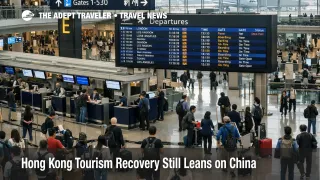
Hong Kong tourism recovery is no longer about whether visitors are returning. They are. The harder question is what kind of recovery the city is building, and the latest WTTC research says that rebound is still too concentrated in mainland demand, short stays, and lower-value mix to fully restore Hong Kong's pre-2019 international position. For airlines, hotels, event planners, and premium travelers, that leaves Hong Kong with real momentum, but also with a clear structural gap. Travelers considering Hong Kong for business events, premium stopovers, or broader Asia itineraries should read the city as increasingly usable, but not fully reset.
Hong Kong Tourism Recovery: What Changed
WTTC said on April 1 that Hong Kong SAR, China can regain more international ground if it shifts investment toward higher-yield travelers and a wider mix of source markets, especially mainland cities beyond Guangdong plus ASEAN, the Middle East, and India. That recommendation matters because the city's 2025 inbound profile remained heavily skewed, with 76 percent of visitors coming from mainland China and only 24 percent from the rest of the world. WTTC estimates 2025 inbound arrivals reached 50.3 million, still 22.9 percent below the 2018 peak of 65.3 million, while business travel spending remained 16.8 percent below 2018 levels.
The broad recovery is real, but the mix is uneven. WTTC said the sector reached 98.5 percent of its 2018 level in 2025, helped by domestic demand that rose 15.5 percent over that period. International visitor spending, however, was still 15 percent below 2018, while Singapore and Macao SAR, China were projected to be above their pre-pandemic benchmarks in 2025. That is the practical distinction. Hong Kong has regained volume faster than it has rebuilt the higher-value international demand that supports longer stays, business events, and more premium spending patterns.
Who Benefits, and Where the Gaps Remain
The clearest near-term beneficiaries are travelers already moving within Greater China and short-haul Asia, plus airlines and hotels that can monetize Hong Kong's restored hub role. Hong Kong International Airport said it handled 10.93 million passenger trips in the first two months of 2026, up 11.7 percent year over year, with a 30 percent rise in transfer and transit traffic helping drive that growth. In 2025, OAG ranked Hong Kong to Taipei as the world's busiest cross-border route, with 6.8 million seats. Those are not recovery-theory numbers. They show real traffic density and a working hub.
The weaker fit is in the segments Hong Kong still needs to rebuild more aggressively. WTTC specifically called for renewed MICE incentives, stronger long-haul positioning in the United States, the United Kingdom, and Europe, and new efforts to raise visitor value and average trip length. The city's average stay is forecast at 3.1 nights in 2025, down from 3.3 in 2019. For hoteliers, event organizers, luxury travel advisors, and airlines chasing premium long-haul demand, that shorter-stay pattern matters because it limits the spend density that made Hong Kong especially attractive before the combined shocks of 2019 unrest and the pandemic.
What Travelers and Travel Planners Should Do Now
For leisure travelers, Hong Kong now looks strongest as a short, high-connectivity stopover or a compact city break that can be paired with another destination in Asia. The city's air network, airport throughput, and government-backed tourism push make it easier to route through Hong Kong again, especially for travelers who value dense urban dining, events, and quick access rather than long resort-style stays. Travelers who want a deeper cultural or neighborhood-based trip should plan intentionally, because WTTC's own findings suggest Hong Kong still has work to do in converting returning traffic into longer visits.
For business travelers and event planners, the next decision point is less about whether Hong Kong can host demand, and more about whether incentive structures and air pricing line up with your timeline. The government's 2026 to 2027 budget raises the Hong Kong Tourism Board subvention to HK$1.661 billion and explicitly backs more MICE work, new market promotion, cruise growth, and higher-value visitor targeting. That should improve the city's selling power for conferences and corporate events, but planners still need to watch airfare pressure and ticket timing. In an earlier Adept Traveler article, Hong Kong Cathay Fuel Surcharge Hike Raises April Fares showed how rising fuel charges were already making some Hong Kong itineraries more expensive from April 1.
Travel advisors building broader Asia itineraries should also treat Hong Kong as a stronger bridge than it was a year ago, but not as a one-size-fits-all value play. In an earlier Adept Traveler article, Europe Asia Direct Flights Grow as Gulf Hubs Stay Tight identified Hong Kong as one of the gateways gaining real utility as Europe-Asia flows adjusted. That supports Hong Kong's role in complex itineraries. It does not, by itself, solve the city's challenge of rebuilding deeper long-haul leisure and business demand.
Why Hong Kong's Recovery Is Still Incomplete
The mechanism is straightforward. Hong Kong has recovered enough air connectivity and tourism volume to function as a major hub again, but recovery driven heavily by mainland demand and shorter stays does not automatically recreate pre-2019 economics. Business travel is still below peak, international spend is still below peak, and the city is competing against regional peers that have already overtaken their pre-pandemic benchmarks. That is why WTTC's recommendations focused less on generic promotion and more on market mix, visitor quality, long-haul positioning, and public-private coordination.
There are also reasons Hong Kong could narrow that gap. The government says Hong Kong International Airport's new passenger departure facilities at Terminal 2 are due to begin operations in May 2026, which should further raise airport capacity. The same budget also highlights plans to expand air service rights with regions including the Middle East, Central Asia, Africa, and South America. If that capacity growth, market diversification, and event investment start producing longer stays and stronger business demand, Hong Kong tourism recovery will look more complete by late 2026. Until then, the city is best understood as a busy, increasingly effective hub that is still rebuilding the most valuable parts of its international travel mix.