

Hong Kong Cathay Fuel Surcharge Hike Raises April Fares
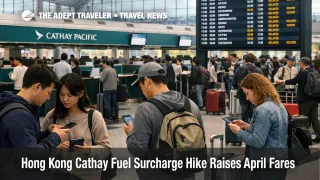
Cathay fuel surcharge rises on April 1, 2026, and that makes Hong Kong, China bookings more expensive almost immediately for travelers using Cathay Pacific as a long haul bridge. Cathay said on March 26 it will raise surcharges by 34 percent across its routes and review them every two weeks, a temporary faster cycle meant to track volatile jet fuel prices. For travelers, the practical change is simple, tickets issued from April 1 can cost meaningfully more even when the base fare looks similar, so anyone who already knows they are flying soon should price and book before the new table takes effect.
Cathay Fuel Surcharge: What Changed
Cathay's official table shows the biggest visible increase on long haul markets. For flights between Hong Kong and South West Pacific, North America, Europe, the Middle East, and Africa, the surcharge on tickets purchased in Hong Kong rises from HK$1,164 to HK$1,560, from $149.20 (USD) to $200.00 (USD) in most other markets, from CAD 202.60 to CAD 275.00 in Canada, and from NZD 252.00 to NZD 343.00 in New Zealand. On Hong Kong to South Asia subcontinent routes, the Hong Kong surcharge rises from HK$541 to HK$725, while most other markets rise from $69.40 (USD) to $93.00 (USD). On flights not covered by those bands, the Hong Kong surcharge rises from HK$290 to HK$389, and most other markets rise from $37.20 (USD) to $50.00 (USD).
There are important exceptions. Cathay's table says some Japan origin surcharges fall rather than rise, and Chinese mainland to Hong Kong sectors remain unchanged at CNY 135 each way, with Hong Kong to mainland sectors unchanged at HK$165. That means this is not a uniform global fare jump. It is most visible on tickets bought under Cathay's Hong Kong, Canada, New Zealand, and "Others" pricing buckets, especially on long haul routes where the surcharge band is highest.
Which Travelers Will Feel It Most
The travelers most exposed are people booking Hong Kong connections after April 1 for Europe, North America, Australia, New Zealand, the Middle East, or Africa. The surcharge is imposed at ticketing, not only at departure, so the immediate decision window is about when the ticket is issued. Families buying several seats, business travelers booking late, and disrupted passengers rebuilding a broken itinerary through Hong Kong will feel the increase faster than travelers already holding tickets.
Connecting travelers are in a weaker position than nonstop travelers because the surcharge lands on top of an already stressed route map. In an earlier Adept Traveler article, Asia Europe Bypass Fares Spike on Replacement Routes tracked how Gulf disruption was already pushing travelers onto scarcer seats via Hong Kong and other bypass corridors. In another earlier Adept Traveler article, Cathay Pacific Dubai Suspension Runs Through April 30 showed that Cathay's own network remains thinner in parts of the Middle East. Higher surcharges now worsen the arithmetic for anyone forced to reroute through Hong Kong instead of taking a more direct or cheaper one stop option.
What Travelers Should Do Before April 1
Travelers who already know they need Cathay in the next few weeks should compare and ticket before April 1, 2026, not after. Cathay's own notice makes clear that the new surcharge applies from that date, and the airline says it may revise the surcharge every two weeks while fuel markets stay unstable. Waiting for a lower base fare could backfire if the surcharge table moves again before you issue the ticket.
The main decision threshold is whether Hong Kong is still the best bridge once total trip cost is counted. For a simple nonstop or single connection that protects a cruise, tour, or fixed meeting, paying the higher surcharge may still be rational. For discretionary trips, or for travelers with flexible arrival cities, it now makes more sense to compare total cost across alternate hubs and not just headline fares. Cathay's surcharge table is also market specific, so travelers booking from Japan or on Chinese mainland sectors should check the origin rules carefully before assuming the increase works the same way on their ticket.
Over the next 24 to 72 hours, watch two things, whether Cathay's post April 1 total prices still beat alternatives once taxes and surcharges are included, and whether the airline's first two week review produces another adjustment. A faster surcharge cycle means the old habit of monitoring fares for several weeks is less useful than usual. In this market, delay can become a pricing penalty.
Why This Fare Pressure Is Spreading, and What Happens Next
Cathay's explanation is straightforward. The airline says the Middle East situation has sharply increased both the crude oil component and the refinery component of jet fuel prices. Its notice cites IATA data showing the global average jet fuel price rising to $197.00 (USD) per barrel for the week ending March 20, 2026, up from $157.41 (USD) two weeks earlier and $95.95 (USD) a month earlier. Cathay also says fuel accounted for about 30 percent of its 2025 operating costs. Reuters reported that Cathay warned it may not be able to sustain effective network operations if those costs cannot be mitigated.
That mechanism matters beyond Hong Kong. Airlines first try to recover a fuel shock through pricing, then through schedule changes, weaker route cuts, or both. Reuters has already reported that higher jet fuel costs are pushing carriers worldwide to raise fares, trim capacity, and revise forecasts. Cathay's move makes that pressure visible at the consumer level on a major Asia hub network. The next sign travelers should watch is not only another Cathay surcharge review, but whether more Asia Europe and Asia North America itineraries begin showing a wider gap between headline base fares and final ticket totals.