

Amritsar Runway Work Cuts Daily Flying Until September
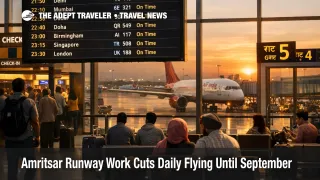
Amritsar runway closure is now a fixed six month operating constraint, not a short lived disruption watch. Sri Guru Ram Dass Jee International Airport (ATQ), in Amritsar, India, is closing Runway 16/34 every day from 815 a.m. to 415 p.m. UTC, which converts to 145 p.m. to 945 p.m. India Standard Time, from April 1, 2026, through September 27, 2026, for recarpeting and related airfield work. That gives airlines a narrow daily window to arrive and depart, and it shifts the main traveler risk from day of travel delays to schedule retimes, tighter onward connections, and fewer recovery options if a flight slips. Passengers booking Amritsar through late September should verify departure times, onward connection buffers, and hotel timing before treating an existing itinerary as settled.
Amritsar Runway Closure: What Changed
What changed is that the airport now has a published daily shut window for most of the daylight and evening period during the summer schedule. India's aeronautical publication system lists an AIP supplement for the closure of Runway 16/34 for work activities from April 1, 2026, at 815 a.m. UTC through September 27, 2026, at 415 p.m. UTC. Local reporting tied to the NOTAM and airport officials says no flight operations will take place during that daily eight hour block, and that the work includes runway recarpeting, runway end safety area development, LED ground lighting, and related monitoring upgrades.
In practical terms, the airport does not disappear for six months, but its usable day becomes compressed. Flights have to be pushed into the morning and late night shoulders. That usually means banks of departures and arrivals bunch more tightly, which reduces slack when one aircraft comes in late, a crew runs out of margin, or an inbound delay spills into the next turn. The immediate traveler consequence is less schedule spread across the day and a higher chance that one disrupted sector affects the rest of the itinerary.
Which Travelers And Routes Face The Most Pressure
The most exposed travelers are the ones who built Amritsar around same day onward movement. That includes passengers connecting to Delhi or Mumbai for long haul departures, families using Gulf flights as the first leg of a wider trip, and diaspora traffic to the United Kingdom that depends on a clean departure bank rather than an overnight recovery. Local reporting says the airport is handling 62 daily flights in the summer schedule, including 40 domestic and 22 international services. Reported domestic links include Delhi, Mumbai, Bengaluru, Kolkata, Ahmedabad, Kullu, Srinagar, and Pune, while international service includes Doha, Dubai, Singapore, Birmingham, London Gatwick, Kuala Lumpur, Sharjah, and Bangkok.
That matters because compressed airport hours raise pressure unevenly. Short domestic flights may be easier for airlines to retime, but they are also the sectors many travelers use to connect into separate tickets. Longer international services can be harder to move cleanly if slots, crew timing, and aircraft rotations elsewhere in the network are already tight. Air India's existing Amritsar network shows how much long haul and India gateway traffic can be layered onto one station, including nonstop Birmingham service and links onward to London and Dubai through its booking network.
In an earlier Adept Traveler article, Jodhpur Airport Closure Forces Rajasthan Route Rebuilds, we noted how Indian runway work can turn an airport from a flexible trip anchor into a hard planning constraint. This Amritsar case is less severe than a full closure, but it creates a longer exposure window because the disruption repeats every day for nearly six months.
What Travelers Should Do Before Booking Or Rechecking Tickets
Passengers traveling through Amritsar before September 27 should check the exact local departure and arrival time now, even if the booking was made weeks ago. The first thing to verify is whether the flight still sits outside the 145 p.m. to 945 p.m. IST runway closure window. The second is whether a connection that once looked safe still has enough margin after a retime. A domestic to international handoff on separate tickets is the weakest structure under this kind of compressed operating day.
Rebook early if the trip depends on a same day connection to a long haul flight, a cruise, a wedding, or a fixed tour start. Wait only if the carrier has not finalized schedule changes, the trip is flexible, and an overnight stay would not materially damage the itinerary. The tradeoff is straightforward, waiting may preserve a cleaner airline driven rebooking path, but moving earlier may preserve the wider trip before better timings disappear.
Travelers should also price the land side of the disruption, not just the airfare. A late night arrival or very early departure can add an airport hotel, a private transfer, or an extra meal stop that was not in the original plan. In an earlier Adept Traveler article, Air India Fuel Surcharge Raises India Trip Costs, we noted that India itineraries are already becoming less forgiving when schedules and costs tighten at the same time. This runway work adds another reason to avoid fragile, stacked bookings through one airport.
Why The Disruption Spreads Beyond One Runway
The mechanism is simple. When an airport loses eight hours of runway availability every day, airlines do not just move one flight. They have to rebuild aircraft turns, crew duty patterns, gate usage, and slot timing around a smaller operating window. First order, flights get retimed, consolidated, or trimmed. Second order, the pressure moves outward to missed onward connections, overnight hotel demand, and tighter seat availability on the remaining morning and late evening departures.
What happens next is likely to be operational rather than dramatic. Travelers should expect more schedule revisions, more concentration of departures outside the closure window, and less room for recovery when weather, late inbound aircraft, or air traffic flow restrictions interfere. The airport work itself is a structural improvement project, but for passengers the useful planning assumption through September 27 is that Amritsar will function like a station with a daily curfew sized to daylight and evening travel demand. That does not mean every day will be chaotic. It means travelers should stop assuming the airport can absorb last minute changes across the full day.