

Brisbane Airport Rail Access Stays Fragile Into Easter
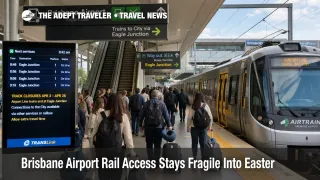
Brisbane airport rail access stays fragile into Easter because Queensland Rail's April shutdown program begins on April 3, 2026, just after approximately 180 services were canceled during April 1 labor disruption. For travelers moving between Brisbane Airport, the city, the Gold Coast, and the Sunshine Coast, that turns a one seat rail trip into a slower and less forgiving mix of trains and replacement buses across much of April. The operational risk is not a single closure day, it is the combined effect of fresh instability followed immediately by planned network restrictions that reach into holiday travel corridors. Travelers with same day flight to rail links, cruise connections, or fixed hotel arrival windows should build extra buffer now and avoid assuming the normal rail map still applies.
Brisbane Airport Rail Access: What Changed
From Friday, April 3, through Saturday, April 11, major track closures affect the Sunshine Coast, Caboolture, Redcliffe Peninsula, Doomben, Shorncliffe, Airport, Gold Coast, and Beenleigh lines. From April 12 through April 26, the closures continue on the Beenleigh and Gold Coast lines. Queensland Rail says buses will replace trains on affected lines during those periods, and Translink says the precise pattern varies by line and by date.
For airport travelers, the key operating pattern is narrower than normal. Over the Easter weekend closure window, Airport line trains run only between Brisbane Airport's Domestic Airport station and Eagle Junction, instead of providing the usual through service into central Brisbane. Translink says trains leaving the airport then continue toward Caboolture after Eagle Junction, while affected inner city stations rely on other services or replacement buses. That is a meaningful downgrade for visitors who normally use a direct airport to city rail ride.
The short term backdrop is also weaker than a routine engineering works story. Queensland Rail said protected industrial action on April 1 led to about 180 canceled services, and the operator separately warned on the afternoon of April 1 that new Electrical Trades Union action could cause significant disruption on April 2 as well. In practical terms, travelers are heading into the planned Easter shutdown after a live disruption week, not from a stable baseline.
Which Travelers Face The Most Disruption
The most exposed travelers are those trying to connect Brisbane Airport with the central city, the Gold Coast, or rail served leisure areas without much time margin. Once the airport trip becomes train to Eagle Junction plus another train or bus segment, the journey gets longer and recovery options shrink if one leg runs late. Airtrain warns that some trips may take significantly longer than usual and says the best option can change during April depending on the day and line.
Gold Coast travelers are the next major exposure group. During the Easter weekend pattern, the Gold Coast and Beenleigh lines run as a combined all stops service between Varsity Lakes and Banoon, with affected inner Brisbane sections covered by rail buses. That matters for hotel arrivals, theme park trips, and onward coach or rental car pickups because a faster intercity corridor turns into a slower local pattern plus bus substitution through the network pinch point.
Sunshine Coast trips also lose simplicity. Translink says Sunshine Coast line services will not run during the major Easter weekend closure pattern, with rail buses covering parts of the corridor. That raises the risk for travelers trying to combine airport arrival with a same day coastal transfer, especially if they are carrying large luggage or relying on the rail leg to absorb road congestion.
In an earlier Adept Traveler article, Brisbane Rail Disruption Hits Airport Trips Before Easter outlined the immediate pre Easter disruption pattern. What changed now is that the story has hardened from a one day labor hit into a longer transfer risk window anchored by scheduled network closures and an airport line that no longer behaves like a normal through route.
What Travelers Should Do Now
Travelers flying into Brisbane and heading onward by rail should price in extra time immediately, not after arriving. A same day airport to hotel or airport to coast plan that once looked routine now needs margin for train changes, bus queues, and road traffic affecting replacement services. If the trip includes a cruise embarkation, tour departure, event ticket, or nonrefundable hotel cutoff, the safer play is to shift to a road transfer or arrive earlier in the day.
The next decision point is whether the rail journey is still worth protecting. If your itinerary depends on a direct airport to city run, a tight handoff to the Gold Coast, or a late evening arrival with limited tolerance for delay, road transport is increasingly the more resilient option during the closure window. Rail still works for some trips, but it is now better treated as a flexible journey rather than a fixed time promise.
What to monitor over the next 24 to 72 hours is narrower and more practical than a generic labor headline. Watch Translink's specific line notices for the travel day, confirm whether your stations are train served or bus served on that date, and recheck the Airport line pattern before leaving for the terminal. Travelers using buses should also remember that Translink says railbuses are affected by road and traffic conditions, and bikes and e scooters are not permitted onboard.
Why The Disruption Spreads Beyond The Airport
The mechanism is straightforward. These closures are tied to a large bundle of works, including Cross River Rail support activity, Logan and Gold Coast Faster Rail, the Beerburrum to Nambour upgrade, station relocation work, European Train Control System deployment, train manufacturing program work, and routine maintenance. That means the disruption is not isolated to one spur line, it is spread across the same network used for airport access, central Brisbane circulation, and leisure corridor travel.
That broad footprint creates the second order problems travelers actually feel. When trains are cut back to Eagle Junction, merged into slower all stops patterns, or replaced by buses in inner city sections, airport access starts competing with commuter flows and holiday demand on the road network. The result is a more brittle transfer chain for Brisbane Airport, the Gold Coast, and Sunshine Coast trips, especially over Easter when load factors and hotel turnover are already higher.
What happens next is partly fixed and partly uncertain. The closure calendar through April 26 is already published, but service reliability around the edges can still change if further industrial action bites or if bus replacement journeys slow more than expected. The likely outcome is not systemwide collapse, but a sustained period where rail remains usable only if travelers treat it as slower, less direct, and more variable than usual.
Sources
- Queensland Rail Urges Unions To Call Off Protected Industrial Action, as at 10 a.m. on April 1, 2026
- Queensland Rail Protected Industrial Action Continues Into Thursday, April 2, 2026
- Plan Ahead, April Track Closures For Major Rail Works
- Translink, Major Easter Weekend Track Closure, Impacts Most Lines
- Airtrain Brisbane, Service Changes, Track Work
- ABC News, Some Travel Times In South East Queensland Could Be Twice As Long In April
- Brisbane Rail Disruption Hits Airport Trips Before Easter