

UK Easter Airport Rail Works Tighten Access
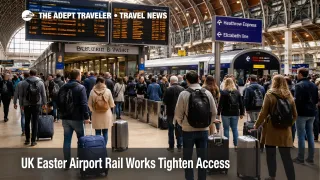
Britain's Easter rail engineering program is now an airport access problem, not just a general holiday travel notice. National Rail says rail changes from Friday, April 3, 2026, through Monday, April 6, 2026, will alter how travelers reach Heathrow, Gatwick, Stansted, Luton, and Southend, with the sharpest pressure on early departures, same day airport transfers, and itineraries that depend on one clean rail link into London. For travelers with flights over the long weekend, the safer move is to treat rail as a variable input, not a fixed plan, and decide now where a bus, a hotel closer to the airport, or a private road transfer is worth the extra cost.
UK Airport Rail Disruption, What Changed
The biggest Heathrow hit falls on Easter Sunday, April 5. National Rail says Heathrow Express will not run before 720 a.m., with the first Paddington departure at 740 a.m., then a reduced service for much of the day. The Elizabeth line also starts later than normal that morning, with no service between Paddington and Ealing Broadway until 7:45 a.m., reduced Heathrow service, and some skipped stops. That does not shut Heathrow access, but it weakens the fastest and most predictable rail path at the exact point when morning departures and hotel to terminal transfers need the most reliability.
Gatwick is less dramatic, but still less forgiving on Good Friday, April 3, and Easter Monday, April 6. National Rail says Gatwick Express, Southern, and Thameslink will all run amended services on those two days, even though Saturday and Sunday stay closer to normal. For a traveler heading from central London or changing between airport and city hotel, that turns a familiar frequent rail corridor into one where the exact train matters more than usual.
Stansted and Luton keep more of their core airport links, but the network around them gets thinner. Stansted Express is normal on Good Friday, Saturday, and Easter Monday, and still runs from Liverpool Street on Easter Sunday, but there is no connecting Stratford to Tottenham Hale rail link until after 6:00 p.m. that day, which removes a common East London shortcut. At Luton Airport Parkway, East Midlands Railway stays largely normal, but Thameslink is amended on Good Friday and Easter Monday, so travelers relying on the standard cross London pattern should expect less slack.
Southend is the least direct of the five airport stories, but it still matters. London Southend Airport (SEN) depends heavily on c2c and London rail interchange logic. National Rail says c2c trains from Friday, April 3, through Monday, April 6, will be diverted away from London Fenchurch Street and into Liverpool Street via Stratford, while missing West Ham and Limehouse. Good Friday and Easter Monday also run at a Sunday level of service. That means the Southend problem is not airport station closure, but a more awkward London end of the journey.
Which Airport Trips Face the Tightest Connections
The most exposed travelers are the ones trying to chain rail and air on the same day with very little margin. That includes short haul passengers leaving London hotels for early flights, international arrivals trying to make a same day rail trip onward, and travelers using Heathrow or Gatwick for long haul departures after a morning train in from another part of Britain. In an earlier Adept Traveler article, London Euston Easter Closure Cuts Rail for Six Days, the main risk was long distance rail into London. This new angle is narrower and more operational, because the final airport leg itself is now less resilient at several gateways.
Heathrow faces the clearest morning vulnerability because both Heathrow Express and the Elizabeth line start later on Easter Sunday. Gatwick becomes more of a timetable discipline story, where trains still run but the normal frequency cushion is thinner on Good Friday and Easter Monday. Stansted is most likely to catch out travelers coming from Stratford or East London who assume their usual interchange still works. Luton is more manageable, but only for travelers who check the exact Thameslink pattern rather than assuming bank holiday trains are close enough to normal.
Southend creates a different kind of risk. Because c2c diverts into Liverpool Street instead of Fenchurch Street and skips some interchange points, a traveler who built the trip around muscle memory can lose time without any single dramatic cancellation. First order, the rail route changes. Second order, taxi demand, airport hotel value, and missed check in risk all rise when several airport corridors need more improvisation at once.
What Travelers Should Do Before Leaving for the Airport
Travelers with Heathrow departures on Sunday morning should strongly consider abandoning a rail first plan unless the later start still leaves a large buffer. If your flight is long haul, if you have checked bags, or if you are moving from a hotel outside Paddington's immediate area, a prebooked road transfer or an airport hotel the night before is the cleaner choice. The tradeoff is higher cost versus a lower chance of starting the trip already behind schedule.
For Gatwick, Luton, Stansted, and Southend, the threshold is less about complete rerouting and more about how tight your plan is. Keep rail if you are traveling midday, if you have a flexible ticket, and if missing one train does not break the trip. Rebuild the journey if your airport arrival margin is under about 90 minutes beyond your usual comfort level, if you need multiple interchanges, or if you are relying on Stratford, Fenchurch Street, West Ham, or Limehouse in a way the holiday timetable no longer supports.
The next decision point is not at the station, it is the night before. Check the operator specific timetable, not just the generic route search. Heathrow travelers should verify Heathrow Express and Elizabeth line start times. Gatwick passengers should confirm which operator they are actually using, because Gatwick Express, Southern, and Thameslink are all touched on April 3 and April 6. Southend travelers should confirm whether Liverpool Street, not Fenchurch Street, is now the correct London endpoint for their plan.
Why Easter Rail Pressure Can Spill Into Flights and Hotels
The mechanism here is straightforward. Bank holiday engineering work does not need to shut an airport line completely to damage an itinerary. It only needs to remove frequency, cut an interchange, or shift a London terminal. Once that happens, travelers lose recovery margin. A missed train turns into a missed check in window, a longer taxi queue, an unplanned hotel night, or a forced earlier departure from a resort, family visit, or business meeting.
That spillover matters more this Easter because the rail works are broad, and road traffic is likely to be heavier as travelers substitute away from trains. TfL is also warning of Easter period changes on parts of the London network, including reduced Elizabeth line service to Heathrow Terminal 4 and an A40 closure that can add pressure to west London road movements. The result is not a single national rail shutdown. It is a more brittle airport access picture across several of the gateways many travelers use most.
What happens next is mostly fixed for this weekend, because these are planned works rather than a fast moving strike or storm. The main uncertainty is how much extra pressure shifts onto taxis, coaches, and alternate rail routes once holiday travelers start reacting in real time. That is why the practical goal is not to chase the last workable train, it is to decide early whether your rail option is still strong enough for the trip you are taking.
Sources
- Travel to and from the airport by train on bank holidays, National Rail
- Bank Holiday Information, Heathrow Express, National Rail
- Bank Holiday Information, c2c, National Rail
- Most services to run as normal over Easter holidays, but customers advised of changes on some routes, Transport for London
- Easter Bank Holiday Engineering Works, Network Rail
- London Euston Easter Closure Cuts Rail for Six Days, Adept Traveler