

Venezuela Consular Support Still Lags After Level 3 Shift
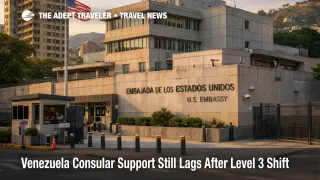
Venezuela consular support has improved on paper faster than it has improved on the ground. The U.S. State Department lowered Venezuela to Level 3, Reconsider Travel, on March 19, 2026, removed the wrongful detention, unrest, and other risk indicators, and updated the advisory to reflect a phased resumption of embassy operations. But the same U.S. guidance still says routine consular services remain suspended in Venezuela, emergency help is limited outside Caracas, and most consular work is still handled through the U.S. Embassy in Bogotá, Colombia. For travelers, that shifts the story from total freeze to cautious access, not normal support.
Venezuela Consular Support: What Changed
What improved is real, but narrow. The State Department now rates Venezuela at Level 3 instead of Level 4, and its March 19 advisory says the top line warning softened while some internal high risk zones were added or clarified. On March 30, 2026, the United States also formally reopened its embassy in Caracas, which is a diplomatic milestone and a signal that the relationship is moving out of the complete shutdown phase.
What did not return is the safety net many travelers assume comes with an embassy restart. The State Department still says routine consular services remain suspended in Venezuela, that the Venezuela Affairs Unit in Bogotá continues to serve as the remote mission, and that the government cannot provide emergency services outside Caracas. AP also reported on March 30 that restoration of the consular section was not yet complete and that people seeking passport or visa help still needed to contact the U.S. Embassy in Bogotá.
Which Travelers Still Face the Hardest Tradeoffs
This change is most relevant to dual nationals, family visitors, business travelers with controlled schedules, and companies deciding whether Venezuela can move back onto approved travel lists. Some of those trips may now reenter planning discussions because the advisory is no longer at the State Department's highest level and the embassy is no longer fully shuttered. That is a meaningful optics shift for insurers, internal travel desks, and risk managers.
The harder tradeoff appears once a trip stops going to plan. The advisory still tells travelers not to go to the Venezuela, Colombia border region within 20 miles of the border, Amazonas state, Apure state, Aragua state outside Maracay, rural areas of Bolívar state, Guárico state, and Táchira state. It also warns about crime, kidnapping, terrorism, poor health infrastructure, risky nighttime travel between Maiquetía Simón Bolívar International Airport (CCS) and Caracas, Venezuela, and unregulated taxis near the airport. That means the first order risk remains personal safety and weak emergency support, while the second order risk is that a lost passport, robbery, medical event, or transport breakdown becomes harder to solve quickly because the support chain still runs partly through Colombia.
What Travelers Should Do Before Booking or Departure
Travelers should not read Level 3 as a broad reopening signal. The practical baseline is still that any Venezuela itinerary needs to work without assuming normal in country U.S. consular help. For essential trips, that means confirmed airport transfers, tightly controlled lodging and surface transport, sufficient medication, cash and backup payment access, and insurance that clearly addresses medical evacuation and security assistance.
The next decision point is whether the trip can remain concentrated in Caracas with tightly managed logistics. Rebook or defer if the plan depends on border regions, rural movement, nighttime road transfers, same day document fixes, or the assumption that the embassy can quickly replace the support travelers would get in a more normalized destination. Proceed only when the trip is important enough to justify that reduced margin for error. Travelers who still go should enroll in STEP, share a movement plan with family or employers, and keep Bogotá, not Caracas alone, in mind as part of the fallback consular path.
Why the Advisory Improved Before Support Fully Returned
The mechanism is straightforward. A travel advisory measures overall risk and official posture, but it does not by itself rebuild consular counters, normalize health infrastructure, or restore fast response capacity across an entire country. Venezuela's advisory improved because the State Department removed several risk indicators and changed the country level, but the same official text still preserves a long list of no go areas and a narrow emergency support footprint.
What happens next depends on how quickly the consular section in Caracas is restored and whether U.S. guidance changes again to reflect normal routine services inside Venezuela. Reuters reported that the State Department described the embassy reopening as preparation for the full return of personnel and the eventual resumption of consular services, which means the process is still incomplete. Until that step happens, Venezuela remains easier to discuss than to manage when a trip fails in real time. In an earlier Adept Traveler article, Venezuela Embassy Restart Still Leaves Trip Risk, the same gap between diplomatic movement and traveler support was already visible. For background on how the warning system itself works, see Travel Advisory.