

Baghdad Security Alert Raises 48 Hour Movement Risk
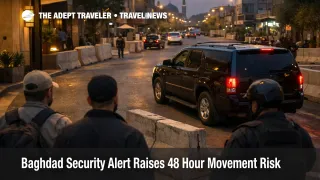
A Baghdad security alert is now a live movement problem, not just background risk. On April 2, 2026, the U.S. Embassy in Iraq warned that Iran aligned terrorist militia groups may intend to conduct attacks in central Baghdad within the next 24 to 48 hours. That narrows the practical decision window for travelers already in Baghdad, Iraq, especially business travelers, aid workers, contractors, and hosted delegations relying on hotel to meeting and hotel to airport road moves. The immediate play is to cut nonessential movement, widen transfer buffers, and treat central Baghdad routing as less predictable until the alert window passes or the embassy issues a follow up.
Baghdad Security Alert, What Changed
What changed is the timing. Iraq has been under a Level 4, Do Not Travel advisory for some time, but the April 2 embassy notice added a specific short term warning tied to central Baghdad and a 24 to 48 hour risk window. That is operationally different from a standing advisory because it pushes immediate decisions about ground movement, staffing patterns, meeting schedules, and airport transfer timing into a much tighter frame.
The broader State Department posture remains severe. The Iraq advisory, updated on March 2, says Americans should not travel to Iraq for any reason, says non emergency U.S. government employees were ordered to leave Iraq on March 2, and notes that U.S. citizens face risks including violence, kidnapping, terrorist attacks, and militia threats in major cities. It also says U.S. government personnel in Baghdad are prohibited from using Baghdad International Airport (BGW), which underscores how constrained official movement already is under the standing security posture.
For travelers still on the ground, the first order effect is tighter city movement. The second order effect is itinerary fragility. When a live alert compresses movement windows, hotel changes, client visits, compound access, domestic connections, and airport handoffs all become harder to time cleanly.
Which Travelers Face the Most Exposure
The highest exposure sits with travelers who still need to move through central Baghdad during the alert window. That includes corporate travelers with fixed meetings, aid and NGO staff moving between compounds or hotels, journalists, technical contractors, and any traveler trying to combine a central city stay with same day airport access. Travelers already in hardened compounds or in locations that do not require central Baghdad movement face a different, narrower problem, how to avoid creating new exposure through unnecessary road time.
This is also a bigger problem for travelers on tightly sequenced itineraries. Same day domestic hops, same day international departures, and any plan that assumes normal urban travel time are weaker during a time bounded alert. Even if the airport itself is operating, the vulnerable segment may be the road move to get there, not the flight once airborne. That distinction matters because many travel plans fail on access, not on the booked seat.
In an earlier Adept Traveler article, Iraq Airspace Closure Leaves Only Overland Exits explained how Iraq travel planning had already shifted toward harder exit logic under regional strain. This new Baghdad alert is narrower, but it makes short term movement inside the capital more sensitive than usual.
What Travelers Should Do Now
Travelers in Baghdad should reduce discretionary movement until the alert window passes. That means postponing nonessential meetings in central Baghdad, consolidating errands or site visits, and avoiding casual routing assumptions between hotels, offices, compounds, and dining locations. Employers and host organizations should review transport plans now, not at departure time.
Airport access needs more buffer than usual. Travelers departing from Baghdad should leave earlier than they normally would, use vetted transport arranged through employers, security providers, or trusted hosts, and assume that route changes, pauses, or longer screening at access points could eat into the journey. A same day departure can still work, but only if the ground segment is treated as the fragile part of the itinerary.
The decision threshold is simple. If a planned movement into or through central Baghdad is not essential in the next 24 to 48 hours, delay it. If a departure is essential, shorten pre departure city movement, stay close to the departure corridor when possible, keep phones charged, carry hard copies of key travel documents, and make sure a responsible contact knows the route and timing. U.S. travelers should also be enrolled in STEP and keep the State Department task force numbers accessible in case the situation shifts quickly.
Why the Alert Matters Beyond the Next Two Days
The immediate alert window is short, but it fits a wider pattern of elevated risk in Iraq and the region. State's Iraq advisory says attacks by terrorist and insurgent groups, including drone, indirect fire, and improvised explosive device threats, occur in many areas, including major cities. The State Department's April 2 Middle East notice separately told Americans in the region to follow the latest embassy security guidance and contact the 24 hour task force for travel help if needed.
What happens next depends on whether the embassy lets the alert lapse quietly, replaces it with another short term notice, or expands its guidance. Right now, the published alert points to central Baghdad, but it does not publicly identify specific neighborhoods, roads, or facilities beyond that broad area. Travelers should treat that lack of granularity as a reason to tighten movement, not as a reason to assume their route is outside the risk zone.
For business and aid travelers, the main lesson is operational. A Baghdad security alert can turn ordinary ground logistics into the weakest link of the trip with very little notice. That is why the next decision point is not whether Iraq's long term advisory changed, it did not, but whether the next 24 to 48 hours require movement that is important enough to justify the added exposure.