

Iraq Airspace Closure Leaves Only Overland Exits
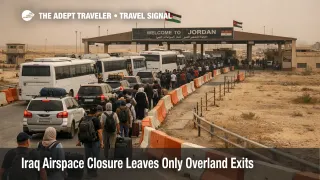
Iraq airspace closure remains an overland only traveler problem on March 25, 2026. The U.S. Embassy in Baghdad said Iraqi airspace is closed, commercial flights are not operating, and overland routes to Jordan, Kuwait, Saudi Arabia, and Türkiye remain open, with long delays expected. For travelers still in Iraq, that shifts the decision away from waiting for a flight that is not there and toward a road based exit that can actually connect to a working airport network. The practical ranking now is Jordan first, Türkiye second, Saudi Arabia third, and Kuwait last, because the border may be open while the onward air side is not equally usable.
Iraq Airspace Closure, What Changed for Travelers
The core change is not new danger inside the sky alone, it is the collapse of normal exit logic. The State Department's Iraq advisory says Americans should leave now if they are there, and the Baghdad embassy has repeatedly pointed travelers toward land routes instead of commercial flying. That means Baghdad International Airport (BGW), Erbil International Airport (EBL), and other Iraqi departure assumptions are functionally off the board until airspace reopens and airlines actually reload schedules. Waiting in Baghdad, Basra, Iraq, or Erbil, Iraq for a sudden restart is now a high risk strategy because every extra day raises hotel, transport, and documentation friction without creating a confirmed seat out.
The first order effect is obvious, no commercial air exit from Iraq. The second order effect is where trips start to break. Travelers who move overland now have to solve for driver availability, checkpoint delays, border hours, visa rules, cash, fuel, and then a second ticket from a neighboring country where fares can spike and seats can disappear. This is no longer a normal rebooking problem. It is a multi leg evacuation style movement problem with a road segment, a border segment, and then a new aviation segment.
Which Overland Exits Are Most Practical
Jordan is the strongest practical exit for most travelers because it combines an open overland route from Iraq with a functioning outbound airport at Queen Alia International Airport (AMM). U.S. Embassy guidance for Jordan says a passport and visa are required, and that visas are issued to U.S. citizens for a fee at most international ports of entry and at most international land border crossings. That does not make the road easy, but it does make the legal entry side more workable than routes that require pre arranged permission. It also gives travelers access to a capital city with a large hotel base and an airport that is still publishing active departures. In an earlier Adept Traveler article, Jordan Travel Advice Hardens Around Amman Exit Runs outlined why Amman works as a fallback even when the regional security picture is worse.
Türkiye ranks second. For U.S. travelers, the U.S. Embassy in Türkiye says ordinary passport holders are visa exempt for up to 90 days in any 180 day period, while the State Department notes that the Turkish government tightly controls entry and exit on the Iraq border. That combination matters. The visa side is easier than Saudi Arabia, but the land crossing side can still be slow and tightly managed. Istanbul Airport (IST) also remains one of the region's biggest onward hubs. The catch is that airlines have repeatedly suspended or cut Middle East flying, including Iraq linked routes, so Türkiye is best used as a border exit and long haul recovery hub, not as proof that the region is back to normal. In an earlier Adept Traveler article, Türkiye Extends Gulf Flight Halt Through March 9 Adept tracked how quickly Turkish network cuts changed fallback planning.
Saudi Arabia is third because the Baghdad embassy says roadways to Saudi Arabia are open, but Saudi entry is more document heavy. U.S. Embassy material says U.S. citizens need a valid passport and visa to enter or exit the Kingdom of Saudi Arabia, and the State Department separately warns of armed conflict risks and rigidly enforced travel bans in some cases. This route can still work, especially for travelers already near southern corridors or with Saudi permission in hand, but it is weaker as a last minute improvisation.
Kuwait is last. The reason is simple. The Baghdad embassy's March 23 alert said commercial flights are not operating out of Kuwait due to the continuing threat of missile and drone attacks. Kuwait can still matter as a land escape from Iraq itself, but it is a bad choice for travelers who need a clean same day transfer to an airport departure. Border open does not equal onward travel open.
What Travelers Should Do Now
Travelers in Iraq should stop treating air departure as the default and build an overland plan around whichever border they can legally enter and realistically reach in daylight. The strongest immediate play for many travelers is a vetted road transfer toward Jordan or Türkiye, plus a hotel and onward flight plan that can absorb a late arrival or forced overnight. This is also the point where cash, passport validity, visa status, phone charging, water, and a hard copy of bookings stop being backup items and become core exit tools.
The decision threshold is no longer subtle. If you do not already hold a confirmed, operating onward flight from a neighboring country, assume you may need one overnight near the border or in the arrival city before flying on. If you cannot lawfully enter Jordan, Türkiye, Saudi Arabia, or Kuwait, do not start the road movement until that document problem is solved. For U.S. travelers, Jordan is generally the easiest land entry among the four based on current embassy guidance, while Türkiye is often the best longer haul recovery hub when the border is passable. Saudi Arabia works better for travelers who already have a visa. Kuwait works worst if your main objective is to get airborne quickly.
Convoy logic matters too, even when officials do not use that exact word. Iraq is under a Level 4 Do Not Travel advisory, the State Department says Americans face violence and kidnapping risks, and the embassy has warned travelers to expect long delays. In practice, that means solo improvised self drive exits are a poor idea. Travelers should move with a vetted driver or operator, share route details with family, keep devices charged, and assume checkpoint friction rather than a clean highway run.
Why the Best Exit May Still Change
The mechanism here is regional, not just Iraqi. Iraq's sky is closed, but neighboring choices are also being shaped by missile threats, changing airline schedules, and uneven hub recovery. Reuters has reported that Gulf carriers are still operating below normal capacity, and that route suspensions and airspace avoidance continue to spread well beyond the immediate conflict zone. That is why a theoretically open border can still lead to an unusable airport bank, a sold out hotel market, or a much higher onward fare.
What happens next depends on two things, Iraqi airspace decisions and neighboring hub stability. If Iraq reopens airspace without a broad airline restart, the traveler benefit will still be limited. If Jordan or Türkiye keep functioning as outbound hubs, they remain the most credible exit anchors. If Kuwait's flight stoppage persists, its value stays mostly defensive, useful for getting out of Iraq, but weak for completing the full journey. In an earlier Adept Traveler article, Iraq Airspace Closure Forces Overland Exit Decisions Adept explained the original shift into land based departures. The March 25 version is narrower and more urgent, travelers should not wait for the air side to fix itself before they decide whether the road side is already their real exit.
Sources
- Security Alert - U.S. Embassy Baghdad, Iraq - March 21, 2026
- Security Alert: U.S. Embassy Baghdad, Iraq - March 23, 2026
- Iraq Travel Advisory
- Travel to Jordan and the Region
- Queen Alia International Airport Arrivals & Departures
- U.S. Citizen Services FAQs, U.S. Embassy & Consulates in Türkiye
- Turkey International Travel Information
- Saudi Arabia International Travel Information
- Security Alert - U.S. Embassy Kuwait - March 19, 2026
- Gulf airlines recover slowly as Iran conflict drags
- Airlines cancel more flights as Middle East conflict escalates