

Spain Airport Ground Strike Hits Easter Flights
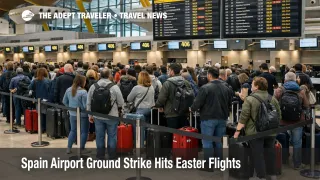
Spain airport ground strike is now an active Easter handling problem, not just a warning. Aena airport notices say Groundforce staff began indefinite partial strike action on March 30, 2026, with stoppages every Monday, Wednesday, and Friday from 500 a.m. to 700 a.m., 1100 a.m. to 500 p.m., and 10:00 p.m. to midnight. For travelers, the immediate risk is slower baggage delivery, delayed aircraft turnarounds, and thinner assistance during busy holiday banks at Adolfo Suárez Madrid-Barajas Airport (MAD), Josep Tarradellas Barcelona-El Prat Airport (BCN), Palma de Mallorca Airport (PMI), Málaga-Costa del Sol Airport (AGP), and other major Aena gateways.
Spain Airport Ground Strike: What Changed
What changed is activation inside the Easter travel window. In an earlier Adept Traveler article, Spain Groundforce Strike Hits Easter Airports, the issue was the start of the labor action. The new traveler problem is that the strike is now repeating on a published rhythm across multiple peak airports, including Madrid, Barcelona, Málaga, Palma, Alicante, Valencia, Ibiza, Gran Canaria, Bilbao, Fuerteventura, and Lanzarote, with Aena carrying live passenger notices and the transport ministry imposing minimum services.
That minimum-services framework matters, but it does not remove itinerary risk. Spain's transport ministry resolution protects different categories of flights at different levels, including full protection for emergency and certain public-interest flights, very high protection for domestic routes to and from non-peninsular territories, and lower protection for other route types. That means airports can keep operating while still running slower in the places travelers actually feel first, bag drop, ramp handling, aircraft servicing, arrivals baggage belts, and reduced recovery options once delays start stacking.
Which Easter Itineraries Face the Most Risk
The most exposed travelers are not necessarily the ones on the longest flights. They are the ones depending on a brittle same-day chain. That includes passengers checking bags on short haul flights, families moving through leisure airports with strollers and hold luggage, travelers heading onward to islands, cruise passengers flying in for embarkation, and anyone landing late and relying on a fixed transfer, hotel check in window, or separate ticket.
Madrid and Barcelona matter most because they combine scale with connection volume. Palma, Málaga, Alicante, Ibiza, Gran Canaria, Fuerteventura, and Lanzarote matter because they sit inside leisure-heavy Easter flows where alternative same-day options can narrow quickly once a delay breaks the trip. Valencia and Bilbao are smaller in holiday profile, but they can still turn a moderate baggage slowdown into a missed onward rail, car rental, or domestic connection problem.
In an earlier Adept Traveler article, Spain Airport Strike Risk Narrows, Easter Stays Exposed, the issue was whether the strike calendar had become more limited. It did. But narrower timing is not the same as low impact. Repeated stoppages that hit early departures, midday turnarounds, and late arrivals can be enough to push a manageable travel day into an overnight rebooking or a bag-miss scenario.
What Travelers Should Do Now
Travelers moving through affected Spanish airports should protect the bag plan first. If you can travel with cabin baggage only, the Spain airport ground strike becomes easier to absorb. If you must check bags, allow more time at departure, keep essentials and medication with you, and assume baggage delivery on arrival may run slower than normal during strike windows.
The next decision point is whether your itinerary depends on a short connection or a hard same-day deadline. If it does, rebooking to a longer layover, an earlier arrival, or a non-strike day can make more sense than waiting for disruption to show up at the airport. That is especially true for island flights, cruise embarkations, event tickets, and late-night arrivals where the recovery path is weak if the first leg slips.
Over the next 24 to 72 hours, monitor your airline rather than the general airport headline alone. Aena's notices make clear that Groundforce serves several airlines, so exposure is uneven by carrier and airport. Check flight status before leaving for the airport, watch for baggage advisories, and treat Monday, Wednesday, and Friday as higher-friction operating days until the dispute is resolved or the strike pattern changes.
Why the Disruption Can Spread Beyond One Delay
Ground handling labor action spreads through travel because it sits under the visible part of the trip. When baggage loading, unloading, ramp service, and aircraft turnaround slow down, the runway can remain open while the passenger experience still degrades. The first order effect is operational drag at the stand, gate, and baggage system. The second order effect is schedule drift, missed onward transport, longer landside queues, and weaker same-day recovery once later flights inherit earlier delay.
That is why Easter raises the stakes. Peak holiday banks reduce slack. Leisure airports carry more checked bags, more family groups, and more passengers with lodging, ferry, cruise, or car-rental commitments that are harder to reset on short notice. Reports from the first live strike day already pointed to delays and baggage disruption at some airports, which is exactly the pattern travelers should expect when minimum services keep the system running but not necessarily running cleanly.
What happens next depends on whether negotiations shorten the dispute or whether repeated strike days continue deeper into Holy Week and the Easter peak. For now, the Spain airport ground strike is serious enough to justify buffer time, simpler bag choices, and less faith in tight same-day chains.
Sources
- Aena, Adolfo Suárez Madrid-Barajas Airport passenger notice
- Aena, Josep Tarradellas Barcelona-El Prat Airport passenger notice
- Aena, Málaga-Costa del Sol Airport passenger notice
- Aena, Palma de Mallorca Airport passenger notice
- Aena, Ibiza Airport passenger notice
- Ministry of Transport and Sustainable Mobility, minimum services resolution for the Groundforce strike
- EL PAÍS, first live Groundforce strike day caused delays and baggage disruption