

Spain Airport Strike Risk Narrows, Easter Stays Exposed
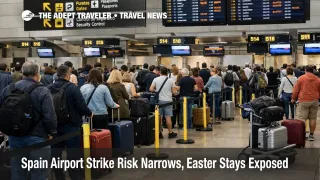
Spain airport strike risk changed on March 27, 2026, but it did not clear. The first Groundforce stoppages due March 27 to March 29 were suspended before they started, yet Aena airport notices still warn that Groundforce staff began indefinite partial strike action from March 30, with repeated stoppages on Mondays, Wednesdays, and Fridays. For Easter travelers, that shifts the decision from broad preemptive rerouting to more targeted protection against baggage delays, slower boarding, and weaker connection recovery on the remaining strike days.
Spain Airport Strike Risk: What Changed
The key update is narrower timing. In an earlier Adept Traveler article, Spain Airport Easter Strikes Shift to March 30, the main traveler takeaway was that March 27 to March 29 had been lifted, while the larger Groundforce labor action remained in place. Aena is now posting live airport notices that Groundforce stoppages are called from March 30, with partial walkouts from 500 a.m. to 700 a.m., 1100 a.m. to 500 p.m., and 10:00 p.m. to midnight on Mondays, Wednesdays, and Fridays, and it is telling passengers to check with their airline.
That means the old blanket warning is no longer the best planning frame. Travelers flying on non strike days may not need to change plans just because of the headline alone. But travelers moving through Spain on the active Groundforce pattern, especially during Holy Week buildup, still face meaningful handling friction because baggage loading, unloading, and aircraft turnaround do not need a full cancellation wave to break a tight itinerary. On March 30, Spanish reporting said the first live strike day produced delays of roughly 40 to 70 minutes in some airports and baggage belt problems in Madrid and Barcelona.
Which Travelers Still Face The Most Disruption
The most exposed travelers are the ones who rely on normal ground handling speed rather than simply a seat on the aircraft. That includes passengers checking bags, travelers making short same day connections, island itineraries that depend on precise onward timing, and people with fixed hotel, cruise, rail, or private transfer commitments after landing. Even when flights operate, slower handling can turn a nominally on time trip into a missed bag, a late arrival, or a broken onward chain.
The airport footprint also matters. El País reported the Groundforce dispute covers 12 Aena airports, including Madrid, Barcelona, Alicante, Valencia, Málaga, Bilbao, Palma de Mallorca, Ibiza, Las Palmas, Tenerife, Lanzarote, and Fuerteventura. Aena's airport notices confirm the strike pattern at affected stations, but impact is uneven because Groundforce does not handle every airline at every airport. Spanish reporting from the first live day said some disruption concentrated on carriers such as Air France, KLM, Lufthansa, DAP, Wizz Air, and some charter operations, while other airlines were less exposed.
What Travelers Should Do Now
For most travelers, the practical move is not automatic rebooking. It is to protect the parts of the trip that Groundforce can break first. On active strike days, checked bags are the weakest link, so travelers who can travel with cabin baggage only should seriously consider it. Anyone keeping a short connection in Spain should also add buffer where possible, because the main failure mode is not only a delayed departure, it is baggage not making the same connection or arriving late enough to undermine the next segment.
The clearest threshold for changing plans is a same day onward commitment that cannot absorb delay. If you are connecting to an island flight, a cruise embarkation, a timed tour, a train with limited later options, or a nonrefundable late arrival, waiting for the airport to "probably be fine" is a weak strategy on a Monday, Wednesday, or Friday strike window. If your trip is a nonstop with no checked bag and no hard arrival deadline, monitoring airline status may be enough. Aena's own advice remains to check directly with the airline, which is the right operational trigger because exposure varies by handler and carrier.
Why The Easter Risk Remains Live
Ground handling disputes spread through travel in a specific way. Ramp and baggage work sit close to the aircraft turn, so even limited staffing pressure can slow bag loading, unloading, boarding support, and dispatch rhythm without producing a clean cancelation pattern. That is why minimum service rules in Spain reduce the odds of total collapse, but do not preserve normal recovery speed once the day starts slipping. The result is a narrower, more targeted risk than the original warning suggested, but it is still a live Easter problem for brittle itineraries.
What happens next depends on whether negotiations narrow the dispute further or whether repeated strike days stack into busier Easter flows. Right now, the confirmed facts are that March 27 to March 29 were lifted, Groundforce stoppages began from March 30, and Aena is still warning passengers to confirm flight status with airlines. In an earlier Adept Traveler article, Spain Groundforce Strike Hits Easter Airports, the issue was activation. The update now is that scope is narrower than the broadest warning, but the remaining strike calendar still matters enough that travelers should treat checked bags and tight connections as the first things to fix.