

Ethiopia Advisory Adds Exit Ban, Outage Risk
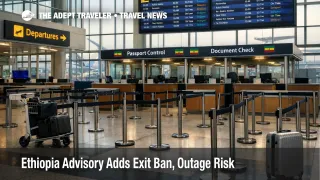
Ethiopia travel advisory guidance became more operationally difficult on April 1, 2026, when the U.S. State Department kept Ethiopia at Level 3 but added exit bans and communications disruptions to the national risk picture. For travelers, that means a trip can now fail even when a road, checkpoint, or airport appears open, because the breakdown may happen through paperwork, telecom outages, or a sudden inability to confirm onward movement. The practical result is a lower tolerance for complex overland plans, remote work trips, and tight domestic to international handoffs through Addis Ababa Bole International Airport (ADD). Travelers who still need to go should simplify itineraries, protect communications redundancy, and avoid assuming that nominal access equals reliable exit.
Ethiopia Travel Advisory: What Changed
The State Department's April 1 advisory did not raise or lower Ethiopia's overall advisory level. It remained Level 3, Reconsider Travel. What changed was the "other" risk indicator, which now explicitly includes exit bans and communication disruptions, and the summary now says travelers should reconsider travel due to unrest, crime, kidnapping, terrorism, landmines, communications disruptions, and exit bans. The same advisory continues to list Tigray, Afar, Amhara, Gambella, Benishangul Gumuz, and specific areas of Oromia as places U.S. travelers should not visit.
That looks like a small wording revision, but it is not a cosmetic edit. An exit ban risk means a traveler can become stuck at departure, border, or administrative checkpoints despite holding a ticket or an otherwise legal itinerary. A communications disruption risk means phone, mobile data, or internet failures can break airline contact, hotel coordination, driver dispatch, tour support, or insurance case handling exactly when a trip needs to be rebuilt. Those are different failure modes from the more familiar model of a trip failing only because of fighting, airport closure, or a blocked road.
Which Travelers Face the Most Exposure
The highest exposure is not evenly spread across Ethiopia. Travelers whose plans stay inside Addis Ababa, Ethiopia, with direct airport transfers and no regional overland legs still face risk, but they are operating in a different environment from travelers bound for Amhara, Tigray, Gambella, Benishangul Gumuz, Afar, or conflict affected parts of Oromia. Canada's current advisory still excludes Addis Ababa from its broader avoid non essential travel warning and instead places the capital under a high degree of caution, while warning that consular assistance is limited in some regions and that telecom disruptions, roadblocks, and curfews can occur across the country.
The most exposed traveler profiles are business visitors with meetings outside the capital, tour clients using long road segments, NGO and field teams working near regional borders, and anyone relying on multi step domestic connections that need local confirmation. These trips are more fragile because one failed call, one dead data connection, or one unexpected restriction can break a sequence of transport, hotel, and air arrangements that would be easy to repair in a more stable system. In an earlier Adept Traveler article, Tigray Flights Suspended, Ethiopian Cancels Mekelle showed how quickly access to northern Ethiopia can narrow when domestic air links drop. In another earlier Adept Traveler article, Marburg Outbreak In South Ethiopia Hits Omo Tours documented how road controls and communications issues were already complicating travel outside core gateway corridors.
What Travelers Should Do Now
Travelers who must go should strip the itinerary down to the fewest possible moving parts. That means favoring nonstop international arrivals and departures where possible, using cancellable lodging in Addis Ababa for the first and last nights, keeping a printed and offline copy of passports, visas, hotel addresses, and flight details, and making sure at least one contact method works without live mobile data. A second phone, an eSIM plus a local SIM, offline maps, and written driver and hotel contacts are no longer optional nice to haves on higher risk Ethiopia trips.
The next decision point is whether the trip truly requires regional movement. If the purpose can be handled in Addis Ababa, that is the lower risk version of the trip. If it depends on road travel, border proximity, or same day domestic connections, the threshold to postpone should be much lower. Travelers should also confirm what their insurer covers before departure, especially for delays tied to civil unrest, communications failure, or an inability to leave a region on schedule. Waiting until a trip has already started to check those terms is too late.
For the next 24 to 72 hours before departure, the useful signals are not only whether the airport is open. The more important signals are whether advisories change again, whether carriers are operating domestic links normally, whether local contacts can be reached consistently, and whether your regional destination is reporting checkpoints, curfews, or reduced telecom service. If those inputs are unstable, a published schedule is not enough proof that the itinerary is viable.
Why the Risk Picture Has Become More Complex
The mechanism here is straightforward. Ethiopia's travel system risk is no longer only about where violence is concentrated. It is also about whether the systems that let travelers move, communicate, prove status, and depart still work reliably enough to support a normal itinerary. When governments start naming communications disruptions and exit bans in a national advisory summary, they are signaling that the failure can happen in the coordination layer, not just the conflict layer. That widens the planning problem from pure security geography into trip resilience.
What happens next will probably depend on whether the advisory language remains stable or starts broadening into more specific operational warnings. The U.K. Foreign, Commonwealth and Development Office already says all of Tigray should be avoided after renewed violence, while Canada continues to warn that the situation can deteriorate without warning and that roadblocks, curfews, and telecom disruptions are possible. That combination points to a country where the capital can still function as a gateway, but regional reliability can degrade faster than travelers are used to seeing on ordinary business or leisure trips. For now, the serious planning mistake is treating an unchanged Level 3 headline as proof that nothing materially changed. The headline stayed the same, but the trip failure modes did not.