

Nigeria Airport Security Alert Changes Departures
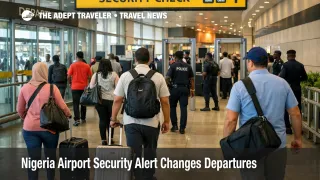
A Nigeria airport security alert has changed the departure playbook without shutting airports. On April 2, 2026, the U.S. Embassy in Nigeria told travelers leaving the country to move quickly to security screening and into the secure airport area, while the State Department's standing Nigeria advisory continues to warn that transportation hubs and other crowded public places can be targeted with little or no warning. For travelers, the practical shift is clear, curbside and pre security waiting now carry more downside than usual. The smarter move is to shorten landside time, tighten transfer timing, and avoid treating the public side of the terminal as a place to linger.
Nigeria Airport Security Alert, What Changed
What changed is behavior, not airport status. The embassy alert did not say Nigerian airports were closed or that flights were broadly suspended. It told departing travelers to move quickly through the public side of the terminal and into the screened area, and to watch for suspicious items. That makes this more operationally useful than a generic destination warning, because it changes what travelers should do on departure day, especially at major commercial airports managed by the Federal Airports Authority of Nigeria.
That distinction matters because many trips fail before the gate, not after it. A published ticket can still be valid while the weakest part of the itinerary becomes the handoff between hotel, driver, curbside, check in, and security. In Nigeria, the broader State Department posture remains serious. The current advisory keeps the country at Level 3, Reconsider Travel, says all locations carry significant security risks, and notes that terrorists may target transportation hubs and other public gathering points.
Which Travelers Need a Different Airport Routine
The travelers most affected are people who normally build extra social or logistical time outside the checkpoint. That includes families waiting for late arriving companions, business travelers meeting drivers or hosts at the curb, travelers using escorts or informal porters, and anyone connecting from a domestic segment to an international departure who assumed the landside side of the airport was a safe buffer zone. The first order effect is less landside dwell time. The second order effect is more pressure on pickups, drop offs, and terminal coordination, because the old habit of waiting outside no longer fits the embassy's guidance.
This also complicates meet and greet routines. If one traveler plans to stay outside until the rest of a group arrives, or a hotel car expects a slow curbside handoff, the safer default now is to compress that exchange. Travelers should expect more value from pre arranged communications, named pickup points, and live phone contact before arrival at the terminal. In an earlier Adept Traveler article, Baghdad Security Alert Raises 48 Hour Movement Risk showed the same underlying lesson in a different setting, the vulnerable part of a trip is often the ground segment and access routine, not the aircraft seat itself.
What Travelers Should Do Now
Travelers departing Nigerian airports should still add time, but use it differently. The goal is not to arrive late. The goal is to arrive with enough margin to clear check in and screening without turning the public side of the terminal into an extended waiting room. For most travelers, that means confirming airline check in requirements in advance, using a driver who understands the departure terminal, finishing fare or hotel transfer questions before arrival, and keeping documents ready so the move from curb to screening is continuous rather than improvised.
For drivers and hosts, the adjustment is simple but important. Drop offs should be tighter, escorts should end earlier unless airport procedures require them to continue, and pickups should rely more on post landing communication than on long public waits near terminal access points. Domestic to international handoffs deserve extra caution, because a missed call, bag delay, or slow landside reunion can create exactly the kind of exposure the embassy is telling travelers to reduce.
The decision threshold is practical. If your plan requires long curbside waiting, a slow handoff of cash or documents, or a casual reunion outside security, change the plan. If your departure is fixed, leave enough time for airport formalities, but aim to complete the exposed part of the process quickly. Travelers who want broader context on how official warnings work can also review Adept Traveler's Travel Advisory explainer before departure.
Why This Matters Beyond One Alert
The alert is narrow, but it fits a wider Nigerian risk picture rather than standing alone. The State Department advisory says violent crime, kidnapping, civil unrest, and terrorism remain live concerns, and specifically notes that terrorists may target hotels, schools, government buildings, transportation hubs, and other places where crowds gather. The embassy's airport instruction should be read as a practical translation of that broader environment into one concrete traveler behavior, spend less time in exposed public airport space.
What happens next depends on whether the embassy updates, extends, or lets the alert fade without replacement. For now, travelers do not need to read this as an airport closure story. They should read it as a Nigeria airport security alert that changes departure discipline. That means faster transitions from curbside to screening, less dependence on public side waiting, and more deliberate coordination with drivers, hotels, and companions before arrival at the terminal.