

Qatar Doha Flights Expand, but Hub Risk Persists
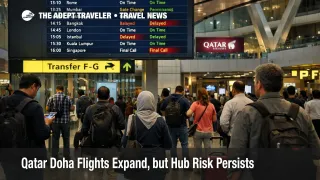
Qatar Doha flights are becoming more available again, but the latest Qatar Airways schedule update still does not amount to a normal transfer hub. The airline said on April 1, 2026 that it had published a revised schedule reflecting a gradual increase in flights to and from Doha to more than 120 destinations by mid May 2026, while stressing that all flights continue to operate through dedicated corridors coordinated with the Qatar Civil Aviation Authority and remain subject to change or cancellation. For travelers, that means the network is broadening, but connection resilience is still weaker than a normal Doha operation. The high level move is simple, confirm the ticket, protect margin, and do not treat a published itinerary as proof that the wider trip is safe yet.
Qatar Doha Flights: What Changed
What changed is scale. Qatar Airways had previously been working through narrower, time boxed revisions, including a March 26 update that added frequencies to more than 90 destinations through April 15, 2026. The newest update pushes beyond that, with the carrier now saying its revised schedule builds toward service to more than 120 destinations by mid May 2026. That is a real operational improvement, and it gives more travelers a usable path through Hamad International Airport (DOH), Doha, Qatar.
The important limit is still in the fine print. Qatar Airways is continuing to tell passengers not to go to the airport unless they hold a valid confirmed ticket, and it is still warning that flights can change or be canceled for operational, regulatory, safety, or other reasons beyond its control. Airlines do not use that language when hub operations are back to routine bank depth and normal fallback capacity. This is a restoration story, but it is still a constrained restoration story.
In an earlier Adept Traveler article, Qatar Doha Timetable Stays Tight Through April 15, the main warning was that a published timetable and a dependable transfer hub were not the same thing. This new update improves the first part more than the second.
Which Travelers Gain the Most, and Who Still Faces Risk
The biggest beneficiaries are travelers whose entire trip sits on one Qatar Airways ticket and whose destination is now back inside the expanded operating map. They gain more frequency, more reach, and a better chance that the original trip can be preserved without a full rebuild. Travelers who were shut out by the narrower March schedules may now find their route has reappeared, or has enough added service to become practical again.
The higher risk group is anyone using Doha as a precision connection point. That includes business travelers with fixed meetings, cruise passengers joining a ship on a hard embarkation day, travelers on separate tickets, and anyone protecting a last flight of the day onward sector. A hub can look busy and still be fragile. If the inbound runs late, the real question is not whether the route exists, but how many same day fallback seats, backup banks, and reaccommodation options still exist inside the constrained system. That is where reduced hub resilience shows up first.
The broader corridor picture also matters. In an earlier Adept Traveler article, Europe Asia Flight Corridors Tighten as Risks Spread, the pressure point was not just flight cancellations, but the fact that fewer safe air routes were carrying more traffic. Doha's dedicated corridor model helps keep flights moving, but it also means the network is still operating inside a managed environment rather than a fully normalized one. That raises the odds that a single delay can cost more than usual.
What Travelers Should Do Now
Start with booking status, not hope. If you already hold a confirmed booking, check the Qatar Airways app or website now, confirm your contact details, and wait for the carrier's updated flight information if your route is included in the revised schedule. Do not go to the airport unless the ticket is valid and confirmed, because Qatar Airways is still repeating that instruction in its live travel alerts.
The main decision threshold is whether you are protecting the flight or the whole itinerary. Waiting can make sense when you are on one Qatar Airways booking, your arrival time is flexible, and a later departure would not break the trip. Rebooking, refunding, or rerouting makes more sense when a missed arrival would trigger a lost cruise, a nonrefundable hotel, a tour departure, or a separate onward ticket. Qatar Airways says travelers with confirmed bookings dated from February 28 through June 15, 2026 remain eligible for complimentary date changes on Qatar Airways operated flights up to October 31, 2026, subject to availability and fare seasonality, or for a refund of the unused ticket value. The airline also says refunds may take up to 28 working days.
For travelers still deciding whether to book new Doha connections, longer layovers are the smarter tradeoff for now. The network is clearly stronger than it was in early March, but not yet proven as a fully forgiving hub again. Treat same day onward plans with extra caution, especially when the itinerary depends on a short layover or there is no easy alternative airport at the far end.
Why the Network Is Improving, but Not Fully Normal Yet
The mechanism is straightforward. Qatar Airways is rebuilding the map in stages, first by restoring reach, then by deepening frequency. That helps travelers move again, but it does not instantly restore the slack that makes a global hub resilient. Slack is what protects connections when an inbound is late, an aircraft swaps, or a departure bank compresses. In a managed corridor environment, the route may be operating, but the recovery room around it can still be thin.
What happens next depends on whether Qatar Airways moves from schedule expansion to more durable operational depth. The signals to watch are clear, another network revision, any change to the June 15 waiver window, and any official sign that corridor limits are loosening rather than merely being worked around. Until those conditions change, Qatar Doha flights are more usable than they were a few weeks ago, but they still require a tighter planning standard than travelers would normally apply to one of the world's biggest connection hubs.