

Europe Asia Flight Corridors Tighten as Risks Spread
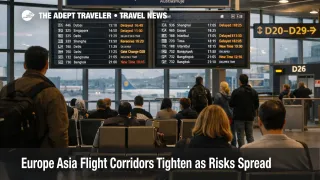
Europe Asia flight corridors tightened again on March 30, 2026, after Europe's aviation safety regulator warned that the Iran war, the Russia Ukraine war, and fighting between Pakistan and Afghanistan are forcing more traffic into narrower fallback paths over Azerbaijan and Central Asia. For travelers, the change is bigger than another round of route suspensions. It means the backup map itself is getting more crowded, which raises the odds of longer routings, delay padding, and harder recovery when a flight runs late or an onward bank is missed.
Europe Asia Flight Corridors: What Changed
What changed is the nature of the risk. Earlier disruption coverage focused on which flights were canceled or which Middle East airspace blocks remained closed. EASA Executive Director Florian Guillermet said on March 30 that airlines are now being forced into "ever tighter corridors," notably over Azerbaijan and Central Asia, and that concentrating traffic on less usual routes can itself generate safety risks. Reuters also reported that EASA renewed its warning against flying over Iran, Israel, and parts of the Gulf, while EASA's current conflict zone bulletin remains active through April 10, 2026.
That makes this a structural network problem, not only a closure problem. When safe airspace shrinks, the flights that still operate have to share fewer usable paths, often with longer detours and less slack built into the day. In earlier Adept Traveler articles, Europe Middle East Flight Cuts Stretch to October tracked the direct suspension side of the crisis, while Jet Fuel Price Shock Hits Global Travel Planning showed how thinner operating margins were already pushing airlines toward higher fares and weaker recovery buffers.
Which One Stop Travelers Face the Most Risk
The most exposed passengers are not only people flying to the Gulf. They are one stop travelers moving between Europe and Asia on itineraries that depend on precise bank structures, short connections, or one daily long haul departure. If the first leg arrives late after a longer reroute or traffic management slowdown, the second problem is not just a missed connection. It is that replacement options may already be tighter because more carriers are competing for fewer viable corridors.
This pressure falls hardest on passengers routing through major connecting systems rather than flying nonstop. Crew legality can tighten on longer sectors, aircraft rotations become harder to protect, and a single late inbound can spill into the next wave of departures. Travelers starting in secondary European cities, or connecting onward to smaller Asian destinations with only one or two daily frequencies, have less margin than passengers booked on dense trunk routes. That is also why the corridor squeeze can show up as a long rebooking line or forced overnight far from the original conflict zone.
What Travelers Should Do Now
Travelers with Europe to Asia trips in the next 72 hours should treat connection time as a risk decision, not a convenience choice. A tight legal connection that normally works may no longer be a smart bet if the trip depends on airspace skirting the Gulf, the Caucasus, or Central Asia. The safest move is extra buffer on one stop itineraries, especially where the onward flight runs only once a day. Passengers should also watch for schedule changes that quietly add block time, because that is often the first sign an airline is padding around persistent corridor pressure.
Rebooking early makes more sense when the itinerary includes a fragile onward connection, an important event on arrival, or limited same day alternatives. Waiting can still work for flexible trips, but only when the carrier has multiple later departures or a strong partner network. Travelers using India linked or Gulf adjacent routings should be especially cautious, because Pakistan related airspace restrictions and Middle East conflict pressure can compound on the same east west trip.
Over the next 24 to 72 hours, the main signals to monitor are fresh airspace notices, further airline block time changes, and any additional airport disruption tied to drones near European airports. Reuters reported that airports from Stockholm to Munich have faced drone related disruption concerns, which matters because a crowded fallback system becomes harder to absorb even short local interruptions.
Why the Corridor Squeeze Is Harder to Fix
The mechanism is straightforward, but the consequences stack fast. EASA's official bulletin says the affected Middle East airspace remains vulnerable to spillover risks, misidentification, miscalculation, and interception failures. Airlines respond by avoiding the highest risk zones, but the traffic does not disappear, it compresses into the remaining usable lanes. Once that happens, every extra detour burns more fuel, uses more crew time, and reduces the spare resilience that normally helps airlines recover from weather, congestion, or a late inbound aircraft.
This is also why the next phase is unlikely to be a clean return to normal. Even if there are no new closures, the system remains vulnerable while conflict risk stays elevated and fallback corridors keep carrying abnormal volume. EASA said it will keep monitoring whether risk for EU aircraft operators rises or falls as the threat picture evolves. Until that changes, Europe Asia flight corridors are likely to stay slower, less forgiving, and more expensive to repair after disruption than travelers were used to before late February.
Sources
- Exclusive: European aviation body eyes safety risks as conflict squeezes flight corridors, Reuters
- Airspace of the Middle East and Persian Gulf, EASA
- Europe Middle East Flight Cuts Stretch to October, Adept Traveler
- Jet Fuel Price Shock Hits Global Travel Planning, Adept Traveler
- India Airline Fare Caps Face Fresh Pressure, Adept Traveler
- Teruel Aircraft Parking Shows Recovery Still Strained, Adept Traveler