

Norway Trondheim to Bodø Rail Disruption Persists
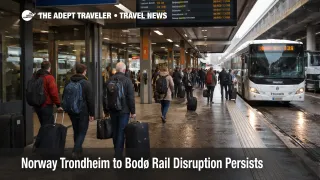
Northbound Norway rail planning is still operating under a broken long distance pattern, not a short lived service hiccup. The Trondheim to Bodø rail disruption remains active on April 6, 2026, with Eurail warning that construction works and landslides continue to affect the corridor, bus replacements are still in place, and the end date tied to the Levanger area damage remains unknown. For travelers using the Nordland Line to reach Bodø, ferries, or onward northern Norway connections, the practical move is to treat this as a bus plus rail journey that can run late, not as a clean scenic train ride that merely has a minor timetable adjustment.
Trondheim to Bodø Rail Disruption: What Changed
What has changed is not only that buses are replacing trains, but that the corridor is still operating without a firm restoration date on the damaged southern section. Eurail says train traffic is fully replaced by buses following a landslide near Levanger and that accurate timetable data on its own platform is not available, pushing travelers to Norway's national planner, Entur, for real journey planning. SJ Norge separately says the Nordland Line is partially closed after a landslide between Åsen and Levanger affected both the railway and the E6, and that the timeline for a full reopening remains uncertain.
The service pattern is also less intuitive than a simple one for one coach substitution. SJ's current Nordland Line timetable shows rail replacement buses operating between Trondheim and Steinkjer for key through departures, while some northbound and southbound long distance services continue beyond that break. The same timetable also states that the night train remains canceled until the line between Levanger and Åsen is repaired. That removes one of the route's most useful itinerary shapes, an overnight northbound or southbound run that preserves daytime sightseeing or onward ferry timing.
Which Travelers Face the Most Disruption
The travelers most exposed are not only rail pass users. Independent travelers building a Trondheim to Bodø rail trip into a larger Norway itinerary are vulnerable because the replacement pattern weakens certainty on a route that often feeds timed decisions later in the day. That includes Bodø ferry connections, overnight hotel arrivals, same day regional transport, and onward planning toward the Lofoten area or other northern gateways.
Travelers using Eurail or Interrail are especially exposed if they rely on pass planner data alone. Eurail explicitly says accurate timetable data is not available on its own website for this disruption and directs travelers to Entur instead. That matters because a long scenic corridor with bus insertion can break in small but expensive ways, a missed same day ferry, a late hotel check in, or an extra overnight in Trondheim, Steinkjer, or Bodø if the chain slips.
There is also a broader fit problem for travelers who picked this route for comfort and experience, not only transport. Visit Norway still markets the Nordland Railway as one of the country's flagship long distance scenic trips, but it now says replacement buses will run on the stretch between Mo i Rana and Trondheim until summer 2026 and that night trains remain canceled until further notice. In practical terms, the journey still works, but it no longer delivers the same product that many travelers expect when they book a long Norwegian rail crossing.
What Travelers Should Do Now
The safest planning strategy is to rebuild the trip around the weakest link, not the headline destination. Start with Entur or SJ for the actual operating pattern on your date, then add a larger buffer than usual at Bodø if you are connecting to ferries, tours, or non refundable lodging. On this corridor, the main risk is not usually total trip collapse, but late running that strips away the margin you thought you had.
For same day connections, treat bus to rail or rail to bus transfers as high risk if the onward leg is fixed and expensive to miss. A through ticket helps, but it does not remove the operational reality that a coach replacement on a long route is more exposed to road conditions, loading delays, and uneven handoffs than a continuous train. If your trip depends on being in Bodø at a precise hour, arriving the night before is the cleaner plan.
For travelers comparing alternatives, the next decision point is whether the scenic rail experience is still worth the tradeoff. If the train itself is the point of the trip, waiting until the line is more fully restored may be smarter. If Bodø or northern Norway is the real goal, a flight, a split itinerary, or an overnight stop en route may protect the trip better than forcing a tight same day rail connection.
Why the Corridor Is Still Fragile, and What Happens Next
The mechanism here is straightforward. This is not a single timetable edit but a corridor resilience problem. A landslide between Åsen and Levanger damaged both railway and highway infrastructure, and long distance services now have to work around that break with replacement transport and revised operating patterns. Once a long route loses a continuous track path, the disruption spreads outward, first into journey time and schedule confidence, then into hotel, ferry, and onward transport reliability.
What happens next is still uncertain. Eurail says the end date for the full bus replacement tied to the Levanger disruption is unknown, while Visit Norway points to replacement bus operations on the Trondheim to Mo i Rana stretch until summer 2026. Those statements do not conflict so much as they show a corridor that is running under temporary solutions rather than a firm restoration calendar. Travelers should assume more timetable revisions are possible and verify details again shortly before departure, especially for night travel and connection heavy itineraries.
Travelers stitching together a wider European rail journey should also keep an eye on Europe Transport Strike Dates 2026 for Flights and Trains, because a fragile Norway segment becomes harder to recover when the backup options elsewhere in the network are also under pressure.