

Schengen EES Goes Fully Live on April 10
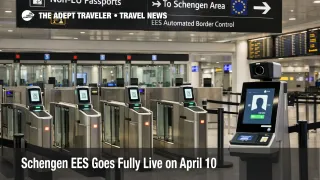
Europe's Entry Exit System reaches full operation on April 10, 2026, ending the six month patchwork rollout and making biometric border checks the standard process for eligible non EU short stay travelers at all participating external border crossing points. That changes the practical planning problem. The main risk is no longer uncertainty about whether a given airport or port has switched on EES, but longer first entry processing at the Schengen border, especially where travelers are arriving on long haul flights, ferry routes, or international rail services and still need to make an onward connection. For trips built on tight same day margins, the safer move now is more buffer, not more optimism.
Schengen EES Border Checks: What Changed
The European Commission says the Entry Exit System, or EES, began operations on October 12, 2025, with a progressive rollout across 29 European countries, and becomes fully operational on April 10, 2026. From that date, manual passport stamping gives way to digital records of entry, exit, and refusals of entry for eligible non EU travelers coming for short stays. The system records travel document data, the time and place of border crossings, and biometric data including a facial image and fingerprints.
In practical terms, the added friction is concentrated at first registration. The official EU traveler guidance says passport control officers will take a photo of your face and or scan your fingerprints, and that this process can be longer than a regular border check. Once the data is already in the system, later crossings should be more about verification than full first time enrollment, which is why the biggest timing risk sits on the first Schengen entry point in an itinerary, not necessarily on every later movement inside the area.
Which Travelers and Routes Face the Most Exposure
EES applies to non EU nationals entering the 29 participating countries for short stays of up to 90 days within a 180 day period, whether they need a short stay visa or are visa exempt. The participating countries are Austria, Belgium, Bulgaria, Croatia, Czechia, Denmark, Estonia, Finland, France, Germany, Greece, Hungary, Iceland, Italy, Latvia, Liechtenstein, Lithuania, Luxembourg, Malta, the Netherlands, Norway, Poland, Portugal, Romania, Slovakia, Slovenia, Spain, Sweden, and Switzerland.
The highest exposure is on itineraries where the first Schengen touchpoint is also a connection point. That includes long haul arrivals connecting onward by air after passport control, Eurostar style or other international rail journeys that cross into the Schengen area, and ferry arrivals where travelers have fixed onward train, flight, or hotel timings. The second order problem is straightforward. A longer border queue does not stay a border queue. It turns into missed flights, missed trains, broken same day transfers, and extra hotel nights near gateway cities when the onward leg leaves without you.
Not every traveler is covered. The EES does not apply to nationals of the participating European countries, or to Cyprus and Ireland nationals, and it also excludes several other categories such as holders of residence permits or long stay visas. Travelers who remain entirely in the international transit area of a European airport are also not registered in EES for that transit country. That distinction matters because an airside transit with no entry into Schengen is a very different risk profile from an itinerary that clears immigration and then continues onward.
What Travelers Should Do Before April 10 Trips
For air itineraries, the safest threshold is to avoid short post immigration connections on the first entry into Schengen. If a trip lands from outside Schengen and then continues on a separate short haul ticket, a regional flight, or a same station rail transfer, travelers should build enough time to absorb first time biometric registration plus ordinary arrival delays. The exact queue time will vary by airport and staffing, but the official guidance already warns that the enrollment step can run longer than a regular border check, which is enough to make aggressive connection planning a bad bet around the full launch.
For rail and ferry travelers, the key question is where first registration actually happens. The EU's own app guidance tells travelers to select the country where they will first cross the external border of a European country using EES. That means the first border control point, not the final city on the ticket, is where the friction enters the itinerary. If that first crossing sits before a timed rail seat, a nonrefundable hotel arrival window, or a same day domestic connection, travelers should widen the buffer or shift the onward segment to a later departure.
There is also a partial mitigation, but it is not universal. The Travel to Europe mobile app lets eligible non EU travelers pre register passport data and a facial image within 72 hours before travel, but the app does not replace border checks and country support remains limited. The latest official FAQ says Sweden currently supports passport data, facial image, and an entry questionnaire, while Portugal currently supports the entry questionnaire. That is useful for some travelers, but it is not a systemwide fix for April 10 queue risk.
Why April 10 Matters More Than the Rollout Phase
The significance of April 10 is that it removes the last operational ambiguity. During the phased launch, travelers could still encounter mixed procedures depending on where they crossed the Schengen external border, and passports could continue to be stamped in places not yet fully switched over. From April 10, the EU position is that EES is fully operational at all external border crossing points in the participating countries. That turns EES from a growing possibility into a fixed border condition for short stay non EU travel to Schengen.
The wider context also matters. EES is separate from ETIAS. ETIAS is the future travel authorization system for visa exempt visitors, but the EU says ETIAS will start in the last quarter of 2026. So the April 10 issue is not a new pre trip permit. It is the hardening of border processing itself, with biometric enrollment and digital entry exit records replacing stamps. Travelers who confuse the two may prepare the wrong way, looking for paperwork fixes when the real planning problem is time at the first border.
In an earlier Adept Traveler article, Europe EES Border Queue Risk Hardens Before April 10 the core warning was that queue pressure was becoming an Easter era planning issue. The new fact now is finality. April 10 is no longer an expected deadline, it is the confirmed point when the full Schengen EES border checks regime takes effect across participating external borders. Travelers with April and early season Europe itineraries should now treat first entry timing as a concrete itinerary design issue, not a background policy note.
Sources
- The Entry/Exit System Will Become Fully Operational on 10 April 2026
- Entry/Exit System (EES), Travel to Europe
- How Will the EES Work? What Is New During the Border Checks?
- FAQs About EES
- Travel to Europe Mobile App
- Travel to Europe EES Leaflet PDF
- What Is ETIAS?
- Europe EES Border Queue Risk Hardens Before April 10