

Europe EES Border Queue Risk Hardens Before April 10.
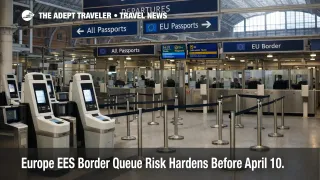
Europe EES border queues are moving from a phased rollout problem into a fixed Easter planning risk. The EU says the Entry Exit System, or EES, began operating on October 12, 2025, and becomes fully operational on April 10, 2026, replacing passport stamps with digital records and biometric capture for short stay non EU travelers. That matters most now for first time arrivals into the Schengen area, and for any itinerary with a short rail, ferry, or flight connection after border control. Travelers should treat the next several days as a tighter buffer period, not as business as usual.
Europe EES Border Queues: What Changed
The biggest correction is timing. April 10, 2026 is not the start of EES. It is the end of the six month phased deployment window, after which the system is expected to be fully operational across the 29 European countries using it. The checks apply to non EU nationals visiting for short stays, with facial image, fingerprint, and passport data recorded in the system.
Operationally, that means an extra processing step is no longer limited to scattered border points or partial rollout conditions. Border officers now have less room to fall back on old stamping routines as the standard process. A few added minutes per first time traveler can compound into long queues at busy arrival banks, ferry sailings, and pre departure rail processing windows, especially as Easter volumes rise. In an earlier Adept Traveler article, Europe EES Border Checks Replace Passport Stamps the final phase date was already clear. What is changing now is the operational pinch point, because the system is moving from partial adoption into full enforcement right as holiday demand builds.
Where Processing Happens By Mode
The main traveler distinction is where the border check happens. At most Schengen airports, EES is felt on arrival, when a non EU passenger reaches passport control in the first Schengen country they enter. If a traveler only remains in the international transit area of a European airport, the EU's own app FAQ says they are not registered in EES for that transit country.
Channel crossings are different. The UK government told Parliament on March 26, 2026 that at UK ports with juxtaposed controls, Dover, Eurotunnel at Folkestone, and Eurostar at London St Pancras International, EES registration takes place on UK soil before departure. Eurostar says non EU travelers on London routes are going through gradually introduced EES procedures before boarding, and LeShuttle says UK passport holders register at its terminals after check in before travel. P&O Ferries uses the same split by route, with Dover Calais processed before departure in Dover, while Hull Rotterdam checks happen on arrival in Rotterdam.
That difference changes where itineraries break. Airport passengers are more exposed to arrival hall queues and onward Schengen misconnects. Eurostar, LeShuttle, and Dover ferry passengers are more exposed before departure, where a border line can eat into check in, train closure times, or sailing cutoffs. In an earlier Adept Traveler article, Schengen EES Border Delays At Airports Into 2026 the airport side of that pressure was already visible. This week broadens the problem across modes.
What Travelers Should Do Now
Travelers should build buffers by mode, and not assume one rule fits every crossing. For Schengen flights where you clear immigration on arrival, the safest move is to avoid short onward rail, cruise, or self transfer plans after landing, especially if this is your first EES processed entry. For Eurostar from London, follow the check in time on the ticket at minimum, because Eurostar says that timing already accounts for pre departure controls, but travelers on Easter period departures should not plan a last minute station arrival around the gate close.
For LeShuttle, the operator says to arrive at least one hour before departure. For Dover ferries, ports and operators are giving broader advice to allow extra time, which means drivers should treat old just in time arrival habits as risky during the first full operation window. A conservative working rule is to protect at least an extra 30 to 60 minutes beyond your normal comfort margin on top of the operator minimum for Channel crossings, particularly on peak morning and holiday departures. That is an inference from the new processing step and official warnings about possible longer waits, not a published universal rule.
The next decision point is whether your itinerary has slack. Keep the booking if your connection is protected, your border crossing is the only timed step that day, or you can absorb a late arrival. Rework it now if you are stacking a ferry onto a timed tour, a Eurostar onto a same day long haul flight, or a Schengen arrival onto a separate ticket connection. Europe EES border queues are most dangerous when one border delay cascades into a non refundable second booking.
Why The April 10 Shift Tightens Easter Trips
EES is designed to digitize entry and exit records, replace passport stamps, and improve enforcement of short stay rules. The tradeoff is throughput. First time users need passport data plus biometrics captured, while later trips should be faster because the data is already on file for a rolling three years or until the passport expires. The EU also now offers a Travel to Europe app that can pre register passport data and a facial image, but the official FAQ says country support is still limited, with Sweden and Portugal the only named users at this stage, so most travelers should not count on the app solving Easter queues across the network.
What happens next is straightforward. The hard date is April 10, 2026. After that, the question is not whether EES is live, but where queues build first, which operators adjust advice, and whether some crossings stabilize faster than others once staff and travelers settle into the new routine. Travelers should monitor their carrier or operator, not just generic government advisories, because the practical bottleneck differs sharply between airport arrivals and UK based pre departure controls at Dover, Folkestone, and St Pancras. In the final days before departure, that operator message is more useful than broad reassurance.
Sources
- The Entry/Exit System Will Become Fully Operational on 10 April 2026
- European Entry/Exit System, Travel Aware
- UK Preparations for the EU Entry/Exit System
- Entry/Exit System, Travel to Europe, European Union
- How Will the EES Work? What Is New During the Border Checks?
- Travel to Europe Mobile App
- Travel to Europe FAQ PDF
- What's the EU's Entry/Exit System, Eurostar
- Check Travel Requirements Between the UK and EU, Eurostar
- Entry/Exit System, LeShuttle
- Crossing the Channel With Eurotunnel LeShuttle
- EU Entry / Exit System, Port of Dover
- EES Travel Rules For Europe, P&O Ferries