

Sweden Rail Works Break Stockholm Narvik Night Train
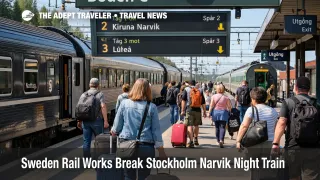
The Stockholm Narvik night train is losing its simplest summer form just as Arctic travel demand builds. Eurail says planned construction works in northern Sweden will affect routes from April through August 2026, and the direct overnight train from Stockholm to Narvik will not run from April 13 until at least mid August. Instead, travelers will need to change trains in Boden, which turns one of Scandinavia's cleanest long distance rail journeys into a transfer dependent itinerary. For anyone linking onward to Lofoten ferries, Narvik hotels, cruises, or fixed tours, the safe assumption is that northern Norway rail arrivals are now less resilient than the ticket alone may suggest.
Stockholm Narvik Night Train: What Changed
The practical change is not that rail access to Narvik disappears. It is that the one seat overnight option disappears for most of the core summer season. Eurail's disruption notice says the direct night train will not run from April 13 until at least mid August, and directs travelers to SJ for the affected routes and alternatives. SJ's construction notice confirms wider northern Sweden works through summer 2026 and shows that some dates bring additional constraints beyond the basic transfer pattern.
That matters because this route has been unusually useful for long, sleep based itineraries. A traveler could board in Stockholm, use a sleeper or couchette, and reach Narvik without rebuilding the trip in the middle. From there, the line feeds onward road and sea travel into the Lofoten area, as well as Kiruna, Abisko, and other Arctic stops. Once the train requires a change in Boden, the journey is no longer one continuous overnight block. It becomes an overnight leg plus a connection, with more ways for a late arrival, a tight handoff, or a reduced timetable to break the day. Eurail has not published a restoration date beyond "at least mid August," so summer planners should treat the disruption as structural until operators show otherwise.
Which Travelers Face the Most Disruption
The most exposed travelers are not only rail enthusiasts riding the full scenic line for its own sake. The bigger risk sits with people using Narvik as a timing sensitive gateway. That includes travelers heading onward to the Lofoten Islands by bus, rental car, or ferry, cruise passengers joining or leaving ships in northern Norway, and tour guests with fixed pickup times. Once Boden becomes a mandatory change point, the train can still work, but it stops functioning like a simple overnight arrival product.
The second exposed group is travelers who specifically chose the route for sleep efficiency. A through night train lets the rail journey replace a hotel night while keeping morning arrival logic intact. A forced transfer weakens that structure. If the south to north sleeper reaches Boden late, or if the onward segment runs on a thinner or altered pattern, the trip may no longer deliver a rested morning arrival in Narvik. That can ripple into early excursion departures, same day drives into Lofoten, and hotel check in timing. In an earlier Adept Traveler article, SAS April Flight Cuts Tighten Nordic Connection Risk, the core problem was thinning recovery options across Nordic itineraries. The same logic applies here, even though this is rail rather than air.
What Travelers Should Do Now
Travelers booking from now through mid August should stop planning around a seamless Stockholm to Narvik sleeper. The safer assumption is a rebuilt journey via Boden, with timetable checks on each leg before booking lodging, ferries, cruises, or guided activities. If the Narvik arrival protects something expensive or nonrefundable, the stronger structure is often to overnight in Narvik before the critical connection rather than treat the arrival day as a connection day.
The next decision threshold is how fixed the onward plan is. If a missed train into Narvik would only cost convenience, the transfer itinerary may still be acceptable. If it would break a cruise embarkation, a tour departure, a ferry slot, or a same day Lofoten lodging chain, the rail trip needs more slack, or a different mode for the final approach. For some travelers, that may mean moving the critical overnight farther south, then using a padded day journey north. For others, it may mean flying into Evenes or another regional gateway and treating rail as a scenic segment rather than the backbone of the trip.
Over the next several weeks, watch for three signals. First, whether SJ publishes more date specific summer changes beyond the base Boden transfer. Second, whether the restoration window firms up beyond "at least mid August." Third, whether your specific Narvik day still offers a robust onward handoff after any retiming. Travelers looking for broader planning context can also review Scandinavia - Travel News and Guides from The Adept Traveler, but for this summer the booking discipline needs to start with operator level timetable checks, not regional inspiration pages.
Why This Is Happening, and What Happens Next
The cause is straightforward and verified. Planned construction works in northern Sweden are disrupting multiple railway lines from April to August 2026. That is a maintenance and capacity problem, not a one day operating glitch. When infrastructure work bites into a long distance corridor this sparse, the damage is not only delay minutes. It changes how the itinerary has to be built. A corridor that normally behaves like one coherent rail product starts acting like separate segments with a vulnerability in the middle.
That is why the seriousness here is higher than a routine timetable tweak, but lower than a full corridor shutdown. Travelers still retain a rail path north, yet the route loses some of its signature value, simplicity, sleep continuity, and connection resilience at exactly the time summer Arctic demand tends to rise. Unless operators restore the through working earlier than expected, the likely next phase is not a dramatic closure headline. It is a summer of travelers discovering that the Stockholm to Narvik rail trip still exists on paper, but now needs more buffer, more verification, and more tolerance for itinerary friction than the classic direct night train did.