

SAS April Flight Cuts Tighten Nordic Connection Risk
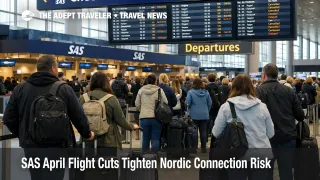
SAS April flight cuts have turned a fuel-cost story into a schedule-risk problem for travelers moving through Scandinavia. Reuters reported on March 17 that SAS will cancel 1,000 flights in April after already canceling several hundred in March, with the airline tying the move to higher oil and jet fuel costs linked to the Iran war and disruption through the Strait of Hormuz. For passengers using Copenhagen, Stockholm, or Oslo as connection points, the main problem is not only fewer seats. It is less schedule slack when a first flight runs late, a rebooking fails, or an overnight stop suddenly becomes necessary.
In an earlier Adept Traveler article, Middle East Oil Shock Lifts Summer Airfare Risk, the pressure was still framed mainly as a pricing problem. This update is harder on travelers because SAS is now removing flying from the system, not just charging more for it. That is the same progression Adept tracked in Jet Fuel Price Shock Hits Global Travel Planning, where higher physical jet fuel prices were already starting to push carriers from warnings into action.
SAS April Flight Cuts: What Changed
The verified shift is straightforward. On March 10, Reuters reported that SAS had already raised fares temporarily because jet fuel costs were climbing. One week later, Reuters reported that the airline would cancel 1,000 flights in April and that several hundred March flights had already been cut. SAS operates around 800 flights a day, so management described the reduction as moderate, but for travelers the practical meaning is that the fallback departures that protect tight itineraries are becoming less available.
What is not yet public is equally important. Reuters attributed the April total to Swedish reporting, but neither Reuters nor SAS published a full route-by-route list in the material available here. That means travelers should not assume a route is safe just because it still appears in search results today. A market can remain on sale while losing the frequency that used to make same-day recovery realistic.
Which Nordic Itineraries Look Most Exposed
SAS says its main hubs are Copenhagen, Oslo, and Stockholm, and its own transfer guidance highlights those airports as key connection points where minimum connecting times vary by route and terminal. That makes hub-bank travelers the most exposed group, especially passengers using one short SAS leg to feed a longer Europe, U.S., or Asia itinerary. When a carrier trims schedules under fuel pressure, the weakest point is often not the long-haul flight itself, but the feeder that gets a traveler to it.
Copenhagen Airport (CPH) looks especially important because SAS has repeatedly described Copenhagen as its principal or main hub, with Oslo Airport (OSL) and Stockholm Arlanda Airport (ARN) supporting the wider Scandinavian network. That does not prove Copenhagen will absorb the heaviest April cuts, but it does mean disruption there can spread farther across the network when banks are thinned. First order, passengers lose frequency. Second order, missed onward connections can spill into hotel demand, rail substitutions, and tighter interline recovery across the rest of the day.
A useful comparison came the day after the SAS report, when Reuters said Norwegian Air would add 120 flights in the Nordic region between March 25 and April 12 because demand rose after SAS announced cancellations. That helps in the near term, but it does not erase the underlying fragility. Extra competitor capacity over a short window is not the same as restoring the original connection lattice SAS passengers expected to use through April.
What Travelers Should Do Now
Travelers with SAS bookings in April should stop treating a legal connection as a safe connection. The immediate move is to recheck each itinerary for schedule changes, then look at how much time remains between flights at Copenhagen, Oslo, or Stockholm after any retiming. If the trip protects something expensive or fixed, such as a cruise embarkation, long-haul departure, or nonrefundable hotel stay, an overnight before the critical leg can now be the safer structure.
The next decision threshold is frequency. If your route pairing now leaves only one realistic same-day backup, the trip has become meaningfully more fragile. In that case, rail can be the smarter hedge on shorter Nordic or nearby continental segments, not because trains are always faster, but because they reduce dependence on a thinned banked airline schedule. Travelers who are still booking should compare nonstop, rail-plus-air, and overnight-hub options before defaulting to the cheapest same-day connection.
Over the next several days, watch for three signals: whether SAS publishes more specific market-level reductions, whether fuel conditions ease enough to slow further cuts, and whether rival carriers keep adding replacement capacity or begin protecting yield instead. The main risk is not that Scandinavian flying disappears. It is that SAS April flight cuts make normal irregular operations harder to recover from just as spring travel keeps building.
Why Fuel Pain Is Now Hitting Schedules
Airlines usually try pricing first because it preserves network utility. Reuters reported that SAS temporarily raised prices on March 10 as higher jet fuel costs hit after the Iran war. By March 17, the airline had moved to cancellations. That sequence matters because it shows fares were not enough to absorb the cost pressure, at least not without trimming flying as well.
The wider mechanism is also visible beyond SAS. Reuters reported that higher oil prices tied to the conflict were already pushing airlines worldwide to raise fares, and EasyJet later warned that fuel costs could push ticket prices up toward the end of summer. SAS's move therefore fits a broader pattern, but with a sharper traveler consequence inside northern Europe because a connecting network depends on frequency. Once frequencies thin, every late inbound flight carries more consequence.
What happens next depends on duration. If energy markets stabilize and jet fuel retreats, SAS could stop deepening the cuts and the April damage may stay limited to weaker frequencies. If fuel stays elevated, travelers should expect more of Europe's spring and early summer pain to show up as trimmed marginal flying, not just higher fares. For Scandinavia, that means the smarter planning posture is no longer simply "book early." It is "book with recovery in mind."
Sources
- Reuters, Airline SAS to Cancel 1,000 Flights in April Due to High Fuel Prices, DI Reports
- Reuters, Airline SAS Hikes Prices on Higher Jet Fuel Cost Following Iran War
- Reuters, Norwegian Air Adds 120 Flights After SAS Cancellations
- Reuters, How Airlines Have Hedged Against Fuel Price Increases
- SAS, About SAS
- SAS, Connecting Flights and Transfer Times
- SAS, SAS Is Building a Global Hub in Scandinavia
- SAS, SAS Launches Most Extensive Summer Program Ever