

Eurostar April 7 Delays Hit Dutch Rail Recovery
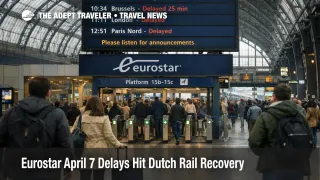
Eurostar April 7 delays are no longer just a live departures board problem. On Monday, April 7, 2026, Eurostar was posting same day delays at Amsterdam Centraal, Brussels Midi, Paris Gare du Nord, and London St Pancras, while its disruption pages still showed limited Dutch network service through April 11, wider Eurostar cancellations through April 12 and May 17, and a canceled Paris to London train on April 11. That combination narrows recovery options for travelers who were already relying on a thinner timetable. For anyone holding a same day flight, ferry, hotel check in, or onward rail booking, the safer assumption is that a modest delay can now do outsized damage.
Eurostar April 7 Delays: What Changed
The new element since April 6 is the stack. In an earlier Adept Traveler article, Eurostar April 6 Delays, Cuts Stretch Into May, the focus was a network already weakened by schedule cuts. On April 7, Eurostar's live updates added active disruption on top of that thinner timetable, including delays tied to Amsterdam Centraal congestion, traffic issues on the Belgian network, delays at London St Pancras, operational restrictions at Paris Gare du Nord, broader Eurostar technical issues, and a disruption on the French network after a train hit an animal. Eurostar also showed a canceled Lille Europe stop on train 9115 after an earlier incident at Amsterdam Centraal.
That matters because the Dutch corridor is already operating with less slack. Eurostar's planning notices still show limited Dutch network service from February 7 through April 11 because of engineering works, and separate Eurostar cancellation windows remain posted through April 12 and from March 22 through May 17 because of operational restrictions. On top of that, Eurostar is showing one specific Paris Gare du Nord to London St Pancras service, train 9007, canceled on Saturday, April 11 because of French network engineering works. This is no longer a clean distinction between a live bad day and a future timetable issue. It is both at once.
Which Itineraries Are Most at Risk
The most exposed city pairs are London to Amsterdam, Amsterdam to London, London to Brussels, Brussels to Paris, and any itinerary that depends on Brussels as the recovery hinge. When Dutch sector performance slips, the Amsterdam and Rotterdam side loses margin first. When Belgian network traffic issues appear at the same time, Brussels stops being a dependable fallback point and starts behaving like another pressure node. When Paris Gare du Nord is also running hot, the western end of the corridor loses its normal ability to absorb late inbound trains.
The first order effect is late departure or missed connection risk on the rail leg itself. The second order effect is where the damage gets expensive. A 20 to 40 minute delay on a normal day is annoying. On a reduced timetable, that same slip can erase the next rail option, force a last minute short haul flight, push hotel arrival past reception cutoffs, or break a same day flight transfer at Amsterdam Airport Schiphol (AMS), Brussels Airport (BRU), or London Heathrow Airport (LHR). Travelers who are also facing Channel border process changes this week have even less room to improvise, as outlined in Schengen EES Goes Fully Live on April 10.
Business travelers and international visitors have the least tolerance for this setup. Leisure travelers with an overnight buffer in London, Paris, France, Brussels, Belgium, or Amsterdam, Netherlands can often ride out moderate disruption. Travelers trying to connect rail to air on the same day should not assume the corridor can self heal quickly once two or three national networks start slipping together. Eurostar's own pages show the issue is not isolated to one station or one cause on April 7.
What Travelers Should Do Now
Travelers with same day onward commitments should make the decision earlier than usual. If your Eurostar train feeds a nonrefundable flight, a cruise embarkation, or the last practical hotel arrival of the night, rebooking to an earlier train or shifting the connection to the next day is now often the better trade. The corridor is still running, but the margin for error is thin enough that waiting for a cleaner live picture can leave you with fewer alternatives, not more.
A useful threshold is this: if missing your arrival by 60 to 90 minutes would materially damage the rest of the trip, the same day plan is too tight for April 7 and likely still fragile through April 11 on the Dutch side. That is especially true for London to Amsterdam and Amsterdam to London travelers, because Dutch engineering works are already constraining service, and the live April 7 notice set shows delays linked directly to Dutch network issues and Amsterdam Centraal crowding.
For travelers who still need to ride it out, the practical move is to simplify the day. Drop optional city side meetings, avoid short self booked rail to air transfers, keep mobile tickets and hotel contact details ready, and price backup air or ferry options before the rail leg fails rather than after. Travelers turning the disruption into an overnight stay can use London Travel Guide: The Ultimate 7-10 Day Itinerary for First-Time Visitors for city logistics if a forced stop in London becomes the least bad option.
Why the Dutch Corridor Still Has So Little Slack
The mechanism is straightforward. Engineering works on the Dutch network reduce the base timetable, which means there are fewer spare paths and fewer practical backup trains if one service slips. Eurostar's own disruption pages also show separate cancellation programs for Paris Brussels services and broader Eurostar network restrictions, which reduces resilience outside the Netherlands too. Once Dutch, Belgian, French, and London terminal delays show up on the same day, recovery stops being local and becomes corridor wide.
NS International's service page also shows Dutch side international timetable changes extending into May, including Amsterdam, Brussels, and Paris adjustments on May 2 to 3 and May 16 to 17 because of works between Amsterdam Centraal and Rotterdam Centraal. That does not mean every day until mid May will look like April 7. It does mean travelers should treat this corridor as structurally fragile for now, not temporarily unlucky.
What happens next depends on whether the live April 7 issues clear faster than the timetable can recover. If same day delay notices drop off, travelers later this week still face a reduced Dutch service pattern through April 11 and at least one confirmed Paris to London cancellation on April 11. If live disruption persists into another day, the case for rebooking around the corridor, rather than through it, gets much stronger.