

KLM Middle East Suspensions Run Through May 17
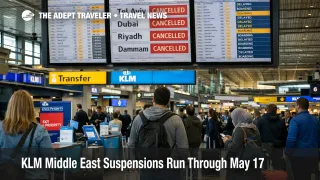
KLM Middle East suspensions now reach Sunday, May 17, 2026, and that turns a short term disruption into a longer spring planning problem for travelers routing through Amsterdam Airport Schiphol (AMS). KLM's current travel alert says flights to and from Tel Aviv, Dubai, Riyadh, and Dammam are suspended up to and including that date, while the carrier also says it is not flying through the airspace of Iran, Iraq, and Israel, or over several countries in the Gulf region. For travelers, the immediate issue is no longer whether this week's flight operates. It is whether an entire May itinerary can still be built around a KLM hub connection at all.
KLM Middle East Suspensions, What Changed
The practical change is duration and scope. KLM's current schedule notice places Tel Aviv Ben Gurion Airport (TLV), Dubai International Airport (DXB), King Khalid International Airport (RUH), and King Fahd International Airport (DMM) in the same published suspension window through Sunday, May 17, 2026. That is a materially longer planning horizon than many travelers would expect from a rolling conflict week alert, and it widens the problem from one city pair to a broader Amsterdam based Middle East network gap.
KLM's commercial flexibility also matters here, because the carrier's own alert shows different waiver mechanics by market. For Dubai, Riyadh, and Dammam, KLM says passengers booked to, from, or via those destinations for travel from February 28 through May 17, 2026, with tickets issued on or before March 19, 2026, can rebook without a date change fee if the same cabin is available, request a travel voucher, or seek a refund if flights are canceled. KLM says the new departure date for those rebooked itineraries must be on or before June 14, 2026. The same page carries a separate Tel Aviv section with different commercial dates, which suggests travelers to Israel should not assume the Gulf waiver rules apply automatically to their booking even though the published schedule line now shows Tel Aviv suspended through May 17.
That is the clearest difference from the earlier KLM angle. In an earlier Adept Traveler article, KLM Dubai, Riyadh, Dammam Suspensions Extend to May 17 focused on the Gulf markets, while Tel Aviv still sat on a shorter published timeline. KLM's current alert now presents all four destinations inside the same operational stop window, even if the passenger options beneath that headline still vary by market.
Which Travelers Face the Hardest Rebuild
The most exposed travelers are not only Amsterdam based point to point passengers. The harder problem hits anyone using KLM's Schiphol hub to bridge North America or Europe into the Gulf or Israel on a single ticket. First order, the nonstop or one stop plan disappears. Second order, the replacement itinerary often gets thinner, because fewer operating carriers means weaker seat availability, higher reaccommodation pressure, and more overnight connection risk when the remaining schedules do not line up cleanly.
Origin markets with heavy KLM or SkyTeam reliance into the region are likely to feel this more than travelers who were already using multiple independent carriers. A passenger starting in a smaller U.S. or European city and connecting at Schiphol loses more than one flight when the Middle East endpoint disappears. They can also lose protected same ticket recovery, easy baggage through check, and the ability to salvage the trip with a same day rebook. Travelers heading to fixed events, cruises, tours, or business meetings in Dubai, Riyadh, Dammam, or Tel Aviv face the sharpest planning pressure because a delayed decision can leave them fighting for fewer remaining seats on alternate airlines.
The broader market context also argues against waiting too long. In an earlier Adept Traveler article, Europe Middle East Flight Cuts Stretch to October showed that KLM is not acting alone. Other European carriers have also pushed Middle East suspensions outward, which means displaced demand is competing for a smaller pool of usable routings across the region.
What Travelers Should Do Now
Travelers booked on Dubai, Riyadh, or Dammam itineraries should first check whether their ticket falls inside KLM's published waiver window, then decide whether the trip still works if the new departure has to occur by June 14, 2026. If the trip depends on fixed dates, and especially if hotel, cruise, or event costs are already locked in, the safer move is usually to rebuild now rather than wait for a late restart that KLM has not promised. Travelers heading to Tel Aviv should be more careful, because KLM's current page shows the May 17 operating suspension, but the Tel Aviv rebooking section on the same page still lists different date rules. That makes direct carrier confirmation more important before canceling or changing the ticket.
The next decision threshold is whether the replacement plan still depends on a fragile hub. If the only alternative requires a short same day connection through another constrained Middle East or Europe gateway, the tradeoff may be worse than it looks on a booking screen. A slightly longer itinerary with stronger schedule depth, or even a non Gulf alternative route into the region, can be the safer choice when the cost of a missed connection is an extra hotel night, visa issue, or lost event day.
Travelers should also check the rest of the itinerary, not just the long haul segment. When a hub based Middle East routing breaks, the damage can spread into onward rail bookings, airport hotel timing, chauffeur or transfer reservations, and corporate meeting schedules on arrival day. The right question is not whether another flight exists. It is whether the trip can still absorb an overnight, a split ticket, or a last minute airline change without becoming more expensive than rebooking the whole plan now.
Why the KLM Middle East Suspensions Matter Beyond One Airline
The mechanism is regional, not route specific. KLM says it is avoiding the airspace of Iran, Iraq, and Israel, as well as several countries in the Gulf region. Once an airline removes both destinations and overflight options at the same time, network recovery becomes harder because the issue is no longer just airport level access. Flight planning, elapsed time, crew duty limits, banked hub connections, and available reaccommodation inventory all get tighter at once.
That is why the problem can keep growing even when a traveler is not flying to a conflict zone itself. Fewer workable routings mean remaining seats concentrate on the airlines and hubs still operating, and that raises the odds of higher fares, thinner premium cabin inventory, and more awkward overnight handoffs. What happens next depends on whether carriers begin shortening published suspension windows, or keep extending them deeper into late spring and summer. Until that changes, KLM Middle East suspensions should be treated as a structural routing constraint for May planning, not as a brief disruption that will likely clear before departure.