

London Euston Closure Still Breaks North South Rail Trips
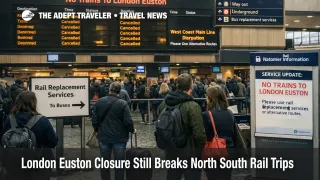
London Euston closure is still breaking normal north south rail travel into London. National Rail says the main lines between Milton Keynes Central and London Euston remain closed through Wednesday, April 8, 2026, with long distance services from Scotland, northwest England, and the West Midlands terminating at Milton Keynes and replacement buses carrying passengers toward Bedford or Potters Bar for onward travel into London. That keeps the West Coast Main Line open in fragments, not as a clean intercity arrival route. Travelers with same day flights, fixed hotel check in times, or business meetings in London should plan around a broken handoff, not assume Euston is nearly back to normal.
London Euston Closure: What Changed
The most important change is that this is no longer just an Easter weekend warning. On Tuesday, April 7, the closure is still active, and National Rail continues to route passengers away from Euston through alternative corridors. Avanti West Coast says no trains will run to or from London Euston from April 3 through April 8, with services starting and ending at Milton Keynes Central and replacement buses running to Bedford. Network Rail says the works are part of a major West Coast Main Line upgrade, including track, signaling, bridge, and station improvements designed to improve reliability after the closure ends.
That distinction changes the traveler decision. A closed London terminal does not just add delay, it removes the normal arrival logic for one of Britain's main north south rail corridors. In an earlier Adept Traveler article, London Euston Easter Closure Cuts Rail for Six Days, the focus was the six day shutdown itself. The sharper April 7 angle is that the disruption is still live deep into the work window, which means travelers cannot treat a London arrival as a simple final leg.
Which Trips and Airport Transfers Are Most Exposed
The most exposed travelers are the ones arriving from Scotland, Manchester, Liverpool, Birmingham, or other West Coast Main Line markets who still need to reach a London hotel, office, or airport on the same day. National Rail says those long distance trains are terminating at Milton Keynes Central, with onward replacement bus links to Bedford or Potters Bar instead of a direct arrival at Euston. That pushes passengers into slower and less intuitive transfer chains, and it weakens recovery options if any one leg slips.
Luton Airport and Gatwick Airport are exposed in a specific way. Bedford feeds directly into Thameslink services, and Thameslink says London St Pancras International has direct trains to both Luton Airport Parkway and Gatwick Airport. That means the Bedford workaround can still function for air passengers, but only if they budget for the added bus leg and the risk of a slower handoff before they even reach the rail network back into London. Trips that looked comfortable with a direct Euston arrival now carry less margin.
Heathrow Airport is exposed differently. Heathrow's official rail guidance says the usual Euston to Heathrow path depends on crossing central London, either by Northern line to Tottenham Court Road for the Elizabeth line or by walking to Euston Square and changing toward Paddington for Heathrow Express. When Euston stops being the arrival point, that familiar transfer logic breaks first. Passengers coming off replacement buses at Bedford or Potters Bar are no longer one clean Underground move from Heathrow, which makes the airport more vulnerable than it would be on a normal Euston day.
What Travelers Should Do Now
Travelers should rebuild same day plans around the workaround, not the published normal timetable. If your north south trip ends in London on or before Wednesday, April 8, keep extra buffer for the Milton Keynes to Bedford or Potters Bar handoff, then for the London transfer after that. For Luton or Gatwick departures, the Bedford to St Pancras path is the cleaner salvage option because it reconnects with direct airport rail. For Heathrow, the safer move is often to leave a much larger margin or switch to a road transfer before the day of travel if the flight matters.
The decision threshold is straightforward. If a missed London arrival would only be inconvenient, waiting out the workaround may still be acceptable. If the rail trip feeds a flight, a cruise, a high value meeting, or a hotel check in with little flexibility, this is the point where rebooking, moving the airport hotel closer to the terminal, or switching to a coach, car, or separate earlier train becomes the more rational choice. National Rail and Avanti are both telling passengers to plan ahead and check before travel, which is usually a sign that the operator expects the amended pattern itself, not just isolated late running, to be the main problem.
Why the Disruption Still Matters on April 7
The mechanism is simple. Once the main lines into Euston are closed, the problem spreads outward from the worksite. A direct intercity rail journey becomes a train, then a bus, then another train or Tube trip, and every added handoff creates another place where delay can compound. First order, passengers lose direct access to Euston. Second order, airport connections, hotel arrivals, meeting times, and same day onward departures all become less reliable because the corridor has less spare capacity and fewer easy fallback options.
What happens next is clearer than in many disruption stories. National Rail says the closure remains in place through Wednesday, April 8, inclusive, with normal service expected to resume after that window. Until then, travelers should assume the West Coast Main Line into London is operating as a managed workaround, not a normal intercity corridor. In an earlier Adept Traveler article, UK Easter Airport Rail Works Tighten Access, the airport angle was already visible. The live April 7 takeaway is that Euston still cannot be treated as a standard London gateway, which keeps north south trips and airport timing under pressure for at least one more day.