

Attari Wagah Border Closure Ends India Pakistan Land Route
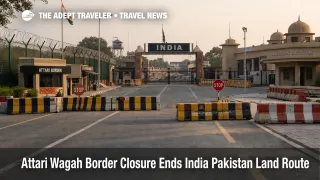
The Attari Wagah border closure has turned India Pakistan land travel from a niche overland option into a dead end for most foreign travelers. Canada now says the Attari Wagah crossing is currently closed, and the U.K. says the Wagah Attari crossing is closed while also advising against all travel within 10 km of the India Pakistan border on the Indian side. For travelers with April and May 2026 itineraries that assumed a land crossing in Punjab, the practical change is immediate, the default overland route is unavailable, nearby frontier areas carry stricter risk language, and flying is now the safer planning baseline for most trips.
Attari Wagah Border Closure: What Changed
Canada's India advisory says travelers should avoid all travel within 10 km of the Pakistan border in Gujarat, Punjab, and Rajasthan because of an unpredictable security situation and the presence of landmines and unexploded ordnance, and it separately states that the Attari Wagah border crossing is currently closed. The same Canadian advisory also warns that tension along the wider frontier can change suddenly, that travelers may face scrutiny if officials know they recently visited the other country, and that the Line of Control in and around Jammu and Kashmir remains volatile.
The U.K.'s India advice is now equally blunt on the Indian side. As of April 12, 2026, it says the Wagah Attari border crossing is closed and advises against all travel within 10 km of the India Pakistan border. On the Pakistan side, the U.K. advises against all but essential travel within 5 miles of the international border with India, notes that the Grand Trunk Highway route via Wagah is currently closed, and says the Kartarpur Corridor is also currently closed for crossings.
For travelers, the consequence is larger than one shut gate. The crossing most outsiders know by name, and the one most often treated as the practical India Pakistan land option, is not functioning. That removes the standard Punjab overland plan and pushes any border dependent itinerary into a higher friction, higher uncertainty environment.
Which Travelers Face the Most Disruption
The most exposed travelers are foreigners holding separate India and Pakistan visas, round the world or specialist overland travelers, religious or heritage visitors trying to pair both countries in one trip, and anyone who built hotel, rail, or private car bookings around Amritsar, Lahore, or onward road movement through Punjab. They are now dealing with a route failure, not just a slower crossing.
The risk broadens once the failed crossing starts breaking the rest of the itinerary. A border plan that no longer works can turn into rebooked international flights, extra nights in Amritsar or Lahore, visa validity pressure, and new security exposure if travelers drift closer to restricted frontier zones in Punjab, Rajasthan, Gujarat, Jammu, or Kashmir while trying to improvise. On the Pakistan side, the advisory map is already tight enough that many frontier areas are poor candidates for ad hoc rerouting.
This also changes the decision for travelers who are not crossing by land but planned to travel near the border. The U.K. and Canada are both signaling that the wider frontier is not a place to treat as normal sightseeing or transfer geography right now. That means people heading to border ceremony areas, road corridors close to the frontier, or Kashmir adjacent itineraries need to distinguish carefully between a symbolic visit and a workable travel plan.
What Travelers Should Do Now
For most foreign travelers, flying is now the only realistic India Pakistan transfer option. That does not guarantee smooth travel, but it avoids the dead end of a closed land crossing and reduces the risk of getting trapped in a border belt where official advice is already restrictive. Travelers who have not yet ticketed the international segment should price flights first and treat any land concept as unusable unless both governments clearly reopen the crossing and their advisories soften.
Anyone already positioned near Amritsar or Lahore with a border plan should stop treating delay as the main problem. The main problem is non functionality. The next decision point is whether your visa dates, hotel bookings, and onward transport still work once the land leg is removed. Rebook early if the trip includes fixed dates, scarce flights, or a chained itinerary with domestic trains, tours, or non refundable lodging on the far side.
Over the next 24 to 72 hours, monitor three signals, the wording of official India and Pakistan travel advisories, any change to the closure language around Wagah Attari and Kartarpur, and wider transport disruption tied to security conditions or protests on the Pakistan side. In an earlier Adept Traveler article, Western Pakistan Travel Risk Starts To Stack, the broader western Pakistan operating picture was already showing how quickly security restrictions can spread into road and transport reliability problems.
Why the Closure Changes the Whole Planning Logic
The mechanism is straightforward. India Pakistan overland travel works only when a very small number of political, security, visa, and border processing assumptions all hold at once. Once the main named crossing closes, travelers do not just lose one checkpoint, they lose the route around which rail, road transfer, hotel timing, and visa sequencing were built. As a result, even travelers staying technically outside the exact closure point can feel the disruption through wasted positioning, missed handoffs, and compressed rebooking space.
The second order effect is that the closure lands inside a wider frontier environment that is already under tighter official warning language. Canada points to landmines, unexploded ordnance, sudden tension shifts, and scrutiny tied to recent cross border travel. The U.K. layers on no travel and essential travel warnings across different parts of the frontier on both sides. That is why this is not just a border queue story. It is a route viability story, and for many foreign travelers the answer right now is that the viable overland route is gone.
What happens next depends on whether the official closure wording changes and whether frontier advisories loosen, not on anecdotal reports from drivers, hotels, or tour operators. Until those official signals change, the safer assumption is simple, do not build India Pakistan itineraries around a land crossing, and do not drift toward border zones hoping conditions on the ground are looser than the advisory map suggests.