

Western Pakistan Travel Risk Starts To Stack
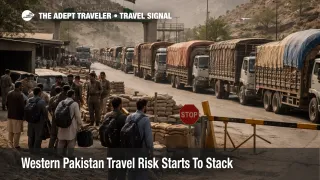
Western Pakistan travel risk is no longer a single issue story. It is becoming a stacked risk zone where separate pressures are building in the same travel geography at the same time. Pakistan said on March 26 that it had resumed military operations against Afghanistan after the Eid pause, while Reuters has already reported that the Baloch Liberation Army's February attacks pushed parts of Balochistan close to a standstill. The travel significance is not that a new insurgency might emerge. It is that an already active insurgent and border conflict environment now has more ways to spread disruption across roads, border crossings, airport access, and overland itineraries in western Pakistan.
Western Pakistan Travel Risk Is Becoming A Stacked Signal
The current evidence is strong enough to treat this as a live Signal, not just a watch item. Pakistan's foreign ministry said military operations against Afghanistan resumed after the Eid al Fitr pause, and Reuters separately reported earlier in March that fighting around the closed Torkham border crossing had already displaced about 100,000 people. That matters for travelers because Torkham is not an abstract frontier point. It is one of the main practical pressure valves on the Pakistan, Afghanistan corridor, and disruptions there can quickly turn into transport delays, border uncertainty, and rerouting problems for anyone moving near the northwest frontier.
The western side of Pakistan was already fragile before this latest border flare up. Reuters reported on February 2 and February 5 that coordinated Baloch Liberation Army attacks across Balochistan brought the province close to a standstill or to a virtual standstill, with militants hitting multiple targets across the province. That is the key difference between a weak Signal and a strong one. This is not one isolated clash layered onto a normal operating environment. It is new pressure landing on top of an already disrupted one.
Where The Pattern Is Showing Now
The signal is showing in two connected western corridors. The first is the Pakistan, Afghanistan frontier, especially the Torkham crossing and the wider border zone where the U.K. already advises against all travel within 10 miles of the border and the U.S. warns against travel to Khyber Pakhtunkhwa. The second is Balochistan, where both the U.S. and U.K. advise against travel, and where the insurgency is already active enough that Reuters has described the province as nearing a standstill during the February attack wave.
That overlap matters because western Pakistan is not just one destination. It is a movement zone. Travelers, aid workers, contractors, overland operators, truck corridors, and some domestic air and road links all rely on the assumption that at least one leg of the chain still works. Once the Afghanistan front, Balochistan violence, and wider regional instability begin pressing on the same geography, the safer assumption is that transport becomes less predictable even outside the exact point of violence. In an earlier Adept Traveler article, Pakistan Advisory Raises Fuel and Transport Risk already showed that Pakistan travel planning had become more fragile because road restrictions, curfews, protests, drone activity, and fuel disruption were stacking into the same operating picture. In another, Pakistan Gilgit Baltistan Unrest Hits Trip Planning showed how quickly movement restrictions and outages can break join dependent itineraries.
What Travelers Should Watch Now
For most travelers, the main takeaway is not to debate whether western Pakistan is risky in theory. Official advisories already answer that. The real decision point is whether a trip depends on any western Pakistan road, border, or remote transfer segment that can fail if even one layer worsens. If the trip touches Balochistan, the Pakistan, Afghanistan border belt, or a contractor route that depends on those corridors, the safer call is to defer or redesign it now.
For travelers elsewhere in Pakistan, this is more of a monitoring Signal than an immediate national shutdown warning. Watch for renewed closure or restricted movement at Torkham, fresh evacuation or displacement reporting near the frontier, new militant attacks in Balochistan, airline schedule changes tied to western Pakistan security conditions, and any expansion of official advisory language. If those indicators start appearing together, the Signal moves from regional stacking risk into a broader transport reliability problem.
Why This Pattern Could Spread Further
The mechanism is straightforward. Travel systems usually do not fail because one headline looks dramatic. They fail when multiple thin margins break in the same corridor. In western Pakistan, one layer is active insurgent violence in Balochistan. Another is cross border fighting with Afghanistan. Another is standing do not travel advice that already limits insurance, operator confidence, and contingency options. Another is the broader March 2026 Pakistan operating picture, where fuel, road restrictions, protests, drone activity, and transport disruption were already part of the advisory frame.
That does not mean all of Pakistan is about to shut down. It means western Pakistan now looks more like a multi front disruption zone than a set of isolated local problems. The next escalation markers are practical, not rhetorical: repeated border interruptions, wider movement restrictions, attacks that hit transport or urban service points again, or new official warnings that broaden the affected map. If those appear, western Pakistan travel risk stops being a frontier story and becomes a much wider planning problem for anyone moving through the country's western side.