

FAA Controller Hiring Push Signals Longer Delay Risk
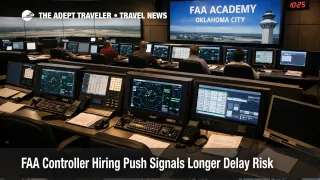
The FAA's new gamer themed recruitment push is a traveler story because it confirms the U.S. air traffic system is still trying to dig out of a deep controller shortage, not because video games are suddenly aviation policy. The next hiring window opens at 12:00 a.m. on April 17, 2026, and stays open only until the agency receives 8,000 applications. For travelers, the important signal is that the FAA still has almost 11,000 controllers in service against a system that the agency says needs an elite force of about 14,000, while GAO says the broader controller workforce remains smaller than it was a decade ago even as flight volume has grown. That means summer and holiday flying should still be planned around a fragile staffing backdrop, especially when weather, runway work, or hub congestion layer on top.
FAA Controller Shortage: What Changed
What changed on April 10, 2026 is not the shortage itself, but the government's public acknowledgment that it still needs a wider funnel to fill it. Transportation Secretary Sean Duffy and the FAA launched a campaign aimed at young adults, especially gamers, ahead of the next annual air traffic control hiring window. The FAA says the traits it wants to tap include multitasking, spatial awareness, high cognitive function, and strategy, and it is pushing applicants to apply early because the vacancy will close once 8,000 applications are received.
The operational point is more serious than the branding. GAO reported in December 2025 that FAA employed 13,164 controllers at the end of fiscal year 2025, about 6 percent fewer than in 2015, even though flights using the air traffic control system rose about 10 percent between fiscal years 2015 and 2024 to 30.8 million. The DOT now says there are almost 11,000 controllers in service and more than 4,000 trainees in the pipeline, but that still leaves the system dependent on a long hiring and certification pipeline rather than a quick staffing fix.
Which Travelers Face the Most Exposure
This does not mean every trip is about to be delayed because of staffing. It does mean travelers should stop treating controller shortages as an occasional headline and start treating them as a standing capacity constraint that can worsen otherwise normal disruption days. The most exposed travelers are those booking tight hub connections, same day cruise embarkations, last flight home itineraries, and trips through airports already dealing with runway construction, weather prone arrival flows, or heavy peak bank scheduling. When controller staffing is thin, the FAA protects safety by slowing the flow of traffic rather than letting the system overrun.
The first order effect is lower throughput at stressed facilities, which can mean ground delay programs, spacing restrictions, or slower arrivals and departures. The second order effect is what travelers actually feel, missed onward flights, later aircraft turns, thinner reaccommodation options, and more overnight hotel risk when a single slowed hub breaks an airline's downstream schedule. That is why a staffing shortage matters even on days when the weather story looks small at noon. A thinner controller bench leaves less room to absorb routine shocks.
What Travelers Should Do Now
Travelers do not need to change April 17 bookings because of the recruitment window itself. They should change how they judge risk for trips over the next several months. Build more buffer into summer itineraries that rely on a single large connecting hub, especially if the trip includes expensive downstream commitments such as cruise departures, guided tours, event tickets, or long distance rail segments. A cheap fare with a short connection can still be the wrong buy if the airport is vulnerable to even modest flow controls.
Rebook earlier rather than later when an itinerary is already marginal. A practical threshold is any connection that only works if everything runs on schedule, especially in the afternoon and evening bank when earlier delays can stack. Nonstop flights, earlier departures, and connections with enough slack to survive a metered arrival are still the cleanest hedge against a staffing constrained system. The tradeoff is price and convenience now versus a more resilient itinerary later.
Over the next 24 to 72 hours, travelers do not need to monitor gamer ads. They should monitor the usual operational signals that expose how much slack the system really has, active FAA traffic management programs, major hub runway projects, and carrier waiver windows when weather hits. The recruitment campaign may widen the applicant pool, but it does not change the fact that becoming a certified professional controller still takes years. The next decision point for travelers is not whether the FAA can attract applicants, but whether their own itinerary can survive a system that remains staffing tight while the pipeline catches up.
Why the Shortage Will Not Clear Quickly
The FAA's own hiring page shows why this is a long game. Applicants must clear a five step process that includes a cognitive aptitude exam, medical and security screening, Academy training in Oklahoma City, and one to three years of on the job experience before becoming a Certified Professional Controller. GAO found the overall process can take two to six years, and some medical clearances alone can take up to two years. In other words, even a successful recruitment burst in April 2026 will not quickly erase the operational pressure travelers face this summer or on the next bad weather day.
GAO also found that attrition remains substantial throughout the hiring and training pipeline. Many applicants never take the Air Traffic Skills Assessment, many who do are screened out by score, and even qualified candidates can drop out later because the process is long, complex, and relocation heavy. The FAA says it has shortened hiring by more than five months, increased instructor staffing, and nearly hit 50 percent of its fiscal year 2026 hiring goal with almost 1,200 controllers onboarded so far. That is progress, but it is pipeline progress, not instant capacity. Travelers should read this campaign as evidence that the FAA is still in recovery mode, and that the controller shortage remains a structural travel planning issue rather than a solved one.
Sources
- Trump's Transportation Secretary Sean P. Duffy and the Federal Aviation Administration Unveil New Campaign to Target Next Generation of Air Traffic Controllers
- Safe Skies. Strong Careers. We're Hiring Air Traffic Controllers.
- Air Traffic Control Workforce: FAA Should Establish Goals and Better Assess Its Hiring Processes
- SFO Landing Restrictions Cut Arrivals Through October 2