

Flight Delays and Airport Impacts: April 12
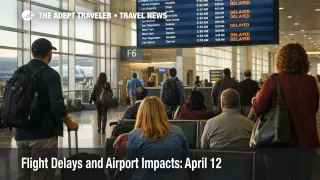
April 12 flight delays look manageable early, but the Federal Aviation Administration's live planning picture points to a later day problem rather than a clean nationwide Sunday. San Francisco International Airport (SFO) is the clearest flashpoint, with the FAA flagging a probable ground stop or ground delay program later today, while Denver International Airport (DEN), George Bush Intercontinental Airport (IAH), and William P. Hobby Airport (HOU) also sit inside the FAA's planned risk map. Early morning status pages still showed major hubs including SFO, DEN, IAH, Boston Logan International Airport (BOS), Washington Dulles International Airport (IAD), and Ronald Reagan Washington National Airport (DCA) on time, which means travelers still have room to protect connections before delays harden into rolling network problems.
April 12 Flight Delays, What Changed
What changed is not a systemwide ground stop at daybreak, but the FAA's forecast that delay programs are more likely to build later in the operating day. The live NAS status feed shows a probable ground stop or ground delay program for SFO after 2000Z, with possible programs later for DEN as well. The same FAA feed also points to routing pressure around Houston, where IAH and HOU face possible route swaps and arrival flow adjustments, a sign that even airports showing on time in the morning can become harder to run efficiently as traffic banks build.
SFO is not starting from a normal baseline. The FAA's current operations advisory shows runway construction at SFO scheduled through November 15, 2026, and that matters because a weather or traffic squeeze now lands on top of reduced operating flexibility rather than a fully open airfield. DEN also has a runway closure in the FAA advisory through July 2, 2026, while IAH has both a runway closure through June 5 and traffic flow work tied to TFDM implementation through April 13. Those structural constraints do not create a delay day by themselves, but they narrow the margin for recovery once spacing programs begin.
Which Travelers Face the Most Disruption
The most exposed travelers are people connecting through SFO, DEN, and Houston on midday and afternoon itineraries, especially anyone depending on short domestic to long haul turns or tight final flights of the day. Morning origin passengers at those airports still have a better chance to get out ahead of the worst compression because FAA status pages showed SFO, DEN, and IAH on time early Sunday. That is the window to use, not proof that the day will stay clean.
East Coast travelers should not read the current on time picture too generously either. FAA planning signals for recent delay days have often started with a quiet morning and widened later toward the Northeast corridor. Boston, Dulles, and Reagan National were on time early on April 12, but the larger pattern in the FAA status feed suggests the afternoon risk map can expand as weather, traffic demand, and airspace management interact. The practical consequence is that a flight showing only a small departure delay at the origin can still misconnect later if the hub arrival flow slows.
For travelers already seeing San Francisco on their itinerary, this is part of a broader capacity story rather than a one day surprise. In an earlier Adept Traveler article, SFO Landing Restrictions Cut Arrivals Through October 2 explained why San Francisco has become more fragile during irregular operations. In another earlier Adept Traveler article, Flight Delays and Airport Impacts: April 10 the same SFO first pattern was already visible.
What Travelers Should Do Now
Travelers with a choice should favor earlier departures over later ones, and they should treat short layovers through SFO, DEN, and Houston as exposed until the FAA risk picture improves. On a day like this, the main tradeoff is simple. Waiting may preserve the original itinerary, but moving earlier or adding connection time can save the trip if programs trigger after the first bank of departures.
If you are not flying until late afternoon or evening, keep checking both the airline app and the FAA airport status page before leaving for the airport. Rebook sooner if your connection buffer is under about 90 minutes at a constrained hub, if you have a same day cruise or tour connection, or if your final leg is one of the last viable departures. That is where a moderate delay turns into an overnight stay.
Travelers flying through San Francisco should be especially skeptical of tight same day plans. Travelers routing through Washington area airports should remember that DCA remains under an FAA operational readjustment through October 31, 2026, and IAD is listed with reduced arrival rate capability in the current advisory through April 16. Those are not necessarily headline disruptions today, but they reduce slack if weather or demand worsens later. For broader system context, see U.S. Air Traffic Control Privatization: Reality Check.
Why the Delay Risk Can Spread Later
The mechanism on days like April 12 is cumulative. A hub does not need to be in crisis at sunrise to become a network problem by late afternoon. Once traffic management initiatives slow arrivals into a major airport, aircraft spend longer on the ground or in the air, crews fall behind planned rotations, gates stay occupied longer, and downstream departures start leaving late even from airports with good local weather.
That spread is likely to be most visible today at SFO because the FAA has already identified it as the strongest later day risk point, and SFO is operating with a narrower recovery margin because of ongoing runway work. Denver and Houston matter for a different reason. They are major connection engines, so flow restrictions there can break onward itineraries well beyond Colorado and Texas. The next decision point for travelers is not whether the early morning board looks calm. It is whether the FAA's live programs begin to activate into the afternoon and evening, when same day recovery options usually get thinner.