

Ireland Fuel Protests Hit Airport and Port Planning
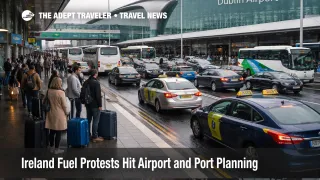
Travel in Ireland is still a live ground-transport and fuel-distribution risk on Sunday, April 12, 2026, even after police operations began clearing some of the highest-profile protest points. The National Emergency Coordination Group said on April 10 and April 11 that blockades were restricting Whitegate Refinery, Shannon Foynes Port, and the Port of Galway, that more than 100 fuel stations were already out of supply, and that storage pressure at some ports was building. That moved the problem far beyond central Dublin congestion and into a national supply-chain squeeze that can still affect airport runs, regional coach travel, rental-car practicality, and timing around Irish ports. Travelers should treat Monday as an improvement phase, not a return to normal, and build extra buffer into any airport, ferry, or long-distance coach move.
Ireland Fuel Protest Disruption: What Changed
The biggest shift since the earlier Dublin-centric phase is that the pressure point became fuel access and network reliability across the country, not just access roads into the capital. On April 10, the government said movement at Whitegate Refinery, Shannon Foynes Port, and the Port of Galway was extremely limited, while more than 100 filling stations were already out of supply and international shipping companies were growing concerned about delays unloading stock at some Irish ports. On April 11, the government said storage capacity at some ports was becoming a concern and warned that prolonged journey times and blockades were straining public transport, vital services, and broader logistics.
By Sunday, April 12, the picture had started to split between places that were being cleared and systems that were still fragile. Reuters reported that Irish police had cleared central Dublin and that Whitegate had already been cleared on Saturday, with operations also starting at Galway Port on Sunday. That reduces the immediate risk of total standstill at some critical choke points, but it does not mean fuel stocks, bus operations, or normal journey times have snapped back. The travel consequence is that visible blockades may shrink before service reliability fully recovers.
Which Travelers and Corridors Still Face the Most Risk
The most exposed travelers now are those relying on road-based airport transfers, intercity buses, or self-drive plans that depend on finding fuel outside major urban cores. Transport for Ireland said Bus Éireann services across the country were facing significant disruption, with major delays in the Greater Dublin Area, substantial delays on the M50 and M1 into Dublin, restrictions in Cork, and continuing delays in Limerick and Galway. It also flagged a Local Link route suspension specifically due to fuel shortage. Bus Éireann's own updates on April 12 still showed protest-related disruption in Galway and Cork, plus diversions and missed stops on routes tied to Dublin Airport and Dublin-bound flows.
That leaves a few higher-risk travel patterns. Dublin Airport (DUB) trips remain vulnerable when they depend on buses, coaches, taxis, or private cars threading through a road network that was disrupted for days and is still showing protest-related diversions. Regional travelers trying to connect from Galway, Cork, Limerick, or the wider west and south into Dublin are exposed to rolling delays even if their flight itself operates normally. Ferry and cruise-adjacent ground arrangements also stay fragile because the government explicitly warned of restricted fuel movement through key ports and growing concern about offloading and storage. In an earlier Adept Traveler article, Dublin Protest Delays Hit Airport Access on April 8, the main weakness was city-to-airport access. The April 12 problem is broader, because even where roads reopen, fuel distribution and public transport recovery can lag behind the visible clearance.
What Travelers Should Do Now
Travelers flying on Monday, April 13, should not use a normal airport timing model yet. For Dublin departures, the safer move is to leave earlier than usual, especially if checked bags, a long coach feeder, or a cross-city transfer is involved. For regional departures or arrivals, confirm not just flight status but also the bus, taxi, and road leg that gets you to or from the airport. A flight operating on time does not fix a broken ground connection.
For self-drive itineraries, the tradeoff is now convenience versus refueling certainty. If your plan depends on topping up in smaller towns or along a long regional route, keep the tank high and be ready to change the day's driving logic rather than assuming normal forecourt availability. For coach travelers, the decision threshold is simple, if your route touches Dublin-bound corridors, Galway city, Cork city, or regional services already flagged by Transport for Ireland or Bus Éireann, build in enough slack that a missed coach does not become a missed flight or ferry.
The next thing to monitor is whether Monday's return of school and work traffic adds fresh pressure before fuel distribution catches up. The government said school transport is intended to resume on Monday, April 13, but warned that if blockades continue to affect road access and fuel distribution, delays and service disruption are likely. That means the first weekday peak after the weekend clearances could still produce renewed airport timing problems even if the headline blockades are smaller. Travelers should check operator updates again before leaving, not just the night before.
Why Recovery May Lag Behind Visible Clearances
The mechanism is straightforward. A blockade at a refinery or fuel port does not just slow one site, it interrupts the refill cycle for stations, bus depots, emergency fleets, and commercial operators across the network. Once enough stations run dry and enough vehicles start rerouting around closures, the stress spreads into longer bus journey times, weaker schedule recovery, and tighter margins for airport and port transfers. The government's April 10 and April 11 updates made clear that the concern had already spread from fuel depots to emergency services, healthcare logistics, public transport, and shipping operations.
What happens next depends on whether enforcement keeps critical infrastructure open long enough for distribution to normalize. Sunday's police operations matter because they reopen high-value bottlenecks, but the official updates also show that Ireland was already dealing with fuel shortages, transport delays, and port-storage pressure before those clearances began. In practical travel terms, Monday should be better than the peak blockade phase, but not reliably normal. Expect the first improvements in central road movement before full recovery in regional bus dependability, forecourt availability, and long-distance transfer confidence.
Sources
- National Emergency Coordination Group meets on traffic and transport disruption
- National Emergency Coordination Group meets as traffic and transport disruption continues
- Live Service Updates and Disruptions, Transport for Ireland
- Service Updates, Bus Éireann
- Irish police clear fuel protesters from central Dublin after days of gridlock, Reuters, April 12, 2026
- Dublin Protest Delays Hit Airport Access on April 8