

LAX Surface Safety Risk Rises After Frontier Near Miss
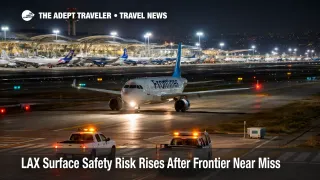
A fresh FAA investigation at Los Angeles International Airport (LAX) does not justify canceling trips, but it does sharpen one practical point for travelers using the airport this week and into the next planning cycle. Late on Wednesday, April 8, 2026, a Frontier Airlines jet had to brake hard after several vehicles crossed in front of it on a service road while the aircraft was taxiing for departure around 11:25 p.m., according to the FAA and Associated Press reporting. No one was hurt, and the event happened at low speed, but it reopened a surface safety question at one of the country's biggest hubs, where small airfield errors can quickly turn into missed connections and late night recovery problems.
LAX Surface Safety Risk: What Changed
What changed is not the airport's schedule, access rules, or passenger screening process. What changed is that the FAA is now investigating a near miss on the ground at LAX involving a passenger jet and airport vehicles, only weeks after the March 22 LaGuardia crash that pushed U.S. airport surface safety back into national focus. AP reported that several vehicles crossed in front of the Frontier aircraft, forcing the crew to stop abruptly. That keeps this in watch item territory for travelers, not network disruption territory, but the location matters because LAX is a major origin and connection hub with limited slack during busy banks.
The stronger travel intelligence angle is not the scare by itself. It is that the incident lands just after the FAA's March 19, 2026 hot spot update, which still charts three airport surface hot spots at Los Angeles International Airport. In an earlier Adept Traveler article, FAA U.S. Runway Hot Spots Flag Major Hubs laid out that LAX already sits on the FAA's list of major airports where surface movement deserves heightened attention. The current event does not prove one of those charted hot spots caused this near miss, but it does make the agency's warning feel less abstract for travelers moving through LAX now.
Which LAX Itineraries Feel This First
Most passengers will never see the exact service road or taxiway geometry involved. The group most exposed is travelers with tight domestic connections, late night departures, or onward plans that fail fast when an aircraft misses its push or arrives late at the next station. First order, a surface incident can pause movement, trigger extra caution, and stretch taxi times. Second order, that can narrow same day reaccommodation options, push crews and aircraft rotations later, and raise the chance that a minor delay becomes an overnight problem.
This matters more at LAX than at a small airport because hub complexity multiplies the cost of small disruptions. If your trip depends on a short connection to Asia, Oceania, Mexico, or another U.S. banked departure, the risk is not that LAX suddenly becomes unsafe to use. The risk is that a surface slowdown, even a brief one, leaves less recovery room inside a schedule that already runs tight. Travelers with cruise embarkations, prepaid tours, or nonrefundable hotel nights tied to same day arrivals should treat that margin as thinner than the public departures board may suggest.
What Travelers Should Do Now
The right response is buffer, not panic. Travelers flying through Los Angeles over the next several days should avoid very short connections, especially on the last viable itinerary of the day. For domestic to domestic trips, a longer layover is the simplest protection. For international departures, arriving at LAX earlier in the day remains the cleaner move when the itinerary has expensive downstream consequences.
Use decision thresholds instead of hope. If your booking depends on a sub one hour domestic connection at LAX, or on a same day transfer to a cruise, event, or long haul flight that has no realistic backup, rebooking into more margin is rational even if your current itinerary still looks normal. If you already have a healthy buffer and multiple later flights exist, monitoring is usually enough. The next useful signals are airline waiver language, FAA airport status tools, and whether any follow on operational advisories appear, not social media noise around one audio clip.
Why This Near Miss Matters Beyond One Frontier Flight
The bigger issue is how airport surface risk works. The FAA says ASDE X can help controllers track aircraft and vehicles on runways and taxiways, while the Surface Awareness Initiative is designed to improve controller situational awareness across the airfield in all weather conditions. The agency also measures safety through a broader runway environment framework that includes taxiway collision accidents and surface incidents, not just classic runway incursions. In plain language, ground safety is a systems problem. Technology, vehicle equipment, controller awareness, markings, sightlines, and driver compliance all have to line up.
That is why this incident deserves traveler attention even without injuries or major delays. A near miss at slow taxi speed is still a signal that the margin for error on the ground can get thin at major hubs. For broader context on how U.S. air traffic and airport operations absorb strain, see U.S. Air Traffic Control Privatization: Reality Check. What happens next is likely procedural before it is passenger facing, FAA review, possible local mitigations, and closer scrutiny of how vehicles and aircraft share the airfield at LAX. For travelers, the useful conclusion is simple, LAX surface safety risk is not a no fly warning, but it is a good reason to buy time into any itinerary that cannot afford a small operational miss.