

FAA U.S. Runway Hot Spots Flag Major Hubs
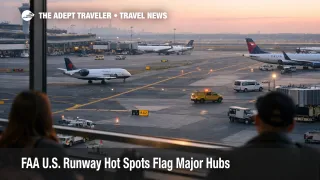
The FAA's latest runway safety update does not mean travelers should avoid the nation's biggest airports, but it does show where surface movement risk is concentrated on the ground. The agency's March 19, 2026 hot spot update charts 453 airport surface hot spots on U.S. airport diagrams, including at Hartsfield-Jackson Atlanta International Airport (ATL), Chicago O'Hare International Airport (ORD), Los Angeles International Airport (LAX), San Francisco International Airport (SFO), John F. Kennedy International Airport (JFK), LaGuardia Airport (LGA), and Newark Liberty International Airport (EWR). For travelers, the immediate consequence is not a blanket safety warning, but a reminder that complex taxiway and runway layouts at major hubs remain a serious operational risk point, especially after the March 22 LaGuardia crash involving Air Canada Express Flight 8646 and an airport fire truck.
FAA Runway Hot Spots: What Changed
The new FAA chart supplement, effective March 19 through May 14, 2026, defines an airport surface hot spot as an area on the movement surface with a history or potential risk of collision or runway incursion, where pilots and drivers need heightened attention. In plain terms, these are the intersections, hold-short points, and taxi paths where confusion is more likely because of layout, traffic flow, markings, signage, lighting, visibility, or human factors. The hot spots remain charted until the FAA judges that the elevated risk has been reduced or eliminated.
What changed for travelers is not airport access, schedules, or ticket rules. What changed is the visibility of where the FAA sees recurring surface risk. The March 19 document shows multiple hot spots at several of the country's busiest hubs, including four at San Francisco, three at Los Angeles, two at Atlanta, two at Chicago O'Hare, and two at LaGuardia. That makes this a useful operational signal rather than a passenger-facing shutdown notice.
Which Travelers Face the Most Exposure
Most passengers will never notice these locations directly, but travelers connecting through large hubs are the group most exposed to the downstream effects when something goes wrong on the airfield. A surface incident can close a runway, slow taxi flows, reduce arrival rates, and turn a normal delay day into a cascade of missed connections, crew knock-on issues, and limited same-day reaccommodation. The risk is highest at airports with dense parallel runway systems, short distances between ramps and active runways, or complicated intersections where aircraft and ground vehicles cross active movement areas.
LaGuardia is the clearest example of why this matters now. The NTSB says Air Canada Express Flight 8646 collided with a fire truck on Runway 4 at LaGuardia on March 22, 2026. AP reporting says the fire truck lacked a transponder, which meant LaGuardia's surface surveillance system did not generate the warning controllers needed in time. That does not prove the FAA hot spot list caused or predicted the crash. It does show that surface safety depends on several layers working together, runway geometry, controller instructions, vehicle positioning, onboard or vehicle equipment, and driver compliance.
What Travelers Should Do Now
Travelers do not need to cancel trips because an airport appears on the FAA hot spot list. A hot spot is a charted caution area, not a declaration that an airport is unsafe. But travelers should treat this update as one more reason to avoid very tight connections at the biggest hubs, especially on weather-affected days, during late-night operations, or when a trip depends on the last flight out.
The practical move is buffer, not panic. If a trip runs through Atlanta, Chicago O'Hare, Los Angeles, San Francisco, or the New York area airports, extra connection time is the simplest protection against the kind of ground delay ripple that follows a runway incident or operational slowdown. The same logic applies to travelers with cruise departures, tours, or nonrefundable hotel check-ins tied to a same-day arrival. The tradeoff is straightforward, shorter connections save time when everything works, but they fail faster when ground operations tighten.
The next decision point is whether the LaGuardia investigation produces broader FAA or NTSB recommendations on vehicle equipment, controller procedures, or runway alerting systems. Travelers should monitor airport-specific advisories, carrier delay waivers, and major hub operation updates over the next several weeks, especially if they are booked through airports with multiple charted hot spots. The FAA runway hot spots list is not a no-fly signal, but it is a clear map of where the margin for error on the ground is thinner.
Why Surface Risk Still Matters at Big Airports
The larger context is that runway safety on the ground is a systems problem, not a single-technology problem. The FAA says ASDE-X can provide visual and aural alerts for possible runway incursions, and Runway Status Lights can warn when it is unsafe to enter or cross a runway. The FAA also encourages airports to equip regular movement-area vehicles with vehicle-mounted transmitters to improve surface awareness. Those tools reduce risk, but they depend on the airport, the vehicle, the controller, and the driver all operating inside the same picture.
That is why the hot spot list matters even when operations look normal from the terminal. First order, a confusing intersection or missed hold-short point raises incursion risk. Second order, any resulting slowdown can spread into gate congestion, connection failures, crew displacement, and fewer recovery options later in the day. For travelers, the main takeaway is operational rather than emotional, major hubs remain safe to use, but some of the busiest U.S. airports are also places where complex surface layouts leave less room for error, which is exactly what the FAA runway hot spots update is designed to show.
Sources
- FAA Airport Hot Spots Chart Supplement, effective March 19, 2026 to May 14, 2026
- FAA statement on the LaGuardia accident
- NTSB investigation page for Air Canada Express Flight 8646 and LaGuardia runway collision
- FAA Airport Surface Detection Equipment, Model X (ASDE-X)
- FAA Runway Status Lights overview
- FAA Runway Safety fact sheet
- FAA advisory circular on airport ground vehicle movement area transmitters
- Associated Press report on LaGuardia safety systems and the missing transponder