

Peru Ecuador Land Crossing Shrinks to Tumbes Only
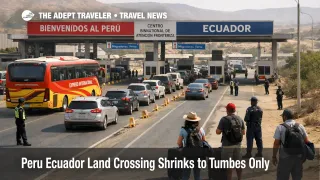
Peru overland travelers now need to treat the Ecuador frontier as a single corridor, not a flexible network. Canada's current Peru advisory says the official crossing near Tumbes, the Centro Binacional de Atención Fronteriza, or CEBAF, reached via the Pan American Highway, is the only land border crossing with Ecuador that is currently open, and it separately warns that basic services in the Tumbes district have become harder to access as migrant flows rise. For travelers, that shifts the planning problem from choosing the best crossing to protecting everything that depends on one border point, including buses, hotels, cash access, and same day onward departures.
Peru Ecuador Land Crossing: What Changed
The practical change is concentration. On the Ecuador side, Canada says most land crossings with Colombia and Peru are closed until further notice for national security reasons, with only the Pan American Highway crossing south of Huaquillas toward Tumbes left open on the Peru frontier. On the Peru side, the companion advisory is even more operationally blunt, directing travelers to cross only at the official point near Tumbes and stating that this is the only land border crossing with Ecuador that is currently open. That means older assumptions about using alternate southern crossings or improvising on the road are no longer good enough for most travelers.
This also changes the balance between air and land planning. In an earlier Adept Traveler article, Ecuador Curfew Changes Ground Travel After Border Closure, the main issue was that Ecuador's wider security posture was already making ground itineraries more brittle. The new traveler facing fact is narrower and more severe for Peru bound overland plans, one practical crossing, one main highway approach, and fewer fallback options when transport slips.
Which Travelers Face the Most Tumbes Risk
The most exposed travelers are the ones trying to stitch a land crossing into a tightly timed itinerary. That includes backpackers moving by long distance coach, self drive travelers expecting routine fuel, cash, and lodging access near the border, and anyone trying to cross from Peru and then catch a same day bus, domestic flight, or hotel transfer on the Ecuador side. When one crossing absorbs nearly all practical overland demand, even modest friction can spread quickly into longer waits, sold out seats, and missed handoffs.
The service warning around Tumbes makes this more than a border formalities story. Canada's Peru advisory says basic services in the Tumbes district have become increasingly difficult to access because of increased numbers of migrants entering Peru from Ecuador. That does not tell travelers exactly which service will fail first on a given day, but it is a clear official signal not to count on the district behaving like a normal transit town with easy last minute problem solving.
There is also a security layer that keeps this from being a simple queue story. Canada warns of increased security presence in Peru's border area with Ecuador due to crime, including theft and extortion, while its Ecuador advisory says border areas often see higher criminal activity and violence and notes reported criminal activity near Huaquillas, where it advises against non essential travel. That combination raises the cost of improvisation. A traveler stuck after dark, short on cash, or searching for ad hoc transport near the border is operating in a weaker position than the same traveler with a reserved bed, daylight timing, and onward tickets built with slack.
What Travelers Should Do Before Crossing at Tumbes
The first move is to rebuild the itinerary around failure points, not ideal timing. Do not assume you will clear the border and continue on schedule. If you are traveling northbound or southbound by land, treat Tumbes as a full day movement problem, not a quick transfer, and avoid same day onward bookings that become expensive if the crossing runs long. The safest version of this trip is daylight weighted, cash ready, and buffered with an overnight on one side of the border when the rest of the itinerary is expensive or rigid.
The second move is to protect the local basics before arrival. Because the Peru advisory explicitly warns that basic services in Tumbes are becoming harder to access, travelers should not rely on easy last minute lodging, simple card acceptance everywhere, or frictionless transport if a bus arrives late. Confirm where you will sleep, carry enough cash for a disrupted day, charge devices fully, and keep documents accessible without flashing valuables in crowded areas. Travelers driving themselves should also assume less room for error on fuel, food, and timing than a normal intercity road leg would allow.
The next decision point is whether land still makes sense at all. If your trip depends on a cruise embarkation, a tour start, a nonrefundable flight, or a work obligation the next day, the rational answer may be to price an air alternative instead of gambling on a squeezed land corridor. For travelers staying with the overland plan, Current Travel Advisories 2025: What U.S. Travelers Must Know is a useful refresher on why advisory changes can affect insurance logic, consular expectations, and rebooking decisions.
Why Tumbes Becomes a Fragile Corridor Next
The mechanism is straightforward. When authorities close most border crossings, traffic, screening, and uncertainty do not disappear, they compress into the crossings that remain open. First order, the Tumbes corridor becomes the main Peru Ecuador land crossing for practical travel. Second order, pressure moves outward into bus availability, hotel inventory, cash access, food stops, and timing risk for every booking that follows the border. The corridor can remain open and still become operationally weak for travelers who need precision.
What happens next depends less on headline policy changes than on corridor performance. As long as both advisories continue to point travelers to Tumbes as the sole Peru side land option, the main signals to watch are whether service strain in the district worsens, whether transport providers begin building in more slack, and whether governments change the list of open crossings. Until that changes, Peru Ecuador land crossing plans should be built around one assumption, Tumbes is usable, but it is no longer forgiving.