

Cape Town Airport Transfers Carry New Route Risk
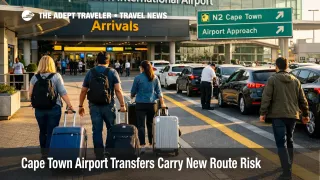
Travelers arriving in Cape Town, South Africa, or heading back to fly out now need to treat the ground leg to Cape Town International Airport (CPT) as a real planning decision, not a routine transfer. The U.K. Foreign, Commonwealth & Development Office updated its South Africa advice on March 31, 2026, and said the change was new information about road attacks to and from Cape Town airport. The warning is narrower than a broad country crime alert, but operationally it matters more for most visitors because it affects the part of the trip where people are tired, carrying luggage, using navigation apps, and often sitting in an unfamiliar rental car or waiting for a ride after landing. That shifts risk from general awareness into route choice, pickup method, and timing.
Cape Town Airport Transfers: What Changed
The FCDO's updated wording says there has been an increase in violent crime and targeted attacks to and from Cape Town airport, including incidents involving visitors driving hired cars. It also gives route level guidance, telling travelers to stay on the M3 and N2 rather than the R300, and to use Airport Approach Road, exit 16 on the N2, rather than Borcherd's Quarry Road leading toward Nyanga. That is a meaningful shift because official travel advice does not always get this specific about which roads to favor and which navigation choices to avoid.
For travelers, the immediate consequence is straightforward. A cheap, improvised, or app directed transfer is no longer just a convenience gamble. It can pull you off the main corridor and into a weaker security position. Cape Town International remains a major working gateway, and Airports Company South Africa continues to present it as the city's main international airport, but the access leg now requires the same kind of planning travelers already apply to late arrivals, tight connections, or after dark ground movement in higher risk destinations.
Which Travelers Face the Most Exposure
The highest exposure is not spread evenly across all passengers. Self drive visitors collecting a hire car after landing face one of the clearest risks because the FCDO specifically notes incidents involving visitors in hired cars. Late arrivals and pre dawn departures are also harder, since the same advice says the threat of violent crime is higher when it is dark, and South Africa guidance more broadly warns that carjacking and robbery are common around junctions, petrol stations, and driveways, with criminals sometimes using spikes, stones, or fake police signals to stop vehicles.
Travelers using unvetted pickups are also exposed. The FCDO advises using safe and reliable transport, arranging for a hotel or tour operator to meet you where possible, and being cautious with taxi apps, including checking vehicle registration and driver ID before entering. That means the weakest plan is often the one many leisure travelers default to, walking out tired, opening a map, and accepting the first cheap ride or following a phone route that looks faster but leaves the main roads.
What Travelers Should Do Now
The strongest arrival plan is a pre booked transfer through a reputable hotel, tour operator, or well reviewed professional car service that confirms the route in advance and keeps to the N2, the M3 where relevant, and Airport Approach Road. If you are driving yourself, build the route before wheels up, review it offline, and ignore detours that pull you onto smaller feeder roads unless there is a clear police managed closure. The FCDO explicitly says to make a journey plan in advance with a trusted local contact and to avoid following GPS routes that take you away from main roads.
Timing matters almost as much as route choice. On arrival, do not linger outside the terminal comparing ride options, exposing phones, or repacking valuables at the curb. Keep bags and electronics close, move through public areas quickly, and leave with your planned transport. On departure, do not cut the airport run too tight. Extra buffer protects you against a route change, a driver swap, congestion on the safer corridors, or the cost of aborting a pickup that does not look right. Travelers with early morning or late evening flights should lean even harder toward a trusted private transfer or an airport area overnight rather than a last minute city to airport run.
Why the Transfer Leg Matters More Now
What makes this change serious is not an airport closure or a suspension of flights. It is that the transfer leg can quietly break the whole itinerary before check in even begins. First order, a bad road choice can lead to robbery, vehicle targeting, or a forced route change. Second order, that can turn into missed departures, new hotel nights, abandoned rental plans, higher private transfer costs, and broken same day connections onward from Cape Town. That practical knock on risk is similar to the itinerary fragility already seen in Cape Town Airport Fire Recovery, Baggage Delays, but the pressure point here is outside the terminal rather than inside it. Travelers wanting current airport context can also monitor Cape Town International Airport (CPT) for related updates.
What happens next depends less on one formal deadline than on whether official advice keeps adding route specific detail or local operators start adjusting their standard pickup patterns. For now, the FCDO has not advised against travel to Cape Town as a whole, but it has drawn a much firmer line around how to move between the airport and the city. That is enough for travelers to change behavior now. The main watch items over the next few days are any fresh FCDO wording, hotel transfer notices, car rental safety guidance, and local reporting on disruptions along the N2 and airport approach roads that could push traffic toward weaker alternatives.