

Cape Town Airport Fire Recovery, Baggage Delays
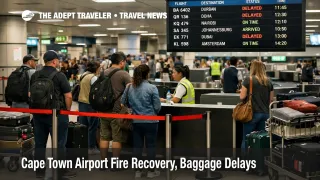
Cape Town airport fire recovery is moving from incident response into the stage where trips quietly break, late bags, missed transfers, and tight connections that no longer work reliably. Airports Company South Africa (ACSA) has said core operations have been restored after the February 24, 2026 fire, but baggage handling is still being managed manually while teams work to restore automated service. That combination, mostly normal flight movement with uneven processing behind the scenes, is where travelers get surprised, especially on international arrivals that depend on fast baggage delivery and predictable onward timing.
Cape Town Airport Fire Recovery: What Changed for Travelers
What changed since the initial disruption is not whether Cape Town International Airport (CPT) is open, it is the reliability profile of the flow. The February 24, 2026 fire disrupted systems on the landside and triggered temporary suspensions and diversions, and while those acute actions have eased, ACSA has continued to flag manual processes in baggage handling as the lingering constraint. In practical terms, that means your flight may land close to schedule, but the last mile inside the terminal, baggage delivery, and any tight onward plan can still run hot and cold.
The traveler facing risk is variance. When baggage and back office workflows are manual, averages do not matter as much as the long tail, because one slow delivery pushes you past a domestic boarding cutoff, a driver's wait window, or a lodge transfer departure time. Even if your airline is operating normally, the airport side lag can still create misconnects that look like airline delays after the fact.
Which Itineraries Are Most at Risk at Cape Town International
International arrivals with onward domestic connections are the most exposed. When baggage delivery timing is unpredictable, a connection that normally works becomes a gamble, especially if you need to recheck a bag for a separate domestic ticket, or if you are connecting close to the last departures of the night. Coverage of the immediate aftermath also noted that some processing and corridors were operating under temporary arrangements, which tends to create uneven pacing through arrivals, and then uneven baggage release.
Safari and tour itineraries are the next high risk band, not because the airport is unsafe, but because the itinerary is brittle. A late bag can force gear purchases, missed meet points, and compressed driving days, and safari operators generally have less flexibility than city hotel check in. If you are landing in Cape Town, South Africa, and moving same day to the Winelands, the Garden Route, or a fly in connection to a lodge, you should assume your usable arrival time is later than the scheduled touchdown time until baggage delivery fully normalizes.
Travelers on split tickets, separate PNRs, or "self connect" plans are also exposed. When you do not have a protected connection, any baggage delay can cascade into a new ticket purchase, because the airline has no obligation to reaccommodate you on the second leg. The tradeoff is simple, a cheaper self connect itinerary versus a higher probability of paying twice when manual processing stretches timing.
What Travelers Should Do Now
Build buffer where it actually protects you. For international arrivals connecting onward, favor longer scheduled connections, and avoid last flight of the day domestic legs until baggage delivery is consistently predictable. If you must connect, choose a routing that gives you later backups the same day, because the real failure mode is not a 20 minute delay, it is missing the only remaining departure and defaulting into an overnight.
For checked bags, act early and document everything. Before you leave the arrivals area, confirm your bag status in your airline app, take screenshots if the status is unclear, and keep your bag tag receipts accessible. If your bag does not arrive, file the report immediately in the baggage hall, not later at the hotel, because the timestamp and the recorded location matter for tracing priority and reimbursement claims. If your itinerary includes a safari or a tour operator pickup, message them as soon as you see baggage delay risk, because they can sometimes resequence your day more effectively with early notice than with a last minute scramble.
Use a decision threshold instead of hoping the system is back to normal. If your trip would break materially if you arrive late, for example you would miss a once daily lodge transfer or a nonrefundable timed activity, rebook into an earlier arrival, or plan an airport area overnight to absorb variance. This is the same logic travelers are using in other disruption contexts, where the operational posture is stable but the variance remains high, for example Munich Airport Snow Disruption: Curfew, Deicing Risks and the knock on effects that show up later at the rebooking desk.
Why Baggage Delays Persist After an Airport Systems Fire
A fire that touches airport networks and IT services does not only delay flights in the moment, it can degrade the automation layers that make high volume travel predictable. Reuters reported that the February 24, 2026 fire affected network and IT services, and ACSA later said baggage processing was being managed manually while teams work to restore automation. Manual baggage handling can keep the airport moving, but it reduces throughput and increases variance, especially during arrival banks when multiple aircraft feed the system at once.
This is also why the second order effects show up outside the terminal. When baggage delivery runs late, travelers miss protected and unprotected connections, which pushes more people into reaccommodation queues, and that is when hotel displacement, driver rescheduling, and tour compression stack quickly. Even travelers who do not check bags can feel the ripple through crowding, longer help desk lines, and slower resolution time for exceptions.
The broader mechanism is that modern travel is a chain of dependent systems. When one link drops into manual mode, the downstream impact is not evenly distributed, it hits the travelers whose plans have the least slack. If you want a deeper explainer on why seemingly small technical faults can create outsized operational consequences, the logic is similar to other infrastructure fragility discussions, including Cosmic Rays, Bit Flips, and the Airbus A320 "Icarus" Recall, where variance and rare edge cases, not averages, drive real world disruption.
Sources
- Cape Town airport fire disrupts international and domestic flights (Reuters)
- Cape Town airport resumes full operations (IT-Online, citing ACSA update)
- Passengers warned of delays as Cape Town International Airport resumes operations after fire (News24)
- Manual systems at Cape Town airport get flights moving after fire (TimesLIVE)