

Cuba Airport Fuel Crunch Cuts Havana Exit Options
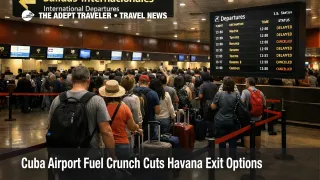
Cuba airport fuel crunch is no longer a background hardship story. It is now a departure planning problem centered on Havana, where the U.K. Foreign, Commonwealth and Development Office says Cuba is facing severe infrastructure disruption, persistent power outages, fuel shortages, and aviation fuel outages at all international airports. As of April 13, 2026, the FCDO says Terminal 2 at José Martí International Airport (HAV) has closed, flights have been diverted to Terminal 3, several airlines have suspended service, and options for leaving the country could shrink further if conditions worsen.
Cuba Airport Fuel Crunch: What Changed
What changed is the move from broad destination stress to hard airport operating limits. The FCDO updated its Cuba advisory on April 2, 2026, and says the advice remains current on April 13, 2026. The advisory says Cuban authorities announced that all of the country's international airports are without aviation fuel, that Terminal 2 at Havana's main airport has closed, and that flights normally using that terminal are being pushed into Terminal 3 instead. The same advisory says some airlines, including all Canadian airlines, Air France, and LATAM, have suspended flights to and from Cuba, while Iberia and Air Europa are reducing weekly flying between Havana and Madrid, Spain.
That makes this more serious than a standard inconvenience story. Airport disruptions normally leave travelers with some mix of later departures, alternate terminals, or same day rebooking. Here, the underlying fuel shortage narrows the system itself. When the problem is Jet A supply rather than only staffing or weather, a published schedule can remain visible while the number of workable outbound options keeps falling behind it. The FCDO is explicit that exit options could reduce further if the situation worsens.
In an earlier Adept Traveler article, Cuba Fuel Shortages Hit Airport Operations, Tourism covered the broader airport and resort strain. The new value now is not another general warning. It is that official travel advice ties all international airports to aviation fuel scarcity, names a closed Havana terminal, and points to a thinner set of carriers still flying.
Which Travelers Face the Most Disruption
The most exposed travelers are those who still need to leave Cuba on a fixed schedule, especially travelers departing from Havana, travelers holding tickets on airlines now suspended, and travelers whose onward plans depend on strict timing. That includes people with visa deadlines, nonrefundable onward flights, cruise joins, medical needs, or cash and medication limits. It also includes travelers who assumed a terminal transfer would be routine. Terminal changes matter more when power outages, fuel shortages, and degraded transport are already straining the rest of the trip.
Canadian travelers are especially exposed because the FCDO says all Canadian airlines are among the carriers that have suspended Cuba flying. Europe bound travelers are not insulated either. The advisory says Air France and LATAM have suspended service, and that Iberia and Air Europa are cutting weekly Havana to Madrid service rather than holding the previous pattern. That means fewer fallback seats even for travelers whose airline has not fully exited the market.
The second order effects are where this can get expensive fast. If an outbound seat disappears, the problem is not just one more hotel night. Ground transport can become less reliable under fuel rationing, medical access and communications are already under strain, and the FCDO says visitors should expect significant disruption across transport and basic services. A delayed departure can therefore compound into cash pressure, missed consular appointments, broken onward itineraries, and document problems if a traveler needs a new route through a third country on short notice.
What Travelers Should Do Now
Travelers already in Cuba should shift from passive waiting to active exit planning. Start with the carrier actually operating your ticket, not a booking platform, and confirm whether the flight is still running, whether it has changed terminals, and whether airport arrival guidance has changed. The FCDO says travelers considering departure should watch airline and tour operator messaging closely, remain ready to change plans quickly, and ensure travel documents remain valid, including any visas needed for onward travel.
For near term trips into Cuba, this is the point where deferring travel becomes the safer default unless the trip is essential and your backup options are strong. Waiting may preserve fare value, but it raises the chance you will enter a system with weaker transport, fewer flight exits, and less room to recover if a carrier cuts more service. For travelers already in country, leaving early is more defensible when your airline is still operating and you have enough cash, documents, and flexibility to act before the next reduction hits.
The practical threshold is simple. If your departure depends on a single carrier, a tight onward connection, or a same day border, visa, or cruise transfer elsewhere, your plan is already brittle. In that case, the risk of staying put is growing faster than the convenience of waiting for things to stabilize. Travelers who do remain should conserve cash, power, fuel, and medicines, and should avoid building plans around assumptions that local transport will work normally.
Why the Disruption Is Spreading, And What Happens Next
The mechanism is broader than one airport terminal. The FCDO says Cuba is experiencing severe and worsening disruption to essential infrastructure, with persistent power outages and fuel shortages affecting transport, medical care, communications, and basic services. Airport fuel shortages sit inside that wider system failure. When energy supply is constrained at a national level, airports, roads, hospitals, telecoms, and tourism operations begin competing for the same limited operating margin.
That is why airport pressure can spread even if no single day produces a dramatic shutdown headline. First order, airlines suspend, reduce, reroute, or keep routes under review because refueling and turnaround reliability weaken. Second order, traveler flows compress into fewer departure windows and fewer terminals, which can slow processing, reduce rebooking choice, and push more people into unplanned hotel stays and last minute route changes. The FCDO warns the situation has the potential to deteriorate quickly and without warning, which means the next meaningful signal is not a policy announcement, but whether more carriers trim service or whether the remaining routes begin to fail more often.
For now, the clearest operational reading is that Cuba remains visitable only under a tighter risk tolerance than many leisure travelers expect. Travelers who still have functioning exit options should treat those options as perishable. Travelers planning new trips should treat Havana airport capacity, terminal routing, and airline continuity as live variables, not fixed assumptions.