

Ecuador Emergency Rule Keeps Key Transit Carveouts
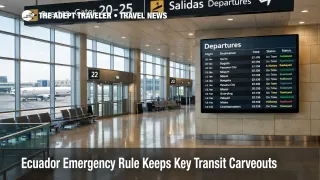
Travelers moving through Ecuador now need a narrower operating map, not just a higher alert level. The U.K. Foreign, Commonwealth & Development Office, or FCDO, says Ecuador's 60 day state of emergency was renewed on April 2, 2026, and continues to cover several provinces that matter for coastal travel and mainland transit. At the same time, the advice still preserves a few practical exceptions, including airside transit within José Joaquín de Olmedo International Airport (GYE) in Guayaquil, Ecuador, and limited movement around the Rumichaca border crossing, Tulcán, and the Pan American Highway in Carchi province near Colombia. For travelers, the main shift is that discretionary coastal movement looks harder to justify, while a small number of transit corridors remain usable if the trip is tightly planned.
Ecuador Emergency Travel Rules: What Changed
The operational change is not a full country shutdown. It is a renewed emergency structure layered on top of existing regional warnings and border area restrictions. The FCDO says the renewed state of emergency applies in Guayas, El Oro, Manabí, Los Ríos, Santa Elena, Pichincha, Santo Domingo de los Tsáchilas, Esmeraldas, and Sucumbíos, plus the cantons of Echeandía and Las Naves in Bolívar, La Maná in Cotopaxi, and La Troncal in Cañar. The same advisory continues to warn against all but essential travel across a broad stretch of the coastal region, including Guayas.
What keeps this from becoming a blanket no go story is the carveout logic. The FCDO explicitly says its warning for Guayas does not apply to airside transit at Guayaquil Airport. It also says the 20 kilometer warning zone along the Ecuador Colombia border does not apply to the Rumichaca border crossing, the town of Tulcán, the Pan American Highway, or El Ángel Ecological Reserve in Carchi province. That leaves travelers with a small set of workable channels even as the wider map stays restrictive.
This is a follow on, not a repeat, of the border story. In an earlier Adept Traveler article, Ecuador Border Crossings Narrow Overland Options, the main problem was corridor concentration at the frontier. The newer development is that Ecuador's renewed emergency framework confirms those narrow transit exceptions remain usable, but inside a broader security posture that can still slow movement with checks, patrols, and short notice disruption.
Which Travelers Face The Most Exposure
The highest exposure sits with overland travelers and anyone trying to join multiple transport modes in one day. Coastal leisure trips, regional bus moves, self drive plans, and same day airport to hotel or border to airport sequences are more fragile because large parts of the coast remain under all but essential travel advice, while the emergency order itself can bring heightened police and military presence nationwide, along with extra security checks.
Travelers using Guayaquil only as an air connection face a different risk profile. The airside carveout means a protected transit use case still exists even though Guayas province remains under stricter advice. That distinction matters. A same terminal connection can remain workable while a road transfer across the province, an overnight stay tied to late ground movement, or a discretionary side trip becomes a much weaker plan.
The northern border corridor also remains usable, but only in a disciplined way. Travelers crossing at Rumichaca or staging in Tulcán should treat the exception as permission for focused transit, not as proof that the wider border zone is back to normal touring conditions. That reinforces the narrower map Adept already flagged in Ecuador Curfew Changes Ground Travel After Border Closure, where the underlying problem was not only border status, but how Ecuador's security measures make ground itineraries less forgiving.
What Travelers Should Do Now
For most visitors, the practical rule is simple. Keep coastal Ecuador out of discretionary route planning unless you have a strong reason to be there, and keep any trip through Guayas as air based as possible. If Guayaquil is just a connection point, staying airside is materially safer than building in a road transfer, city stop, or hotel repositioning that depends on smooth local movement.
For border plans, travelers should treat Rumichaca, Tulcán, and the Pan American Highway as protected corridors, but not resilient ones. That means crossing in daylight, building hotel slack on one side of the border, and avoiding same day chains that depend on a bus arrival, a checkpoint crossing, and a flight or long onward coach all landing on schedule. The right threshold for switching from land to air is when a missed segment would break the larger itinerary, especially an international departure, a guided tour, or a nonrefundable hotel stay.
Over the next 24 to 72 hours, the signals that matter are not just headline decree changes. Watch for tighter travel advice wording, transport operator reductions, and reports that checks or protests are slowing the roads that feed the legal corridors. If those hold steady, Ecuador remains passable through a small number of channels. If they worsen, the real shift will be from narrow but usable transit routes to narrow routes that are too brittle for time sensitive travel.
Why The Emergency Structure Still Leaves Some Routes Open
The mechanism here is selective control, not blanket closure. Ecuador's emergency approach is aimed at internal disturbance and armed violence, which is why the renewed decree and the FCDO advice focus on named provinces, cantons, and high risk regions instead of declaring the entire travel system unusable. That lets authorities preserve essential transport functions, such as airport transit and key border corridors, while still keeping broad security powers and heavier enforcement in place.
For travelers, that creates a two speed map. First order, some areas become poor choices for optional movement, while a few air and overland channels stay open. Second order, the remaining channels matter more, because every extra road check, delay, or queue pushes stress outward into hotel timing, missed flight protection, driver scheduling, and cross border onward transport. The route may stay legal without staying reliable.
What happens next depends on whether Ecuador keeps this current balance, broad restrictions with narrow transit exceptions, or tightens it further. For now, the carveouts are real and useful, but they should be treated as controlled pathways through a live security environment, not evidence that broader travel conditions have normalized.