

France Fuel Shortages Complicate Western Road Trips
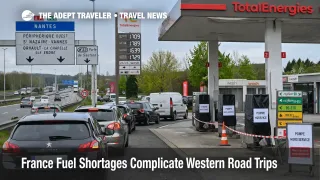
France fuel shortages have become a practical route planning problem, not just a fuel price headline. Reuters reported on April 7 that about 18% of French petrol stations were facing supply issues, while official French government pages updated on April 9 and April 10 said the state is tracking about 9,900 stations daily through a public map that shows sites with shortages in petrol or diesel. For travelers driving in France, especially on western itineraries or any trip chained to a ferry, airport pickup, or rural hotel stay, that means refueling assumptions need more margin than usual.
France Fuel Shortages, What Changed
What changed is that the problem looks broad enough to affect planning, but uneven enough that travelers can still manage it with better routing. Reuters reported on April 7 that French officials put the share of stations with at least one missing fuel type at around 18%, and that drivers and truckers staged a roadblock in Nantes, France, over rising prices. That is a different traveler problem from a national refinery shutdown. It points to patchy availability, local congestion, and route friction that can ruin a tight driving day even when the country is still moving.
The French government's published methodology also matters here. A station is counted as having supply difficulty when at least one product type, petrol or diesel, is unavailable, and the daily data comes from station operators themselves. The official map is designed for drivers to check supply and prices by location or along an itinerary. In practice, that means travelers should stop thinking in country level terms and start thinking in corridor terms. A long drive can still work, but one preferred stop may fail.
Which Road Itineraries Face the Most Risk
The travelers most exposed are self drive visitors on western France routes, airport renters collecting cars for long onward drives, and anyone linking road segments to fixed departure times such as ferries, flights, or timed rural check ins. Nantes matters because the April 7 protest happened there, which puts added attention on western France as both a price pressure zone and a movement choke point. The main risk is not that all fuel disappears. It is that a route planned around ordinary refueling habits becomes less resilient when one or two convenient stations are partly dry or crowded.
There is also a network pattern inside the shortage data. Reuters reported that Energy Minister Maud Bregeon said the issue was tied to internal logistical problems, not to a refinery or crude supply collapse, and other reporting on her remarks said 83% of affected stations were in the TotalEnergies network after the company's capped prices pulled in extra demand. That makes branded station choice part of the traveler exposure. A driver who assumes the cheapest or most familiar network will also be the most dependable may be making the wrong decision.
Second order effects are easy to miss until the day breaks. When forecourt supply is uneven, coach timing can slip, last mile hotel shuttles can run tighter, and ferry approach plans get riskier because drivers arrive needing fuel before boarding rather than after. The pressure can also stack with the wider fuel story already affecting European travel planning. In an earlier Adept Traveler article, Europe Jet Fuel Shortage Threatens Summer Flights, the concern was flight reliability. On France roads, the same broader energy stress shows up one layer lower, at the pump and on the ring road.
What Travelers Should Do Now
Travelers driving in France over the next few days should treat half a tank as the new empty on long segments. The practical move is to refuel earlier, use the French government fuel map before departure and again before the longest leg of the day, and avoid leaving a city, airport, or ferry zone assuming the next station cluster will be normal. On western itineraries, especially around Nantes and longer Atlantic side drives, an extra refueling stop is worth more than a small price saving.
The replan threshold is straightforward. If your route depends on one specific service area, an evening arrival into a rural property, or a same day airport return with little slack, build at least one backup station and at least 30 to 60 extra minutes into the road day. If you are collecting a rental car after a flight, do not assume the first cheap branded forecourt near the airport will be the best stop. Choose redundancy over habit. The cost of one unnecessary fuel stop is low. The cost of missing a ferry or flight because two convenient stations were crowded or partly dry is much higher.
Travelers should also watch the type of official language now appearing in France. The government says crude is arriving, refineries are not the issue, and storage depots are not the issue, which suggests the next useful signal is not panic buying rhetoric but whether distribution strain eases, whether branded station gaps narrow, and whether protests spread beyond isolated western actions. In an earlier Adept Traveler signal, Travel Fuel Risk Is Becoming a Refinery Fit Problem, the bigger point was that fuel stress does not hit every transport layer in the same way. For France road trips, that now means monitoring local station reliability, not abstract oil supply headlines.
Why This Looks Like a Distribution Problem, for Now
The most important distinction is between fuel scarcity and fuel access. French officials have publicly framed the current station gaps as an internal logistics problem amplified by demand shifting toward lower priced TotalEnergies forecourts, while the official government pages keep steering drivers to the live station map rather than announcing emergency rationing or a national refining crisis. That does not make the problem minor. It means the operational consequence is unevenness. Some corridors remain workable, some stations are stressed, and travel reliability depends on how much slack a driver builds into the route.
What happens next depends on whether the demand surge at discounted stations eases and whether protests around fuel costs remain local. If those pressures cool, France fuel shortages may retreat back into a nuisance issue. If they spread, the travel effect broadens quickly from private cars into airport transfers, coach punctuality, freight dependent hotel operations, and regional tourism flows. Travelers do not need to scrap France road trips. They do need to stop planning them on the assumption that every forecourt on the map is equally dependable.
Sources
- Nearly a fifth of French gas stations facing supply issues, truckers protest in west, Reuters
- Carte des stations de carburant connaissant des difficultés d'approvisionnement sur au moins un produit (essence ou gazole), Ministère de l'Économie
- Carburant: quelles sont les stations en rupture de stock?, info.gouv.fr
- Prix des carburants en France, site gouvernemental
- Around 18% of fuel stations lack at least one type of fuel, Anadolu Agency