

Ireland Fuel Shortage Recovery Keeps Travel Fragile
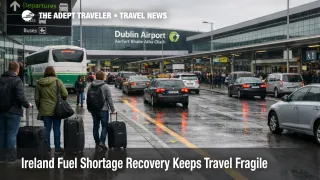
Ireland fuel shortage recovery has begun, but it is not yet a clean return to normal travel conditions. Police cleared high profile blockades at Ireland's only refinery, Galway Port, and key Dublin roads by April 12, 2026, yet Reuters reported that the protests had already left about one third of Ireland's petrol stations without fuel. For travelers, the practical risk has shifted from visible gridlock to uneven recovery across airport transfers, coach operations, rental car planning, and regional same day connections. The safer assumption for Monday, April 13, is improvement, not full normalization.
Ireland Fuel Shortage Recovery: What Changed
The biggest change is that some of the most visible choke points have reopened, while the supply and transport system behind them is still catching up. Reuters reported on April 12 that Garda operations had already cleared access to Whitegate Refinery in County Cork, Galway Port, and blocked roads in Dublin. That reduces the risk of a full standstill at the country's most important fuel gateways, but it does not instantly refill forecourts, restore normal bus running times, or remove the knock on effects from several days of disrupted deliveries.
That distinction matters because the visible protest phase and the operational recovery phase are not the same thing. The Irish government said on April 10 that Whitegate, Shannon Foynes Port, and the Port of Galway were all restricted, that movement at those sites was extremely limited, and that more than 100 fuel stations were already out of supply, with the number potentially rising sharply. By April 11, the government was warning that fuel supply chains, public transport, and other vital services were under serious strain. Roads reopening helps, but the refill cycle still has to work through depots, hauliers, stations, and operators that have already been disrupted.
Which Travelers and Corridors Still Face the Most Risk
The most exposed travelers are those relying on road based airport transfers, regional coaches, or self drive plans that assume fuel will be easy to find outside the largest urban centers. Dublin Airport (DUB) remains a live pressure point because passengers can still be delayed even when flights operate normally, especially if their trip depends on buses, taxis, or private cars arriving on a road network that was disrupted for days. Bus Éireann had to reroute or truncate multiple Dublin Airport linked services during the protest phase, including services touching Waterford, Ballina, Sligo, Donegal, Letterkenny, and Dundalk.
The wider network is still fragile beyond Dublin. Bus Éireann posted protest related disruption notices for Galway and the western and northwestern region on April 12, while Transport for Ireland said services were affected by protests and partial blockades. Even where Monday service patterns improve, transport operators are recovering from several days of diversions, missed stops, and slow running. That leaves tighter margins for travelers connecting from Galway, Cork, Limerick, or other regional points into Dublin flights, ferries, or fixed hotel check in windows.
In an earlier Adept Traveler article, Ireland Fuel Protests Hit Airport and Port Planning focused on the live blockade phase. The new problem is narrower, but still operationally serious. Travelers are now less likely to be trapped by a single headline road closure and more likely to be caught by thin fuel availability, slower coach recovery, or a transfer plan with no slack built into it.
What Travelers Should Do Now
Travelers departing on April 13 or April 14 should still avoid tight same day airport runs in Ireland. For Dublin departures, the safer move is to leave earlier than usual, especially if checked bags, an intercity coach, or a cross city transfer is involved. For arrivals, confirm the road or bus leg after landing, not just the flight status. A normal departure board does not guarantee a normal ground transfer.
Self drive travelers should also treat fuel as a planning variable, not a background assumption. Reuters said about one third of petrol stations were without fuel as of April 12, and outside reporting on the recovery cited industry warnings that restocking could take days, not hours. That does not mean every region will remain short, but it does mean travelers should top up early when they can, avoid running close to empty, and think twice before planning long regional drives with no time cushion.
The next decision point is whether Monday and Tuesday operations look merely improved or reliably normal. If coach operators resume full schedules, forecourt availability visibly improves, and protest actions stay away from fuel infrastructure, the travel risk should ease quickly. If localized convoys, renewed blockades, or patchy fuel supply continue, travelers should keep favoring overnight buffers, earlier airport departures, and fewer same day handoffs between road, rail, ferry, and air.
Why Recovery Can Lag After Roads Reopen
Fuel disruptions spread through travel in layers. The first order effect is obvious, blocked roads, blocked depots, and stations running dry. The second order effect is what travelers feel later, buses missing schedule recovery, taxis and rental cars becoming less practical, airport approaches losing reliability, and hotels or tours absorbing late arrivals and missed check ins. That is why the recovery phase can still damage itineraries after the most photogenic blockades are gone.
Dublin's new support package may reduce some of the political pressure. Reuters reported that the government announced about €500.00 (EUR), about $586.00 (USD) million in added spending increases and tax cuts, including a 10 cent per litre reduction for petrol and diesel and a delay to a carbon tax increase. But those measures do not instantly repair fuel distribution. For travelers, Ireland fuel shortage recovery should be judged by whether transfer reliability, coach running, and forecourt availability improve over the next 24 to 72 hours, not by whether a single blockade has been cleared.
Sources
- Irish police clear blockades as Dublin acts to soften fuel price blow, Reuters, April 12, 2026
- Irish police move to break blockade of oil refinery by protesters angry at fuel prices, Reuters, April 11, 2026
- National Emergency Coordination Group meets on traffic and transport disruption, April 10, 2026
- National Emergency Coordination Group meets as traffic and transport disruption continues, April 11, 2026
- Live Service Updates and Disruptions, Transport for Ireland
- Service Disruption Notice, Bus Éireann
- Service Update, Galway city disruption, Bus Éireann
- Service Updates, Bus Éireann
- Ireland Fuel Protests Hit Airport and Port Planning, Adept Traveler