

Eurostar April 14 Delays Hit Border, Station Flow
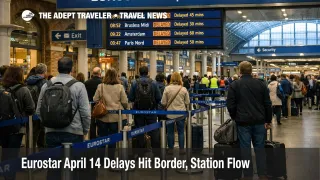
Eurostar April 14 delays have shifted from a same day lateness story into a corridor throughput problem across London, Paris, Brussels, Amsterdam, and Germany. Eurostar's live updates on Tuesday, April 14, 2026, show border control friction at Amsterdam Centraal, crowding and partner operating problems at Paris Gare du Nord, operational restrictions at London St Pancras International and Brussels Midi, plus wider Dutch, Belgian, and German network issues. For travelers, the practical move now is to stop treating the route as a normal high frequency backup corridor, especially when one train protects a flight, cruise, hotel cutoff, or business meeting.
Eurostar April 14 Delays: What Changed
The April 14 operating picture is more specific, and less forgiving, than the broader spring disruption framing earlier this week. Eurostar's official disruption page says trains at Amsterdam Centraal are being delayed by EU border control procedures, crowding, and station level operational restrictions. At Paris Gare du Nord, the operator is listing partner operational difficulties, over running maintenance work, station crowding, and separate operational restrictions. London St Pancras and Brussels Midi are both carrying operational restriction notices, while wider technical and traffic related problems are also hitting the Dutch, Belgian, and German networks.
That matters because April 14 is not just another day of scattered late running. The same official page still shows a reduced Eurostar timetable running from March 22, 2026, through May 17, 2026, which means fewer recovery options when a station problem widens into a missed connection or a broken day plan. Eurostar is also already publishing more planned cuts ahead, including Dutch network cancellations on April 18 to April 19 and Eurostar network cancellations on April 21 to April 23 because of over running maintenance work.
In an earlier Adept Traveler article, Eurostar April 12 Delays Layer Onto Spring Cuts, the main issue was live delays landing on top of a thinner spring timetable. By April 13, that had widened into a multi station hub problem in Eurostar April 13 Delays Hit Cross-Channel Hubs. On April 14, the new development is that Eurostar is naming fresh operational causes at specific stations, including border processing at Amsterdam and station throughput problems at Paris, London, and Brussels.
Which Travelers Face the Most Disruption
The most exposed travelers are not just leisure passengers going city to city. The bigger risk sits with people using Eurostar as one link inside a longer chain, especially rail to air handoffs, rail to cruise transfers, same day hotel arrivals with hard check in limits, and Germany bound itineraries that depend on the Brussels and Cologne side of the network. Eurostar's live updates show that the problem is crossing borders, station handling, and downstream network movement at the same time.
Amsterdam is a particular pinch point because the delay cause there includes EU border control procedures. That is a throughput issue, not just train movement. When border processing slows, passengers can still lose time even if the train itself is otherwise recoverable. Paris Gare du Nord is another weak point because Eurostar is simultaneously flagging crowding, partner operating problems, maintenance overrun, and operational restrictions there, which makes station flow less predictable than a single technical fault would.
London St Pancras and Brussels Midi matter for a different reason. They sit at key interchange ends of the corridor, so operational restrictions there can break itinerary timing even when the traveler is not starting in those cities. The first order effect is a late departure or arrival. The second order effect is that fewer remaining trains are available to absorb missed onward plans when the timetable is already reduced.
What Travelers Should Do Now
For April 14 travel, plan from the disrupted corridor, not the advertised timetable. If your Eurostar segment protects a flight, a cruise embarkation, a timed tour, or a hotel arrival that cannot slip, the safer move is to build in a wider buffer, shift to an earlier train where possible, or overnight before the next fixed segment. Same day rescue works best when the trip is rail only and the arrival time is flexible.
Rebooking early makes more sense when your trip runs through Amsterdam Centraal, Paris Gare du Nord, London St Pancras, or Brussels Midi and then depends on another hard timed segment. Waiting makes more sense when you are traveling point to point, have no onward dependency, and can tolerate a later arrival. Travelers headed to or from Germany should be more conservative, because Eurostar is also listing traffic and operational problems on the German network, which reduces confidence beyond the core cross Channel segment.
The next decision point is not only whether today's train is delayed. It is whether the remaining corridor still gives you a workable fallback if something slips. That fallback is thinner than normal through May 17, and it tightens again around the already published April 18 to 23 disruption windows. If your travel falls into that period, check the specific train before departure and price backup air or hotel options before the corridor gets more crowded.
How the Disruption Spreads Through Cross-Channel Travel
The mechanism here is stacked throughput failure. Border controls slow passenger processing at Amsterdam. Crowding and partner operating problems reduce station efficiency at Paris. Operational restrictions at London St Pancras and Brussels Midi constrain movement at two other core hubs. Then wider Dutch, Belgian, German, and Eurostar network issues reduce the system's ability to recover. A high frequency rail corridor can absorb one weak point. It struggles when several parts of the chain fail at once.
That is why the seriousness is above routine friction. Eurostar is still running, and this is not a total shutdown. But it is meaningful itinerary risk because the problem affects station throughput, border processing, and onward network reliability at the same time, while a reduced timetable limits spare capacity behind the disruption. Travelers should expect the main pressure point to remain same day reliability, not only headline cancellations.
What happens next depends on whether Eurostar removes the station specific delay notices and whether the planned April 18 to 23 cuts stay contained to the published windows. If Amsterdam border delays and Paris station pressure persist into the next few days, the corridor could remain brittle even before the next scheduled disruption period begins. For now, the signal from Eurostar's own updates is clear, April 14 is a day to protect connections, not test them.